

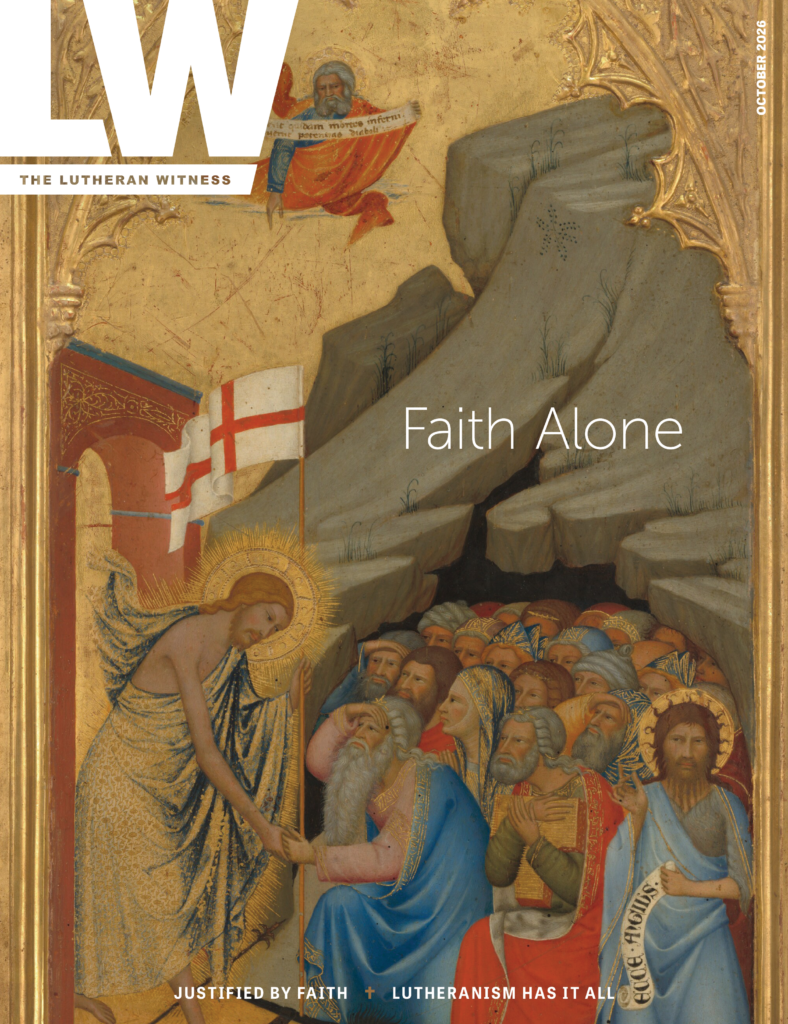
The October issue of The Lutheran Witness focuses on a core theme of the Lutheran Reformation: justification by faith.
- From the President: Who Is This ‘Me’ in ‘Christ for Me’? — Matthew C. Harrison
- Life in the Church Year: Music and the Christian Life — Kristen Einertson and Tessa Muench
Print Features
- ‘Not Guilty’ — Because of Jesus: The meaning of justification — Cameron Mackenzie
- Lutheranism Has It All: What weary evangelicals need to hear — Matt Doebler
- Justification and the Fathers: ‘Faith alone’ in the Early Church — James Preus
- Justification by Faith: The central article of Christian Doctrine — Roland Ziegler
Departments
- Snippets: News from around the LCMS and the world
- Commonplaces: Selections from Scripture, the Confessions and Lutheran hymnody on justification
- The Contemporary World: Undoing the Damage to ‘Transitioned’ Children — Gene Edward Veith
- On the Podcast: LW partners with KFUO for international church leader interviews
- Searching Scripture: Following the Formula Article X: Church practices
From the editor
As an editor, I love to be right. Finding and correcting errors — whether factual, logical or grammatical — is (let’s face it) a total rush. Who among us doesn’t love to start a sentence with the words, “Um, actually …”?
As a Lutheran, I also love to be right. Whether I’m talking with atheists or evangelicals, I find it deeply satisfying to know that my words rest securely on the sure truth of the Bible and the clear teaching of the Lutheran Confessions.
Let’s face it: Even as a human being, I love to be right — in the eyes of my neighbors, my colleagues, my husband, my teenagers (a mom can dream, right?) and, especially, my God. I seem wired to “hunger and thirst for righteousness,” and I long to be found not just factually correct before man but morally right before a holy and almighty Judge.
This deep hunger for righteousness seems to run through humanity. We see it in the ancient Egyptians, among whose tomb inscriptions we find the declaration, “His heart is [found] righteous, and it hath come forth from the balance; it hath not sinned against any god or goddess” (Egyptian Book of the Dead). We see it today, too, in noisy calls for churches to “affirm” and “validate” those who stubbornly cling to their sins — thus declaring even the unrepentant righteous before God “just as they are.”
But neither pleasing all the false gods and goddesses in the pantheon nor securing the affirmation of an apostate church can make us righteous before God. Even if I managed to fix every stray comma in the universe or earn the begrudging respect of every eye-rolling teenager, I still wouldn’t be able to justify myself before God. My hunger for righteousness would remain gnawing and unsatisfied.
Thanks be to God for the grace He has shown us in Christ Jesus. Through Christ’s death and resurrection, God declares His own great mercy by justifying sinners, including me.
What, then, is justification? Cameron Mackenzie explains it better than I can, but in short, to be justified is to be declared righteous by God, without regard for our own merit. And how do we unworthy sinners access that justification? By faith.
Justification by faith is, as Roland Ziegler points out, the chief article of Christian doctrine. It’s the one teaching that helps us put all other teachings in good order. It’s also (no surprise) the central article of the Lutheran Confessions, as we will celebrate once again on Reformation Day on Oct. 31. This is what separates us as Lutherans even from so many other Christian churches: We boldly confess that faith in Christ — not good works, not even a “personal decision for Jesus” — is the means by which God justifies us and declares us righteous in His sight.
I love to be right. I’m sure you do too. Being right is a good thing.
But being made righteous in God’s eyes? Being justified by grace through faith in our crucified and risen Lord? That’s far, far better.
In Christ,
Rachel Bomberger
Managing Editor, The Lutheran Witness