



By Jonathan Conner
The preacher’s voice echoes in Ecclesiastes:
Vanity of vanities, says the Preacher,
vanity of vanities! All is vanity. (Eccl. 1:2)
The Hebrew word translated “vanity” (hevel) means “vapor” or “breath.” The idea is one of transience, of temporality, of something that, like the wind, cannot be grasped or held. And all is hevel. Your job is hevel. Your house is hevel. Your youth is hevel. Your relationships are hevel. Someday somebody else will occupy your office, preach in your pulpit, drive your truck, teach in your classroom and coach your team. Someday somebody else will watch TV in your family room — maybe even in your recliner. Somebody else will eat supper in your dining room — maybe even at your table. Someday, if God grants you life, your youth will wither and wrinkle. Someday your relationships will die. All is hevel.
Seeking Solid Ground
At first the preacher’s message might sound demoralizing, but he’s not aiming to depress us. His goal is to teach us — to teach us wisdom. He would not have us spend our life trying to cling to vapor, chasing after wind. Instead, he would urge us to ask where permanence can be found. Is there anything under the sun to which God has attached a promise of permanence? Is there anything that doesn’t move?
If there is, wouldn’t it be wise to build our lives around it, to make it what I call “the thing around which everything else must move”? Perhaps you’ve seen sidewalks built around established trees or roads built around significant landmarks. The builders treated the tree or landmark as the thing around which everything else must move. We do the same thing in our lives. We all treat something as the thing around which everything else must move. For some of us, it’s sports. We move meal and work plans, adjust budgets, change appointments, and drop other commitments to prioritize sports. For some of us, it’s our job. We take calls during family meals, interrupt conversations to respond to texts, and step away from our kids’ events to speak with a client. These (and many other things) become the thing around which everything else must move.
What the preacher of Ecclesiastes would have us avoid is making anything that will move — anything that is hevel/vapor/breath — the thing around which everything else must move. This would be supremely foolish, like building a house on shifting sand, as Jesus Himself warned against. Who wants to feel their house shift beneath them, to experience the transience of the thing they treated as permanent? What a terrifying thought!
Can permanence be found? Is there anything that doesn’t move, that isn’t hevel? The prophet Isaiah answers, “Yes!” “The grass withers, the flower fades, but the word of our God will stand forever” (Isaiah 40:8). The apostle Peter echoes Isaiah:
You have been born again, not of perishable seed but of imperishable, through the living and abiding word of God; for
‘All flesh is like grass
and all its glory like the flower of grass.
The grass withers,
and the flower falls,
but the word of the Lord remains forever.’And this word is the good news that was preached to you. (1 Peter 1:23–25)
The Word of our God remains forever. It is this Word that He has fixed in His church. And to His church Jesus connects this promise: “The gates of hell shall not prevail against it” (Matt. 16:18). The Word-founded church is the thing that doesn’t move. Wouldn’t it be supremely wise, then, to make it the thing in our lives around which everything else must move? If it has Christ’s promise of permanence, wouldn’t it be wise to build our lives on and around it?
God’s Promises and Our Traditions
Before we offer our simple “yes,” we need to assess how far Christ’s permanence-promise extends in His church. Does it reach to our traditions? Many of them are good, but has Christ attached His permanence-promise to them? Christ has attached His promise of permanence to the Word He has placed in His church, to the Word preached, the Word poured (in Baptism), and the Word administered and eaten (in Holy Communion). The first thing we need to do, then, is be exceedingly clear about where the promise of permanence resides: in the given Word that lives in our midst.
Second, we need to be clear about what the church is and what it is not. Martin Luther, in the Smalcald Articles, offers a beautifully simple definition: “Thank God, a seven-year-old child knows what the Church is, namely, the holy believers and lambs who hear the voice of their Shepherd” (SA III XII 2). I have found great benefit in referring to the church, with Luther’s explanation to the Third Article of the Apostles’ Creed in mind, as “the gathering of the gathered.” The church is the people God has gathered, gathering around the Word God has given to be heard, poured and consumed.
This Word is not fastened to a building. It is not anchored to a plot of land. It is not fixed to a certain gathering time. Paradoxically, the Word of our God in its permanence is perpetually mobile! Having buildings, land and fixed gathering times can all be meaningful and good traditions, all tremendously helpful in bringing the Word to hungry souls. We are right to celebrate these things, but they are not the thing around which everything else must move. They don’t have God’s permanence-promise attached to them. That means we need to hold them lightly. They’re hevel.
It also means that some traditions might need to change in order to prioritize the thing with the permanence-promise, God’s Word. To be more direct: Our worship time might have to change. Our worship day might have to change. Our church governance structure might have to change. Our confirmation practice might have to change. Our midweek Advent/Lenten traditions might have to change. Our staff might have to change. Our attitudes about working with sister congregations might have to change.
We simply cannot treat anything without Christ’s promise of permanence as the thing around which everything else must move. This will become increasingly necessary as our population ages and many of our communities condense. Congregations will need to prioritize partnerships. It’s not just about keeping the doors on our buildings open; it’s about keeping the permanent Word present in the midst of people, about ensuring the Word keeps being heard, poured and eaten. It’s about keeping the Word as the thing around which everything else must move, and being willing to move everything else accordingly.
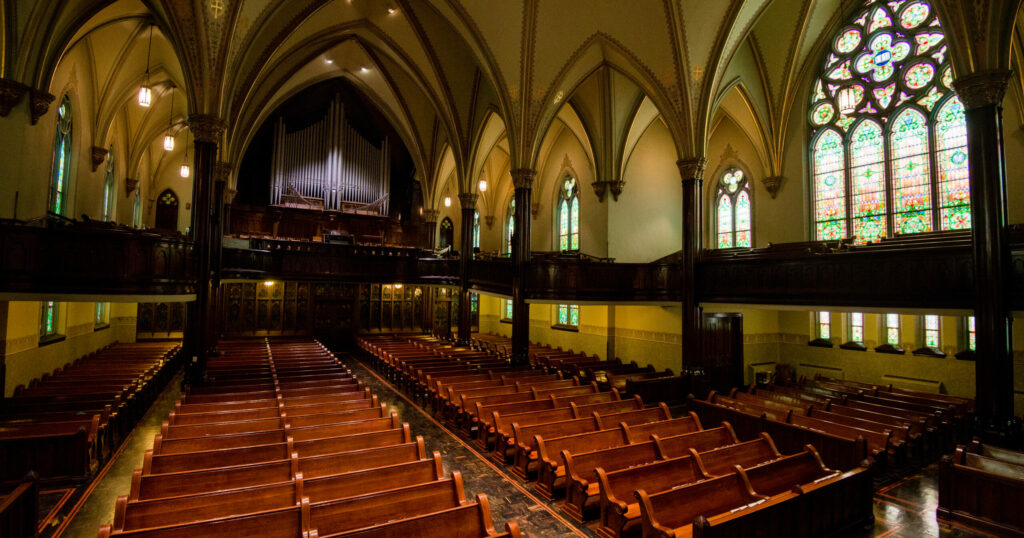
Photo: LCMS Communications/Erik M. Lunsford.
This article originally appeared in the December 2025 issue of The Lutheran Witness.
From the secular world: “Adapt or die.” There’s some wisdom in that.
The article asks, rhetorically, “If it has Christ’s promise of permanence, wouldn’t it be wise to build our lives on and around it?” But is it the permanence of the Word that causes us to esteem it as supremely good, or is it the supreme goodness of the Word that causes us to value its permanence?
What exactly does the Word convey that we should value its permanence? What are all the benefits brought through the Word that we should aspire to remain connected with it and with one another as fellow disciples learning, relearning and celebrating what it means for us? What does God want for us, and for himself, according to what he has spoken?
Jesus spoke of the key benefits of trusting his words when he said, “The words that I have spoken to you are spirit and life” (John 6:63). And he also spoke of the endurance of his words when he said, “My words will not pass away” (Matt. 24:35)?
Where God chooses to have mercy (Ro. 9:15) and send his Spirit (1 Cor. 2:14), the Word becomes becomes fruitful (1 Cor. 3:6-7), bringing about love, joy, peace, patience, kindness, goodness, faithfulness, gentleness, and self-control (Gal. 5:22-23); also contentment, hope, edification, justification, sanctification, inspiration, selflessness, righteousness, thankfulness, blessedness, good works, endurance, fellowship (koinonia), and eternal life.
Isn’t a godly desire for all of that — for ourselves and for others — an excellent motivation to adapt creatively to sustain an outpost of God’s Kingdom? Why come together in one service when you have had two services for decades, for example, or why begin to partner with another congregation on the other side of the tracks? Perhaps it’s like this: As a campfire ebbs, its embers will burn more brightly, more warmly and longer if you can bring them together.
One can think of the local church as a kind of dispensary where the Word is delivered through a sermon and the sacraments are delivered. Those things are essential. Yet the Bible also describes the church as a house of living stones (1 Peter 2:5), where people engage one another deliberately — cheerfully encouraging each other in the faith (Acts 2:42), lovingly looking after one another’s needs and interests (Gal. 6:10, Phil. 2:4), and energetically “[stirring] up one another to love and good works” (Heb. 10:24).
“The word is near you, in your mouth and in your heart” (Ro. 10:8, Duet. 30:14).
This article was so blessedly timely to my soul and what I have been thinking about recently as I grow older in The Christian Faith! Thanks be to God for this confirmation! Amen!!