


By Joshua Pauling
In the middle of the 20th century, the philosopher Josef Pieper warned of an “overvaluing of the sphere of work.” Worklife was coming to consume everything else. Careerism was overtaking marriage and family. The home sat empty while the lights stayed on at the office. Every aspect of life was subsumed into what Pieper called the cult of “total work” — all for the sake of consumer capitalism, GDP and the American Dream.
Developments since Pieper’s day confirm his warnings. Those lights that stayed on at the office have now morphed into the ever-glowing light emanating from our backlit slabs of glass that stand always at the ready. The cult of total work now extends even further, as digital devices enable our work to come with us literally everywhere. And not only do our devices nudge us toward the cult of total work, they nudge us toward total distraction and amusement. Amid all of this, it is unsurprising that we find it difficult to experience true Christian leisure, that attunement to reality and posture toward God, one another and the world for which we are designed.
In response to this modern, digitally amplified rat-race, a practice called a “digital Sabbath” has become trendy, promoted by both Christian and secular sources. The idea is to take an intentional weekly break from screens and the internet to recalibrate ourselves to the real world, to real people — and, for Christians, to our very real God. What are we to make of these attempts and efforts? Should we participate? Do these practices have anything to do with our keeping of the Third Commandment, to remember the Sabbath day by keeping it holy?
What Are Digital Sabbaths?
The digital Sabbath trend started picking up steam around 2010, a few years after the release of the smartphone. Tiffany Shlain, an early promoter of the concept, explained recently, “For over 15 years, I have turned off all screens for one day a week for what my family and I call our ‘Tech Shabbats.’ … The idea of taking one day a week off from responsibilities and work is a very, very, very old idea. In our 24/7 information overload world, it’s a good time to bring this idea back.”
In his best-selling book The Tech-Wise Family, well-known Christian author Andy Crouch offers a similar take on digital Sabbaths: “We are designed for a rhythm of work and rest. So one hour a day, one day a week, and one week a year we turn off our devices and worship, feast, play and rest together.” Likewise, in The Common Rule, Justin Whitmel Earley posits the daily principle of “Scripture before screen; prayer before phone,” and suggests that each day we eat at least one meal with others and have one hour with our phones off. Weekly, he suggests that we have at least one hour of in-person conversation with a friend, that we fast from something for a 24-hour period during the week, and that we practice some sort of Sabbath rest. Some churches have also encouraged their members to participate in digital fasts during Lent.
One might say this type of guidance is too prescriptive and verges on legalism. At the same time, we all crave practical advice for navigating life in the digital age and can benefit from simple rules practiced in community. Such actionable suggestions, when properly understood within the framework of Christian liberty, can be expressions of Christian prudence and sanctified wisdom for living well in these times.
How Do ‘Digital Sabbaths’ Relate to the Christian Sabbath?
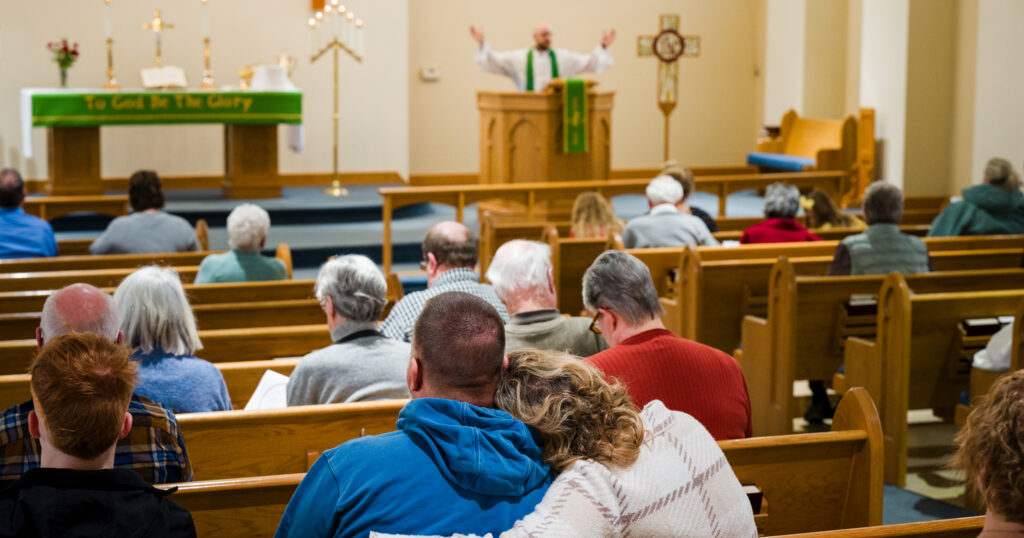
But how do these practices relate to remembering the Sabbath day by keeping it holy? In the narrow sense, they don’t have anything to do with keeping the Third Commandment per se. As Luther writes in the Small Catechism, the meaning of the Third Commandment is that “we should fear and love God so that we do not despise preaching and His Word, but hold it sacred and gladly hear and learn it.” When the Pharisees accused Jesus’ disciples of “doing what is not lawful on the Sabbath,” our Lord minced no words: “The Sabbath was made for man, not man for the Sabbath. So the Son of Man is Lord even of the Sabbath” (Mark 2:23–28). Christ came to fulfill the Sabbath, bringing the healing, forgiveness and restoration that the Sabbath always pointed toward. In the Divine Service, we get a foretaste of this true Sabbath rest, where Christ, who has done all the work for us, gives us Himself and grants us true rest as we hear His living voice and receive His living body.
On the other hand, Christ’s fulfillment of the Law is not an abolishing of the Law (Matt. 5:17). The Formula of Concord reminds us that the Law “is properly a divine doctrine,” which shows how man ought to be “in his nature, thoughts, words, and works, in order that he may be pleasing and acceptable to God” (FC SD V 17). Though Old Testament Sabbath observance is done away with in Christ, this is by way of pattern and fulfillment, shadow and reality, lesser and greater — not by way of erasure or demolition. As the writer to the Hebrews puts it, “there remains a Sabbath rest for the people of God, for whoever has entered God’s rest has also rested from his works as God did from His” (Heb. 4:9–10).
There also remains a Sabbath principle stitched into the natural order and into our human bodies. We need rest; animals need rest; all of creation needs rest (Rom. 8:18–23). And that rest finds its culmination in our restful reception of Christ and His perfect work for us. But we can also acknowledge that our practical choices can either aid or hinder our reception of Christ’s gifts on the Lord’s Day. Might a decision to, say, not bring our phones into the sanctuary during the Divine Service help us avoid distractions and aid our glad hearing and reception of Christ’s Word and gifts? To go further, might a period of time with no digital devices on Sunday help us experience a measure of refreshment and recalibration that could strengthen our faith toward God and love toward neighbor?
The Old Testament Sabbath has been fulfilled in Christ, and we are no longer obligated to keep it in the Old Testament sense — this is a wonderful thing. And yet, perhaps we can also learn from this long tradition of rest/work cycles in order to facilitate a more restful and receptive Lord’s Day — not in the sense of returning to the Mosaic shadow, but of experiencing the Christological reality of feasting, worship and celebration; resurrection, rest and rejuvenation; all as a foretaste of the true Sabbath rest for the people of God.
What Is True Leisure?
As we consider things that may be beneficial to avoid at times, it is also helpful to consider the ways we should invest our time and focus. As discussed elsewhere in this issue (see p. 9), our culture has an anemic view of leisure. When we hear the word “leisure,” we tend to think of things like watching TV, consuming entertainment, playing video games or engaging in other free-time activities. Josef Pieper again is helpful here, as he explains that leisure is something much more. Leisure isn’t the absence of work or the escape from “total work.” Nor is it the individualistic pursuit of amusements. Rather, true leisure is the presence of something meaningful in itself: the activities and practices that further us as human beings and bring us into a deeper contemplation of goodness, beauty and truth. Leisure, in its historical usage, was not about amusing ourselves, but about advancing ourselves in ways that foster a life of faith toward God and love toward neighbor.
In a society that views just about everything through the lens of efficiency, optimization and quantification — only furthered by our digital devices — this older conception of rest and leisure is countercultural. But it is also freeing. You don’t need to be obsessed with squeezing profits out of every minute of your day. You don’t need to be consumed with optimizing every aspect of your life with the latest life hacks. You don’t need to be worried about whether caring for a loved one or walking with someone through depression is efficient or not; you can do it because you are free in Christ to love your neighbor as He has loved us. True rest seems wasteful and inefficient to the world. But that is the whole point: Christ has ushered in a different kind of kingdom, not based on works, but on mercy, where the love of God in Christ is extravagant, reckless even, as He pours Himself out fully for the redemption of the world. In His kingdom, efficiency, productivity and the cult of “total work” have been dethroned by faith, hope and love.
What Should We Do?
Christ has brought us into new life in Him. He gives us true rest. And, perhaps, healthy digital habits can help us more fully experience that rest as part of an overall approach to living virtuously as Christians. The day of resurrection might just be the perfect day to habituate ourselves to a deeper reality and experience of something freeing — as long as such digital detoxes do not become the focus of our Sundays.
When understood within a positive Gospel vision, such forms of self-denial and self-discipline as a weekly digital “fast” can be invigorating and liberating as they serve a larger purpose to point us toward Christ and our ultimate rest in our union and communion with Him. Just as the spiritual life is punctuated by times of fasting and feasting, so too our technological habits can be characterized by such wisdom and prudence, enabling us to more fully experience freedom in Christ as we are transformed into His image. Not because such things are required by the Law, but because we are free in the Gospel to get a taste of something better. As Paul writes, “Where the Spirit of the Lord is, there is liberty. But we all, with unveiled face, beholding as in a mirror the glory of the Lord, are being transformed into the same image from glory to glory” (2 Cor. 3:17–18 NKJV). And seeing the glory of the Lord as in a mirror might be easier when we’re not looking at ourselves on a screen.
Photo: LCMS Communications/Erik M. Lunsford.
This article originally appeared in the January 2026 issue of The Lutheran Witness.



RE: “True rest seems wasteful and inefficient to the world.”
With a simple internet search it is not hard to find an abundance of secular material acknowledging the value of rest and the benefits of various kinds of recreational activity.