



By Hans Fiene
“Tradition” can be a tricky word, and one that is often used in very different ways. Sometimes people use the term against Lutherans in a dismissive sense, like when an evangelical tells you that, because there’s no Bible passage directly commanding us to bring our little ones to the font, infant Baptism is not a scriptural practice. It doesn’t matter to him that virtually no one in church history until the 16th century shared his rejection of this practice. He can just hand-wave it all away by calling infant Baptism “a tradition of men.” Tradition, in this sense, is dismissed as something that doesn’t need to be considered at all.
In other cases, people speak of “tradition” as something that must be not only considered, but accepted. If you’ve ever discussed St. Mary, the mother of our Lord, with your Roman Catholic friends, you may have encountered this. They assert that Mary was bodily assumed into heaven. You ask, “How can you know that, since it’s not contained in Scripture?” The answer, they tell you, is “tradition.” This is what all the pious men have taught throughout the centuries! (Not counting the ones who didn’t, of course.) And how could you possibly reject something as sacred and good as tradition?
This all can feel rather confusing. Is tradition inherently bad, like the evangelical seems to believe, or is it inherently good, like the Roman Catholic asserts? The answer, of course, is “neither.”
To express it with a simple mathematical formula: tradition = teachings and/or practices + time.
In the Christian sense, tradition is what a collection of believers has asserted or done over the course of years or decades or centuries. But while time is an essential part of the formula for making a tradition, time is not a determining factor in whether a tradition is either good or bad. Time can turn new ideas into ancient traditions, but it can’t turn an unfaithful practice into a faithful one. Rather, the goodness or badness of a practice is entirely dependent on its faithfulness to the Scriptures.
Our Lord on Tradition
Consider Jesus’ response to the Pharisees and the various traditions they held to. Jesus and the Pharisees agreed that the Law of Moses required the Jews to rest from their labor on the Sabbath. But the Pharisees insisted, based on the non-inspired writings of past teachers, that the requirements of the Third Commandment were so severe that Christ’s disciples should have gone hungry instead of plucking heads of grain on the Sabbath. In response to this, Jesus reminded them that David and his men entered the house of God and ate the bread of the presence on the Sabbath, then quoted the prophet Hosea, saying, “If you had known what this means, ‘I desire mercy, and not sacrifice,’ you would not have condemned the guiltless” (Matt. 12:7).
In this passage, Jesus is ultimately saying to the Pharisees, “God didn’t give you the Sabbath so you could impress Him with how much you’re willing to suffer for His sake. He gave you the Sabbath so you could rest from your labor and meditate on how much I am willing to suffer for your sake. So it doesn’t matter if your approach to the Third Commandment is part of a centuries-long tradition. Condemning others for not following it places you at odds with the Word of God.”
Likewise, when the Pharisees questioned Jesus over divorce, they approached the issue from the perspective of tradition. They asked Him, essentially, “If divorce is so bad, why did Moses establish this glorious, ancient tradition where we can send our wives away after writing them a certificate of divorce?” (see Matt. 19:3). Jesus responded by referring them back to God’s creation of Adam and Eve, essentially saying, “Because of your hardness of heart, Moses instituted a tradition that allowed the women you wanted to throw out of your homes to be taken in by someone else and not be guilty of adultery. But God didn’t create marriage as something to be torn apart. So if you guys like ancient traditions so much, you should go back to the most ancient one of all, the one where God created man and woman to belong to each other for all their lives” (see Matt. 19:4–10).
In all of this, we see that Jesus is neither reflexively pro-tradition nor reflexively anti-tradition. He favors faithful traditions that accurately reflect what God has promised us in His Word, and He opposes unfaithful traditions that obscure God’s promises, regardless of how long those traditions have been practiced or how many people have accepted them.
Keeping the Baby, Throwing Out the Bathwater
Martin Luther and many of his fellow reformers followed this example during the Reformation era. The Radical Reformers were prone to tear down statues of the saints in churches and jettison any other traditions that smacked of “popish idolatry.” The Lutheran approach, however, was far more measured. To them, it didn’t matter how long unfaithful popes or priests had taken part in a tradition. If the tradition was taught by the Scriptures, like infant Baptism, or in keeping with the Scriptures, they would keep it. If a tradition wasn’t in keeping with the Scriptures, like only allowing the laity to receive communion in one kind, they would get rid of it, no matter how long or how widely it had been practiced.
Likewise, the Reformation-era Lutherans also believed they could separate the baby from the bathwater with regard to issues like worship. In Article XV of the Augsburg Confession, they wrote, “Our churches teach that ceremonies ought to be observed that may be observed without sin. Also, ceremonies and other practices that are profitable for tranquility and good order in the Church (in particular, holy days, festivals, and the like) ought to be observed. Yet, the people are taught that consciences are not to be burdened as though observing such things was necessary for salvation.”
So, for example, we don’t need a verse from the Bible commanding us to celebrate the birth of Jesus in order to celebrate His birth. It’s helpful to pick a day on which all of us do so. Therefore, it’s good for Christians to celebrate the birth of Jesus on Dec. 25, the day ancient Christians selected. But if anyone tells you that you can’t be saved unless you celebrate the birth of Jesus specifically on Dec. 25, such a person should be rejected. Once again, traditions are good when they bring unity and clarity to the church, but they are bad when they bring disorder and obscure the promises of our Lord.
Unity and Freedom under God’s Word
We should seek the mind of Jesus and follow in the steps of our Lutheran fathers when we consider the traditions of our own day and whatever controversies they might bring. Congregations often face divisions over their forms of music and whether they should be more contemporary or traditional, to use the common terms. Similar divisions sometimes arise when pastors change various worship practices in congregations or when people in the pews start to notice their fellow congregants engaging in unfamiliar forms of piety.
Concerning forms of music, the age of a sacred composition shouldn’t matter to us. A piece of music written two years ago that beautifully confesses the saving wounds of Jesus is more beneficial than a 500-year-old hymn that, despite its enduring popularity, fails to proclaim Christ. In the same way, a glorious ninth century hymn that was cast aside by previous generations is more beneficial to the church than a well-known modern composition without much theological substance. We shouldn’t value tradition so highly that we rob ourselves of newer treasures, and we shouldn’t ignore tradition to the extent that we rob ourselves of the ancient ones.
Concerning our use of the liturgy, we should avoid binding consciences while also aiming toward unity. The Scriptures do not require that we use one of the Divine Service settings in Lutheran Service Book, and anyone who claims that we must do so in order to be faithful Christians is not thinking scripturally. But, at the same time, the purpose of holy worship is to “[teach and admonish] one another in all wisdom, singing psalms and hymns and spiritual songs” (Col. 3:16). The Divine Service liturgies in our hymnals do this quite beautifully, conveying for us through a variety of Scripture passages the story of God’s love in Christ. It’s a great gift for a church body to be able to sing that story in unison throughout our various congregations. We should not give the impression that we must sing that common song in order to be saved, but we should also be very cautious about casting it aside for things that may well not endure.
Concerning changes in worship services or forms of piety, we should again aim for the comfortable ground between legalism and disunity. Making the sign of the cross has been a tradition within the Lutheran church since our division with Roman Catholicism. But the practice has not endured in all corners of Lutheranism. Those who make the sign of the cross should feel free to continue embracing the tradition. Those who don’t shouldn’t think they’re far from Jesus until they do. A pastor is correct if he asserts that weekly communion was the historic practice expressed in the Lutheran Confessions, though he should be careful not to give his sheep who didn’t experience that tradition growing up the impression that the pastors they had were unfaithful, just as the sheep should not assume that receiving communion every other week or once a month is the superior practice simply because it’s the one they’re used to.
In all things, we shouldn’t assume that the ancientness of a tradition makes it great, nor should we think that a tradition is unworthy of rediscovery simply because it didn’t endure in our specific time and location. We should examine all traditions in light of Scripture, and prayerfully consider which ones best express both our union with Christ and the unity His blood gives us with our fellow congregation members, with those who share our confession of faith today and with those who have shared it throughout history.
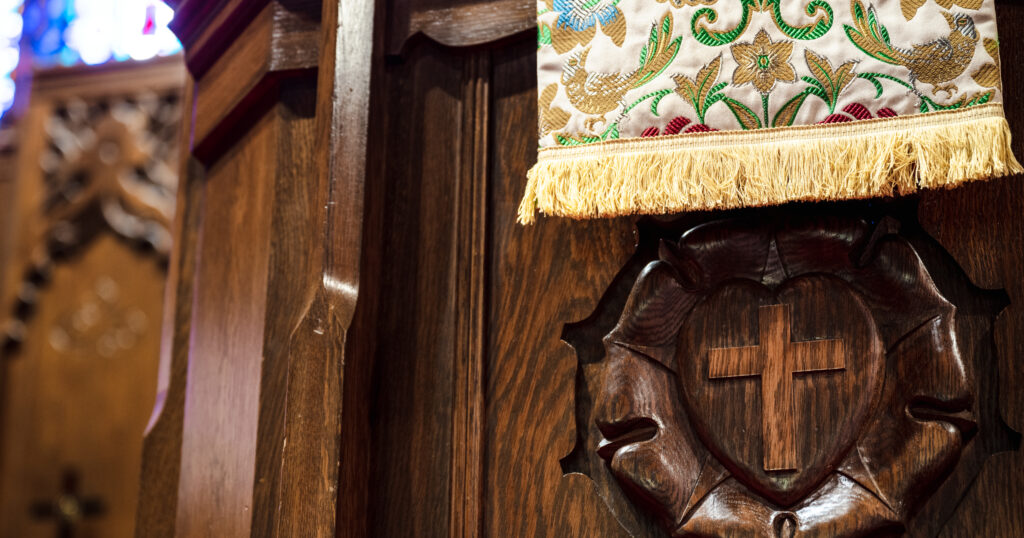
Photo: LCMS Communications/Erik M. Lunsford.
This article originally appeared in the December 2025 issue of The Lutheran Witness.


“Tradition is the living faith of the dead, traditionalism is the dead faith of the living. And, I suppose I should add, it is traditionalism that gives tradition such a bad name.”
― Jaroslav Pelikan, The Vindication of Tradition: The 1983 Jefferson Lecture in the Humanities
Sometimes letting go of a desire to satisfy personal preferences helps us to grasp things that are far more important to our relationship with one another. I have often said admiringly of my own congregation that “people here seem to hold their preferences lightly.” Indeed, in the months before I joined a couple of years ago, the congregation decided to worship together in one service rather than the two that had employed very different styles of music. Coming together has been a blessing in many ways.
“Oh sing to the Lord a new song” (Ps. 96:1).
“But test everything; hold fast what is good” (1 Thess. 5:21).