

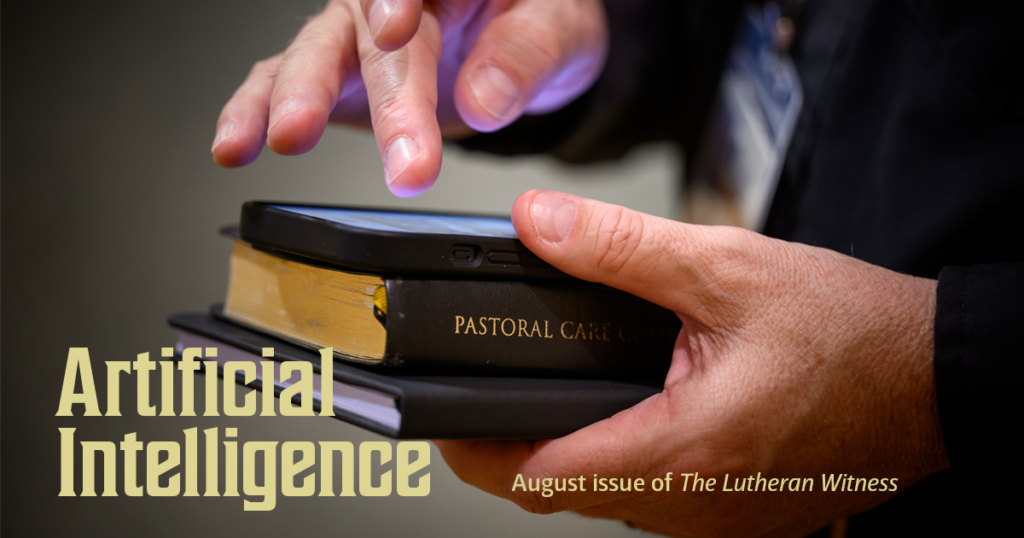
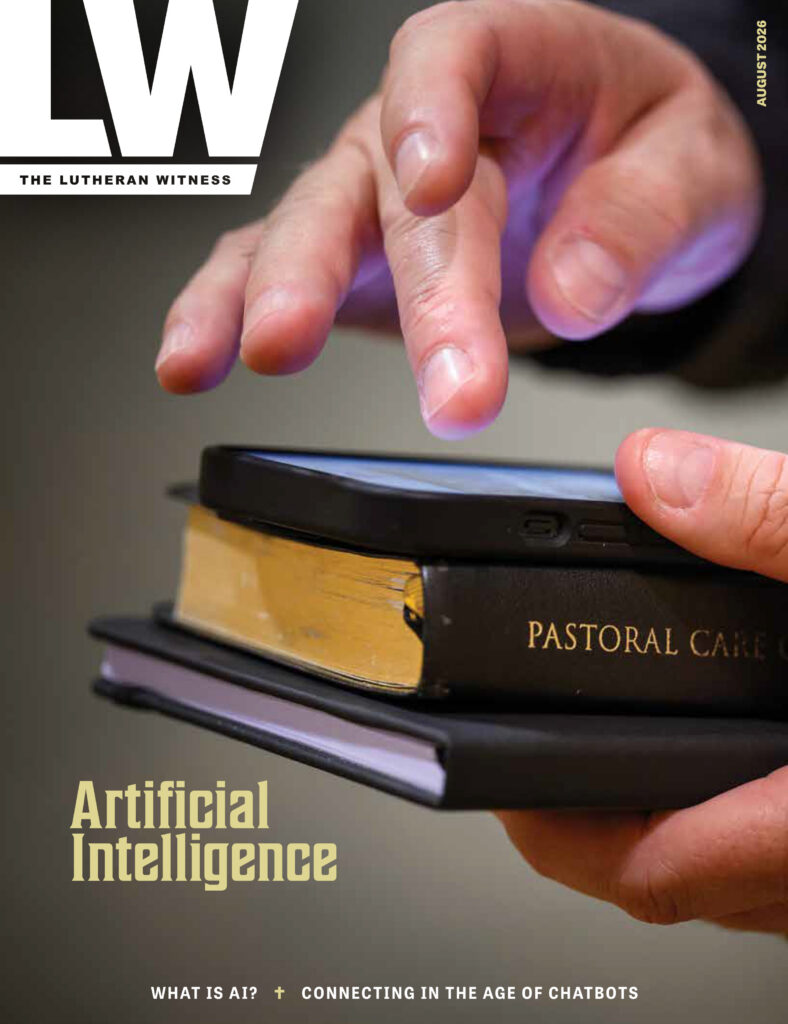
The August issue of The Lutheran Witness deals with life in the digital age and the rise of artificial intelligence.
- From the President: ‘Non Multa sed Multum’: As knowledge abounds, so too does the need for discernment
- Life in the Church Year: Fasting as an Embodied Practice
Print Features
- What Is AI? Insight from an industry insider
- Finding Lutheranism on the Internet
Departments
- Snippets: News from around the LCMS and the world
- Searching Scripture: Following the Formula Article VIII: The person of Christ
From the editor
AI. Artificial intelligence. It was nothing more than a sci-fi gimmick in an Isaac Asimov novel or a Terminator movie — until it wasn’t. Has there been a day in 2026 that AI hasn’t been in the news? Can you think of a single friend or family member who hasn’t at least tried using it? And how many among us, within just a few short years, have already come to rely on this rapidly advancing set of technologies to create our spreadsheets, book our travel, amuse us in our free time or even keep us company when we’re feeling lonely?
Yet as the Rev. Jonathan Conner points out, citing Thomas Sowell, when it comes to technological advancements, “There are no solutions, only tradeoffs.” The same printing press that brought widespread literacy to Europe and turbo-charged the Lutheran Reformation also rendered the very idea of an oral tradition (and with it, the human mind’s capacity to memorize thousands of lines of epic verse by ear) practically obsolete. The same automobile that powered modern civilization and its many creature comforts also brought us air pollution, urban sprawl, fractured communities and all the myriad diseases brought on by a sedentary lifestyle.
As it was with the printing press and the automobile, it looks like there will be no turning back the clock on AI. “Whether or not the downsides outweigh the upsides,” tech professional Nonso Mogor predicts, “AI is here to stay and will likely grow to play an even more prominent role in society.”
To my own anxious heart, these are ominous tidings. As a reader, writer, home educator and now (returning after a seven-year hiatus) managing editor for LW, I have discovered very few real “upsides” to AI. I love my mind, and outsourcing any of the essential mental labor God has given me to do — the planning, the creating, the analyzing, the deep pondering — somehow feels wrong (not to mention lazy, irresponsible and unsatisfying). Maybe I’m an outlier here. Maybe I’m not.
Either way, I take great comfort in the words of Scripture, especially those texts featured in this month’s Commonplaces. God accomplished the salvation of the world by sending His only-begotten Son — not as a disembodied “intelligence,” but incarnate as a man, Jesus Christ: “The Word became flesh and dwelt among us” (John 1:14). While we are called by God to “test the spirits,” rejecting all those that “[do] not confess Jesus” (1 John 4:1, 3), we also find eternal comfort in knowing that God has created us — body, mind and soul — in His image, that He has freely redeemed us by the blood of the incarnate Christ, and that He will continue to draw us to Himself — truly, physically — by His Word and Sacraments until the Last Day.
Like Solomon, we must seek heavenly wisdom as we navigate this brave new world of artificial intelligence. Yet like Solomon, we must also recognize that there really is “nothing new under the sun” (Eccl. 1:9). From the bronze age to the digital age, there has been and will continue to be no end to humanity’s drive to create new technologies. Thanks be to God that Christ, not AI, is the Alpha and Omega, our beginning and our end — and that, come what may, “Jesus Christ is the same yesterday and today and forever” (Heb. 13:8).
In Christ,
Rachel Bomberger
Managing Editor, The Lutheran Witness