
by Matthew C. Harrison
They say that the cumulative total of human “knowledge” through recent centuries used to double every hundred years. Then every 25. Now it’s purported that this “knowledge” doubles every 12 hours.
The rise of artificial intelligence is expanding exponentially the use, profitability and economic impact of all things digital, and that is in turn affecting every aspect of our material world. Amazing medical and scientific breakthroughs are happening. A recent study using AI to analyze the Dead Sea Scrolls’ various handwritten scripts has indicated that the Daniel scroll is a century older than previously thought, increasing the scientific likelihood that it was actually Daniel who wrote it. (This is, of course, something Jesus already affirmed in Matthew 24:15, when He says, “So when you see the abomination of desolation spoken of by the prophet Daniel …”)
AI is an infinitely useful source for all sorts of harmless information. We recently had a family of armadillos take up residence under our back porch. My dear wife managed to trap a small one, but the mama was more challenging. She somehow ran over my wife’s foot and right back under the porch. All kinds of questions came up. Does St. Louis County have armadillo laws? Do armadillos carry leprosy? How can they be trapped? What do they eat? AI rounded up answers to my questions in three seconds flat. The critters have since moved out.
Of course, the dark side of the digital world is also growing at an alarming rate. The world is already deep into the use of AI for warfare. Sexual perversion abounds. All manner of sin, theft, fraud and debauchery has been put into hyper drive. AI informs vulnerable individuals about committing suicide — and the list of AI evils and abuses goes on and on, ad infinitum. In the lead up to this summer’s LCMS convention, AI was notably conspicuous, both in some of the resolutions submitted and in many of the anonymous disinformation campaigns aimed at undermining Synod institutions and theology.
With all this information at our fingertips, some would argue that we can justifiably cut corners in educating our pastors. After all, with AI, we essentially have unlimited knowledge at our immediate disposal. There’s no need for us to cram so much into a pastor’s brain.
I use AI often. I use it for research. I use it for sermon prep and study. I’m often scribbling outlines while in airplanes, and access to information on the road is priceless. (I do NOT ask AI to write sermons, nor should our pastors!) I’ve been trying to include archaeological information about the events and people of the Bible to emphasize that the Bible really is history. AI can get me to original documents and sources in seconds.
But I’ve noticed something. AI is far from infallible. It has attempted to mislead me often, especially on theological issues. If I hadn’t had — and continued — a rigorous education in the Scriptures, the Lutheran Confessions and the history of the church, I wouldn’t have the discernment to push back and say, “No. AI, you may know everything, but you don’t have a clue!” I’m amazed at how often, when I challenge a false answer, AI immediately capitulates and redirects.
There’s an old Latin saying: non multa sed multum (“not many things, but much”). It’s not so important that a pastor has read a thousand books, but that he’s deeply familiar with the greatest and best. Give me the Bible, the Lutheran Confessions and Walther’s Law and Gospel! That’s because the greatest books, few in number though they be, teach a man the priceless framework and paradigm of truth by which all other matters are evaluated and judged. Our seminary education produces biblical Lutheran minds capable of discerning what is good, right and true. It is vital that our pastors be rigorously trained and tested in the theological fundamentals, so they have the necessary discernment to recognize what is true — and what is truly helpful — as they deliver the blessed Gospel of Jesus Christ from the inerrant Scriptures and care for the souls of God’s people.
God give us all discernment in this strange world and cause us to cling unswervingly to Christ our Savior.
—Pastor Matthew C. Harrison
This article originally appeared in print in the August 2026 issue of The Lutheran Witness.
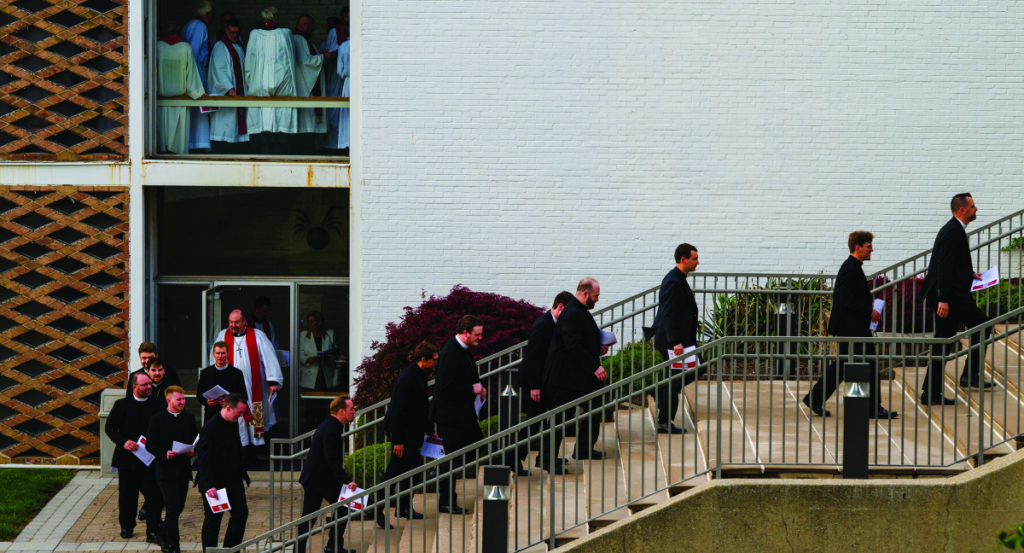
Cover image: Seminarians make their way to the April 29 Call Day service at Concordia Theological Seminary, Fort Wayne. LCMS Communications/Erik M. Lunsford