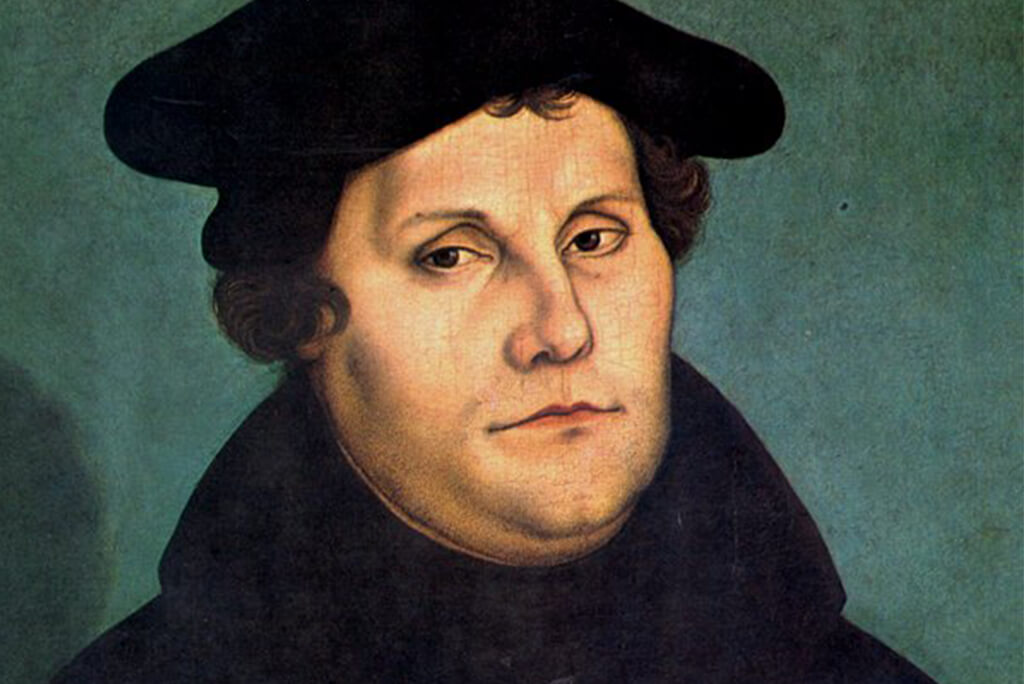


Since I’m currently burning the candle on both ends and in the middle, attending the first convention of our newest sister church, Lutheran Mission—Australia, I’ll let Luther have the word this month.
— Pastor Matthew C. Harrison
“I have been crucified with Christ. It is no longer I who live, but Christ who lives in me. And the life I now live in the flesh I live by faith in the Son of God, who loved me and gave Himself for me” (Gal. 2:20).
Luther on ‘For Me’ in Galatians 2:20[1]
Who is this “me”? It is I, an accursed and damned sinner, who was so beloved by the Son of God that He gave Himself for me. Therefore if I could have loved the Son of God and come to Him by works or by merits …, what need would there have been for Him to give Himself for me? From this it is evident how coldly the papists treated the Holy Scriptures and the teaching of faith, in fact, how they completely neglected them. For if they had only looked at these words, that the Son of God had to be given for me, it would have been impossible for any order or sect to arise, because faith would have replied immediately: “Why are you choosing this way of life, this order, this work? Is it so that God may be placated or that you may be justified? You scoundrel, do you not hear that the Son of God was given and that He shed His blood for you?” Thus faith in Christ would have been able very easily to resist all sects.
Therefore I say that there is no force that can resist the sects, and no remedy against them except this one doctrine of Christian righteousness. If this doctrine is lost, it is impossible for us to be able to resist any errors or sects. We can see this today in the fanatics, Anabaptists, and Sacramentarians. Now that they have fallen away from this doctrine, they will never stop falling, erring, and seducing others ad infinitum. Undoubtedly they will arouse innumerable sects and think up new works. Although in outward appearance all these things may be very good and saintly, what are they in comparison with the death and the blood of the Son of God, who gave Himself for me? Who is this Son of God? What are heaven and earth in comparison with Him? Rather than that the truth of the Gospel should be obscured and the glory of Christ perish, let all the fanatics and papists go … with all their righteousnesses, works, and merits — even if the whole world should be on their side! Then why is it that they brag about works and merits? If I, an accursed and damned sinner, could be redeemed by some other price, what need was there that the Son of God should be given for me? But because there was no price in heaven or on earth except Christ, the Son of God, therefore it was extremely necessary that He be given for me. He also did this because of His great love; for Paul says: “who loved me.”
Now these words, “who loved me,” are filled with faith. Anyone who can speak this brief pronoun “me” in faith and apply it to himself as Paul did, will, like Paul, be the best of debaters against the Law. For He did not give a sheep or an ox or gold or silver for me. But He who was completely God gave everything He was, gave Himself for me — for me, I say, a miserable and accursed sinner. I am revived by this “giving” of the Son of God into death, and I apply it to myself. This applying is the true power of faith. One who performs works does not say: “Christ loved me, etc.” Paul opposes these words, which are the purest proclamation of grace and of Christian righteousness, to the righteousness of the Law. It is as though he were saying: “All right, let the Law be a divine teaching and let it have its glory. It still did not love me or give itself for me, but it accuses and frightens me. Now I have Another, who has freed me from the terrors of the Law, from sin, and from death, and who has transferred me into freedom, the righteousness of God, and eternal life. He is called the Son of God, who loved me and gave Himself for me.”
As I have said, faith grasps and embraces Christ, the Son of God, who was given for us, as Paul teaches here. When He has been grasped by faith, we have righteousness and life. For Christ is the Son of God, who gave Himself out of sheer love to redeem me. In these words Paul gives a beautiful description of the priesthood and the work of Christ, which is to placate God, to intercede and pray for sinners, to offer Himself as a sacrifice for their sins, and to redeem them. Therefore you should learn to define Christ properly, not as the sophists and fanatics do; they make of Him a new lawgiver who, after abrogating the old Law, established a new Law. For them Christ is a taskmaster and a tyrant. But you should define Him as Paul does here, as the Son of God, who, not because of merit or any righteousness of ours, but because of His sheer mercy and love, gave and offered Himself to God as a sacrifice for us miserable sinners, to sanctify us forever.
Therefore Christ is not Moses, not a taskmaster or a lawgiver; He is the Dispenser of grace, the Savior, and the Pitier. In other words, He is nothing but sheer, infinite mercy, which gives and is given. Then you will depict Christ correctly. If you let Him be depicted to you any other way, you will soon be overthrown in the hour of temptation. The highest art among Christians is to be able to define Christ this way; it is also the most difficult of arts.
[1] Martin Luther, Luther’s Works, Vol. 26: Lectures on Galatians, 1535, Chapters 1–4, ed. Jaroslav Pelikan and Walter A. Hansen (Concordia, 1963), 176–178. Used by permission.
This article originally appeared in print in the October 2026 issue of The Lutheran Witness.

Cover image: Detail from ‘Scenes from the Passion of the Christ [Right Panel]’ by Andrea Vanni, c. 1380s (National Gallery of Art)