



By Jason Dulworth
If we were asked to articulate our understanding of the relationship between leisure and service of neighbor in terms of American poetry (I realize it’s a big ask), we might arrive at the final stanza of Robert Frost’s “Stopping by Woods on a Snowy Evening.” He writes, “The woods are lovely, dark and deep, But I have promises to keep And miles to go before I sleep.” We want to rest and enjoy the scenery, but we have work we must do. We have “promises” and obligations to our neighbor that we must fulfill. We strongly desire to be at rest, but the obligations of this life press upon us and, thereby, cut short our free time (or, more honestly, our me time).
While we can all relate to such a sentiment, this understanding is ultimately a misunderstanding. More informed by modern self-help books and contemporary culture than by the Bible or the Lutheran Confessions, this attitude toward life takes a low view of both leisure and service of neighbor. Christians should resist this attitude: We must understand that seeking to “balance” leisure and our obligations to our neighbor is fundamentally wrong-headed and short-sighted. Rather, leisure’s proper goal consists of rejoicing in Christ’s benefits, meditating on His Word, and seeking to “put on” our neighbor just as Christ did.
Rest Through Selfless Submission to God’s Order
We often see our neighbor as an impediment to our self-actualization, our best life, our pinnacle of existence. Though tragic, this is not shocking in a society that exalts the self and self-expression above all else. In his recent book Against the Machine, Paul Kingsnorth asserts that the world today runs on values that he calls the “Four Ss”: Science, the Self, Sex and the Screen. Leaving alliteration behind, we might label them Control, Autonomy, Pleasure and Entertainment. Unless we are very careful to avoid them, Christians can uncritically adopt these values — with disastrous consequences. These values are fundamentally self-centered, asserting the individual as the center of the universe. They have no place in the Christian life. Each of these values aims at propping up the old Adam, and approaches any situation with the selfish question, “How does this improve my life?”
In addition to being just plain wrong, this attitude makes genuine leisure impossible. It can only conceive of leisure as either “getting one’s own way” or “escape from obligations.” That is, leisure is reduced to either beating other people or not playing at all. With these values, the self can never truly rest, because it must always and continually seek to assert itself, to magnify itself, to preserve itself. In his poem “Healing,” poet-farmer Wendell Berry reveals that “order is the only possibility of rest.” The mindset that adopts the “Four Ss” and seeks to glorify the self is essentially disordered, and renders rest impossible. Only a person who submits to God’s order can rest, in the fullest sense of the word. Only a person who rests fully in Christ’s righteousness can serve his neighbor with delight, in the fullest sense of the word.
Freed to Love Our Neighbors
God’s order, His will, informs both our work and our leisure. Lutherans have a robust theology of vocation, and it is all in play here. Though not commonly mentioned in conversations on vocation, Luther’s Explanation to the First Commandment in the Large Catechism is especially helpful here. Luther writes, “We receive these blessings not from [our neighbor], but through them, from God. For creatures are only the hands, channels, and means by which God gives all things” (LC I 26). This is true for each of us. God gives us all things through our neighbors. Now ask yourself: How is Luther’s teaching true for your neighbor? The answer: Through you! You are the hands, channel and means through which God gives to your neighbor. To reflect upon and make effort toward this goal is the proper sphere of leisure. In consideration of the neighbor, leisure asks, “How, specifically, can I best serve my neighbor today?” This question harangues a person who trusts in his works for salvation, but the one who clings to Christ’s righteousness delights in it. Totally freed, he sets about loving his neighbor as he has been loved by God.
So, how often should we do this? Reader, I hope you felt as absurd reading this question as I did writing it! Like Christ, we must always “be about [our] Father’s business” (Luke 2:49 KJV). Thus, Lutheran theologian Francis Pieper rightly affirms both the quality and quantity of good works: “Since Christ by His blood has purchased [Christians] entirely for Himself, it is self-evident that they should place themselves entirely, with everything they have, into His service.” Good works are no “add-on” to the Christian life, but its very vocation. Love of God and neighbor are not additions to the Christian life, they are the Christian life.
‘This Is Living!’
Leisure is a selfless attention toward the neighbor. It is a hopeful curiosity about how God might bless your neighbor through you. This attention may be private and contemplative, such as silent prayers for your neighbors as you walk the street, or communal and active, such as the story that follows.
I recently encountered Dan as he was serving his neighbor. I can’t remember if we were frying up hundreds of sausages for the annual sausage supper, or moving new bleachers into the school gym, or installing a clothes dryer. In any case, we were working hard to help someone else. In the middle of work, when the action was liveliest, Dan wiped the sweat from his forehead, looked up with a smile and said, “This is living, ain’t it!?” We have all had these experiences. Times when we are giving it everything we’ve got, and yet seem to be having more fun than one could imagine. Times when the question, “Are you working or playing?” just does not make any sense. Times when God is, through us, giving something to our neighbor.
Even though we have experienced this joy for ourselves many times, we nonetheless often find ourselves viewing life through a false division between play and work, between fulfillment and pay, between love and necessity — between freedom and vocation. We sometimes live with the latent assumption that “what I want to do” and “what I have to do” cannot be the same thing. In other words, our flesh submits to the Four Ss, and we desire to assert our own will rather than praying “Thy will be done.” This inner discord fills our lives with tension and dissatisfaction, as we are pulled constantly between our duties and our desires. When God works through us to serve our neighbors, however, we receive that astonishing peace and rest that result from our will being conformed to God’s, from service that is also delight.
‘Putting On’ the Neighbor
Recall Luther’s famous propositions from The Freedom of a Christian: “A Christian is a perfectly free lord of all, subject to none. A Christian is a perfectly dutiful servant of all, subject to all.” Luther points out that these statements are taken directly from St. Paul (see 1 Cor. 9:19; Rom. 13:8), and explains that, though the statements seem contradictory, they are, in fact, the Christian life, because they are Christ’s life. Though Christ “was in the form of God,” He took on “the form of a servant” (Phil. 2:6–7). Luther goes on to say that, just as Christ did for us, so the Christian “should ‘put on’ his neighbor and so conduct himself toward him as if he himself were in the other’s place.”
To return once again to American poetry, Frost has already put his pen on it. We too easily pit leisure and love of neighbor against each other. Just as two eyes work together to see, so do leisure and service of neighbor work together to draw us ever closer to Christ. In the last stanza of “Two Tramps in Mud Time,” Frost puts it this way:
My object in living is to unite
My avocation and my vocation
As my two eyes make one in sight.
Only where love and need are one,
And the work is play for mortal stakes,
Is the deed ever really done
For Heaven and the future’s sakes.
Where is service of neighbor motivated by delight? Where is enriching our neighbor’s life the object of our contemplation? In the life of a Christian. Freed by Christ and justified by Him, the Christian “puts on” his neighbor and serves him. Then, whatever the Christian does, in word or deed, he does “heartily, as to the Lord” (Col. 3:23 KJV).
Photo: LCMS Communications/Erik M. Lunsford.
This article originally appeared in the January 2026 issue of The Lutheran Witness.


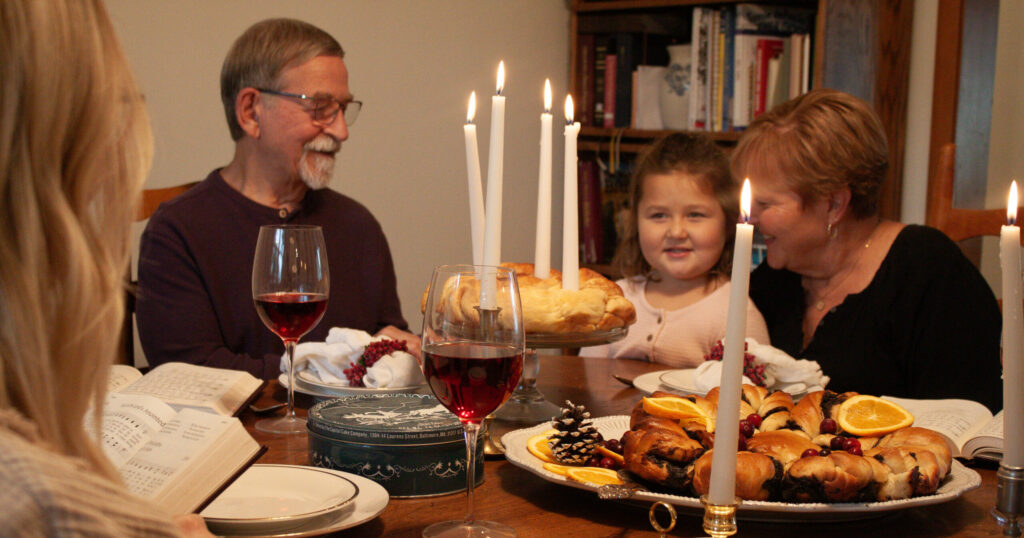
“And [Jesus] said to them, ‘Come away by yourselves to a desolate place and rest a while.’ For many were coming and going, and they had no leisure even to eat. And they went away in the boat to a desolate place by themselves” (Mark 6:31-32 ESV).
“Leisure, in the biblical context, refers to time free from work or duties, allowing for rest, reflection, and recreation. The concept of leisure is intertwined with the biblical principles of rest and Sabbath, emphasizing the importance of balancing work with periods of rest and spiritual renewal” (https://biblehub.com/topical/l/leisure.htm).