

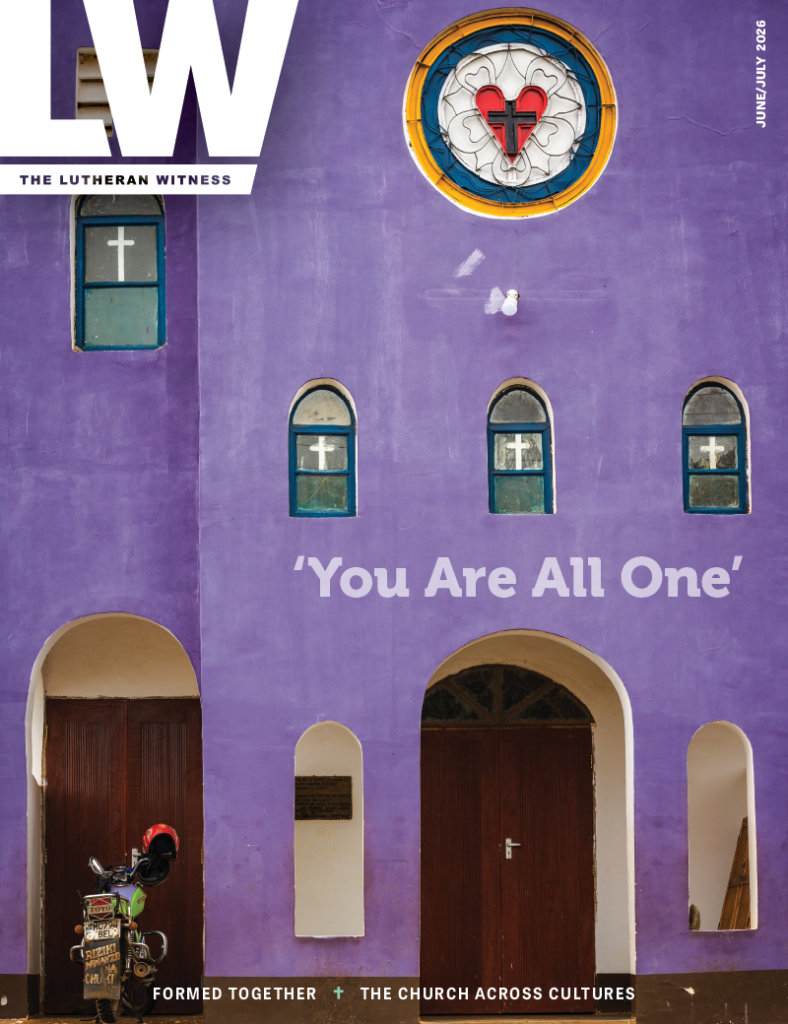
The June/July issue of The Lutheran Witness takes up the topics of unity and variety in the church.
- From the President: The Lutheran Way: Liturgical Freedom Tempered by Love
- Life in the Church Year: The Catholicity of the Church Year
Print Features
- Formed Together: A call to faithful and harmonious variety
- On Unity in the Church: An invisible reality and a blessed goal
Departments
- Snippets: News from around the LCMS and the world
- The Road to Convention: How Does Convention Work?
- Searching Scripture: Following the Formula Article VI: The Third Use of God’s Law
- Searching Scripture: Following the Formula Article VII: The Lord’s Supper
From the editor
St. Paul appealed to the Corinthian church “that all of you agree, and that there be no divisions among you, but that you be united in the same mind and the same judgment” (1 Cor. 1:10). He encouraged the Ephesians to be “eager to maintain the unity of the Spirit in the bond of peace” (Eph. 4:3). But what true unity in the church looks like is not always easy to determine. Exactly how many things must be believed in common to say we are “united in the same mind”? And when it comes to practice, where is uniformity desirable, or in what ways is variety healthy?
Unity and variety — these can be thorny topics among us, as they have been among bodies of Christians who have cared deeply about the teachings of Jesus Christ from the church’s earliest days. Our June/July issue takes up these topics.
We confess “one holy Christian and apostolic Church,” and yet, when we look at the church, we often find division and bickering rather than unity. The Rev. Dr. Joel Lehenbauer explains two different kinds of unity of which Scripture speaks: the true spiritual unity of all believers, a gift of God that cannot always be seen; and the visible unity, the unity of doctrine, for which the church in every age must strive (p. 18).
This issue’s theme was inspired by a document the LCMS Commission on Theology and Church Relations released late last year titled “Unity in Doctrine, Uniformity and Variety in Practice” (called for by the 2019 LCMS convention). The Rev. Dr. Richard Serina gives an overview of that document (p. 8), recounting how questions of uniformity and variety have caused conflict in every era of the church’s history — and explaining why such questions can never be resolved once and for all, but must be taken up among every body of believers with patience and intentional dialogue.
The LCMS is a confessional church body. We strive to stay true to the doctrine given to us by the Holy Spirit in sacred Scripture and expounded upon in our Confessions, keeping it ever the heart of our teaching. Our director of LCMS Worship, the Rev. Sean Daenzer, encourages us to the kind of fruitful, beautiful, faithful Lutheran variety in our congregational worship that can only grow from a common foundation and formation, which has in turn grown from our shared teaching (p. 11).
Even as we mourn the divisions the church faces and press on in pursuit of unity and faithfulness, we can take heart looking at the church across history and across cultures. Indeed, in spite of many arguments and differences, over the centuries a truly remarkable unity shines forth: We find since the time of Christ and on all continents examples of a Christian church that is “one holy Christian and apostolic” — a church that proclaims the Word of God, with Christ as its cornerstone. Just so, as Joshua Hollmann writes in this issue, multicultural congregations today, when they are rooted in Christ and faithful to His Word, provide a foretaste of the feast to come in heaven (p. 15).
As you peruse this issue and ponder these topics, we pray that you keep in mind the final hope of all the faithful: the Lamb around whom believers of all nations, cultures and peoples will one day be united in one song: “Salvation belongs to our God who sits on the throne, and to the Lamb!” (Rev. 7:10).
In Christ,
Stacey Eising
Managing Editor, The Lutheran Witness