



This is the latest installment of “Life in the Church Year,” a series by Dr. Kristen Einertson and Tessa Muench of All the Household. This series will provide guidance for living out the seasons of the Church Year at home with your families. Find month-by-month lists of Lutheran feasts, festivals and commemorations here.
The Christian faith is full of great paradoxes, and so is the Church Year with its many feasts, festivals and holy days. On one hand, these days are deeply local — Christians throughout the world mark them in distinct ways. Days are remembered differently depending on the culture, time of year, place of their commemoration, and even the foods that accompany them. On the other hand, these days are profoundly universal — throughout the world you’ll find that the same feasts and fasts are part of the liturgical cycle, the same prayers and readings are proclaimed, and the same Christ is confessed and received. These days bind Christians together across centuries and continents and form a shared Christian life that is far richer and broader than any one place or people.
This is what Christians mean when they speak of the catholicity of the Church Year, and it echoes the Nicene Creed, where we confess that we believe in “one, holy, catholic, and apostolic Church.” The Church Year is a place where unity and variety meet. The church confesses “one Lord, one faith, one baptism” (Eph. 4:5), and yet that faith takes root in a multitude of places. The beauty of catholicity is that unity does not result in a flattening uniformity. Instead, those differences evince a unified church with a rich variety of practices. To live according to the Church Year is to hold both of these truths together and to step into a story already in motion.
Witnesses Across Time and Place
Within the church’s calendar, we reflect upon Jesus’ incarnation, birth, ministry, suffering, death, resurrection, ascension and the sending of His Spirit — we annually ponder the whole scope of how our Lord has acted for the salvation of His people. At the same time, the remembrance of the saints shows how He continues to work through His church across time and space, ordaining that His Word be proclaimed and His gifts administered to the ends of the earth. The customs that have evolved to accompany the church calendar — the food, songs, prayers and practices — bear the imprint of specific people and places and serve as celebrations of Christ. These traditions give great texture to the shared life of the faithful and highlight the beauty and strength of the Gospel.
In the summer months, after the great festivals of Christmas, Easter, Pentecost and Ascension, the church enters into a quieter richness within the time after Trinity and a focus on some of these saints’ days. We are invited to consider how the faith once delivered to the saints has been lived out in distant centuries and unfamiliar settings and how, even there, it remains recognizably the same faith we confess today.
The Gospel Carried into the World
A few figures, remembered in June and July, offer a particularly vivid window into this shared faith across time: St. Justin, Martyr; St. Boniface of Mainz; and St. James the Elder.
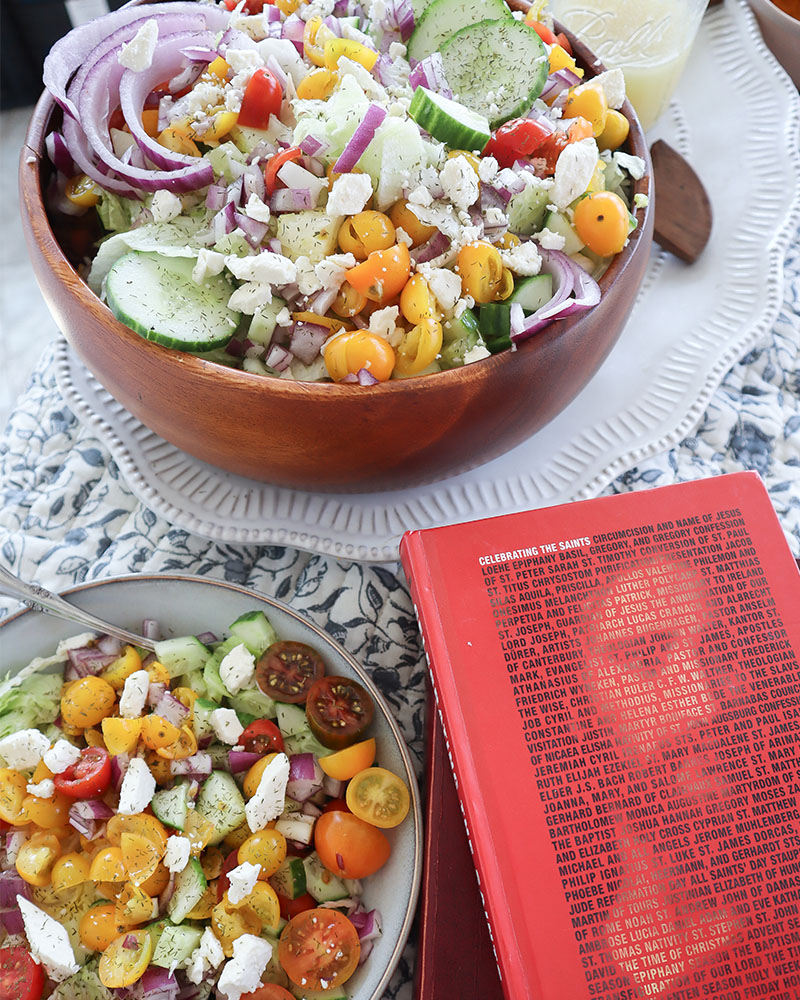
St. Justin, Martyr, commemorated on June 1, was a philosopher by training, formed within the intellectual traditions of the Greco-Roman world. With his conversion to Christianity came his dedication to explaining and defending the Christian faith to a skeptical and often hostile audience. It seems fitting to mark his day with a simple Greek salad that reflects the land and climate in which he lived. (Many recipes can be found online.) His day helps to remind us that the faith we confess has always been lived somewhere, among real people who lived real lives.
St. Boniface, commemorated on June 5, also draws us into the missionary life of the church, this time as it moved northward into the Germanic lands. Born in Anglo-Saxon England, he was sent to proclaim the Gospel among peoples whose customs, languages and religious practices were far removed from the Mediterranean world in which Christianity first took root.
The well-known account of St. Boniface felling the pagans’ sacred oak tree idol, out of which a church was later built, captures an important element of this missionary calling. He used what was present in his community to establish a firm foundation for the faith. It was in this work of planting and tending the Word that Christianity would take root. It is fitting to mark his day with a Blitztorte, as this dessert was shaped by this region and has a layered richness reflecting how a culture receives the faith and expresses it over time. (See the recipe below.) Here again, we see how the spreading of faith does not erase difference but rather gives rise to new forms of life and celebration.
Finally, St. James the Elder took the Gospel westward, carrying it far beyond Galilee and into Spain. On July 25, Christians remember St. James, one of the first witnesses to Christ, whose life reminds us that the church’s life is never static but is always being received, carried and handed on. A tradition associated with his feast is the Tarta de Santiago, made from almonds, eggs and sugar, and marked with a cross in powdered sugar. (Many recipes for this cake can be found online.)
Through these customs, we remember that the Gospel travels across borders and languages, taking root in unlikely places. When we mark these days in our own homes, churches and schools — whether with a Greek salad and a German Blitztorte in June or a Spanish Tarta de Santiago in July — we are participating in the shared life of the church, one that is both locally celebrated and universally confessed. Thanks be to God that as we gather in the life of the church, we can remember Christ’s blessings across time and place and our oneness in Him.
For month-by-month lists of Lutheran feasts, festivals and commemorations, visit lcms.org/worship/church-year.
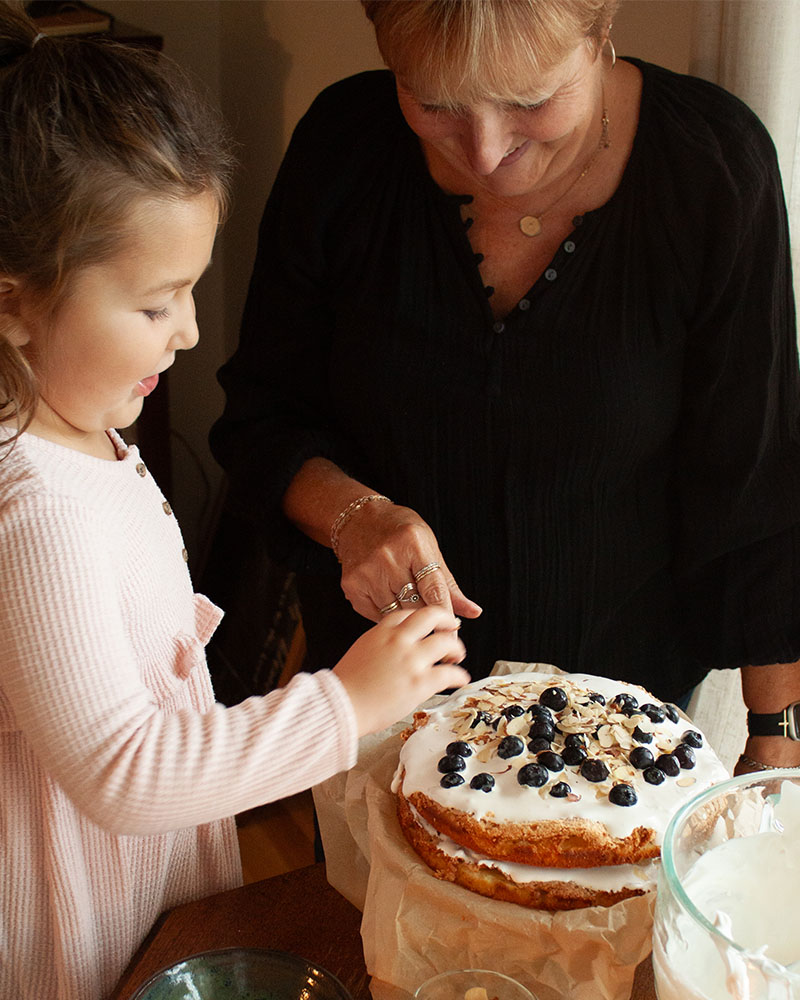
St. Boniface Blitztorte
Ingredients:
- ½ cup shortening
- 1 cup sugar, divided into half
- 2 ½ tsp. vanilla or almond extract, divided 1 cup all-purpose flour, sifted
- 2 tsp. baking powder
- ¼ tsp. salt
- ½ cup milk
- 1 cup cold heavy whipping cream
- 2 Tbsp. powdered sugar
- ¼–½ cup slivered almonds (optional)
- ½ cup chopped berries (optional)
Instructions:
- Preheat the oven to 350°F. Grease two 8-inch cake pans. Separate the eggs, placing the whites in one bowl and the yolks in another.
- Cream together the shortening, sugar, egg yolks and 1 tsp. of the vanilla/almond extract until well blended.
- In a separate bowl, sift together the flour, baking powder and salt. Add to the creamed mixture and mix until incorporated. Add the milk and beat until smooth.
- Divide the batter evenly between the prepared pans.
- In a clean bowl, beat the egg whites until soft peaks form. Gradually add the remaining ½ cup sugar and 1 tsp. vanilla/almond extract. Continue beating until a light, airy meringue forms with stiff peaks.
- Spread the meringue evenly over the batter in each pan. Sprinkle with almonds.
- Bake for about 35 minutes, or until the meringue is set and lightly golden. Cool completely in the pans on a wire rack.
- For the filling, beat the cold cream, powdered sugar and remaining ½ tsp. extract until soft peaks form.
- To assemble, place one cake layer on a serving plate, meringue side up. Spread the whipped cream over the top, adding berries or additional almonds if desired. Place the second cake layer on top, meringue side up.
- Refrigerate until ready to serve. Slice with a serrated knife.
Cover image: Tessa Muench



RE: “Through these customs, we remember that the Gospel travels across borders and languages….”
Might the work of many missionaries serving today could also be routinely acknowledged?