
by Matthew C. Harrison
“And having food and raiment let us be therewith content.” — 1 Tim. 6:8 KJV
My memory is somewhat vague, but it was in the lower hall of Redeemer Lutheran Church, in Sioux City, Iowa, probably around 1974, that I first committed this verse to memory. A parent volunteer was sitting in the hall, and we kids were reciting “memory work” from CPH’s 1943 edition of Luther’s Small Catechism one by one, as we did every Wednesday night. On the ride to class, I could quickly memorize a memory verse and enough of the catechism lesson to squeak by. First Timothy 6:8 was, I think, the easiest memory work I was ever assigned. The strange, antiquated King James English just lodged immediately and permanently in my brain. John 20:23 was the same: “Whose soever sins ye remit, they are remitted unto them; and whose soever sins ye retain, they are retained.” And the catechism text regarding the Office of the Keys that goes along with this verse is likewise burned into my memory: “I believe that when the called ministers of Christ deal with us according to his divine command, this is as valid and certain as if Christ our Lord dealt with us himself.”
I’m so thankful my parents insisted on getting me to church, Sunday school and “midweek” classes, and then to confirmation on those Wednesday evenings. I recall delivering the Sunday Des Moines Register as a 12-year-old. Walking those dark, often tree-covered streets alone in the dark, streetlight to streetlight, tested my courage. At 4 a.m., I’d start my round walking right down the center of the street, thereby giving me the best chance of escaping the monsters should they attack from left or right! Loaded with newspapers, I would recite Bible verses and sing hymns like “Jesus Loves Me” (LSB 588). What a profound blessing that the Word of God had burned into my mind, heart and soul. The same texts comfort me today.
Later, as a young man in college, I encountered evangelicalism. I was attracted to the music and emotionalism. The constant introspection about how holy or unholy I’d been living was deceptively captivating. I began to parrot the lingo. “Jesus Christ has done all He could do for you. Now it’s up to you. The choice is yours.” I began to disparage the liturgy, not realizing that all of it was just taken from the Bible. The common confession (“I, a poor, miserable sinner …”) became distasteful to me. The conversion “decision” was everything to my evangelical friends, and the precious doctrine of justification was absent in their lives — not a daily reality for the Christian. What brought me back to my senses? Luther’s Small Catechism, especially his explanation of the Third Article of the Apostles’ Creed, which hit me like a bolt of lightning from memory: “I believe that I cannot by my own reason or strength believe in Jesus Christ my Lord or come to him, but the Holy Ghost has called me by the Gospel … ”
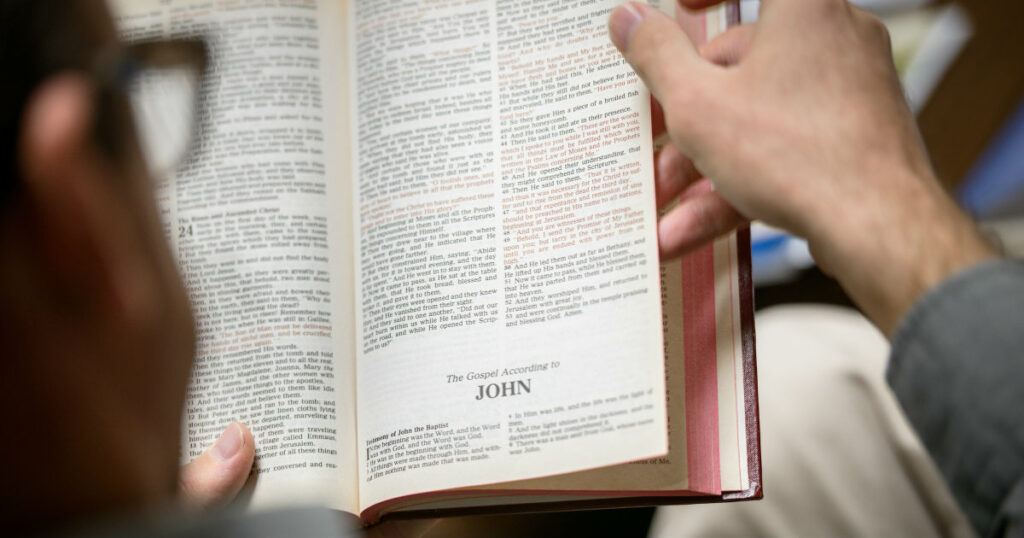
A great joy and wonderment to me when I became a pastor was that I got paid to study the Bible — to pack my mind full of texts that are all, as the writer to the Hebrews says, “living and active, sharper than any two-edged sword” (Heb. 4:12). And that blessed Word kills and makes alive, both me and my hearers! It brings Jesus and all His blessings.
My favorite Bible these days for personal study is the Novum Testamentum Tetraglotton (Diogenes-Verlag, 2010), an old reprinted New Testament which includes four columns — the KJV, Luther’s German, the original Greek and the Latin Vulgate. Using it almost daily for several years has brought regular delight as I see how well the translated versions render the Greek text. The KJV especially is so wonderfully precise, even putting minor words which are not exactly in the Greek original in italics!
Thanks to my early biblical education and years of Bible study since, my head is swimming with texts, and the beautiful thing is there are always more! And because the texts bring Christ and His Gospel, there is always more Christ, more forgiveness, more comfort, more joy, more peace. If you don’t have one, get yourself a Lutheran Study Bible from CPH — the ESV is a good translation. Listen to an audio Bible. The Word of God never stops giving.
“And having food and raiment let us be therewith content.” And indeed we are more than content, “born again, not of corruptible seed, but of incorruptible, by the word of God, which liveth and abideth for ever” (1 Peter 1:23 KJV).
— Pastor Matthew C. Harrison
This article originally appeared in print in the September 2026 issue of The Lutheran Witness.
Cover image: LCMS Communications/Erik M. Lunsford