



By Roy S. Askins
“He has to spill coffee on his shirt by 7:05. 7:05 at the latest,” one dapper, fedora-wearing “adjuster” said to the other. If not, David Norris would end up on the right bus bonding with the wrong woman, causing a serious deviation in the chairman’s carefully crafted plan. The movie The Adjustment Bureau (2011) plays out a determinist reality: What if some quasi-religious being scripted out your life and used a cadre of special operatives (should we say “angels”?) to ensure you stayed on the plan?
Many Christians drift into a similar determinist perspective when speaking with young adults considering big life decisions: “God has a career picked out for you.” “God has a spouse chosen for you.” While well-meaning, such ideas can introduce confusion, frustration and fear. How am I supposed to know what the plan is? What if I pick the wrong career? The wrong spouse? If it’s all planned out in advance, what if I do the wrong thing? Does God send out fedora-sporting gentlemen to spill coffee at the exact right time to correct the plan?
Many have used passages such as Jeremiah 29:11 to point to a secret divine plan: “For I know the plans I have for you, declares the Lord, plans for welfare and not for evil, to give you a future and a hope.” The surrounding passages add a bit of context, however. Through Jeremiah, God promises the Israelite exiles in Babylon that in 70 years, He will return them to Jerusalem. Why? Because God knows the plans He has for the exiles in Babylon. The passage was written for a very specific audience, not as a promise that God has scripted out every decision in your life. Further, for our immortal God, foreknowledge is not the same as determination: God certainly does know what jobs a Christian will hold in his lifetime — but this is not the same as selecting those jobs.
Another passage is found in Romans: “For those who love God all things work together for good, for those who are called according to His purpose” (Rom. 8:28). God does, indeed, work all things for good; this does not mean your every decision is fated to happen a certain way. Scripture never promises us that God will offer specific plans for each Christian’s life. Yet God works His overall plan and purpose for the good of His people.
A Quick Caveat About Free Will
In fact, for many matters related to daily life, God gives His people freedom to make decisions. “Our churches teach that a person’s will has some freedom to choose civil righteousness and to do things subject to reason” (AC XVIII 1), our Lutheran forefathers confessed. Many daily decisions fall into this category, such as the clothing you wore this morning and even your career and spouse. And while your heavenly Father does send His holy angels to guard and keep you, their work is a far cry from a bureau of well-hatted men making minor adjustments to your life choices to keep you on “the plan.”
It is in a spiritual or theological sense that your will is “bound”: Apart from the enlivening work of the Holy Spirit to convict you of sin and create faith in your heart, you cannot understand spiritual things (1 Cor. 2:14). You were dead in your trespasses and sins (Eph. 2:1–3). You cannot earn His favor, for your righteousness is as filthy rags before Him (Isaiah 64:6). You cannot choose God. Instead, He has chosen you (John 15:16). In this arguably much greater sense, you do not have free will, while in many earthly areas of life, decisions are left in your hands.
The Problem with a Plan
If God has a secret plan for your life that you must uncover, the essential problem is that this plan is, well, secret. The Scriptures do not spell out specific plans for your life. God has not hidden the plan in Hebrew codes for you to decipher.
Perhaps a “still small voice” will direct you? This notion finds its genesis in Elijah’s attempt to escape Jezebel in 1 Kings 19. God finally speaks to Elijah in a low whisper. But like Jeremiah 29:11, nowhere does this passage promise that all Christians will receive this sort of direct revelation from God. What most people experience as a voice in the mind guiding them is simply the internal dialogue of a human being. For the Christian who regularly attends worship and finds time to be in the Word of God, this voice will have been trained by God’s Word. It will have been formed so that in the crucible of life, it desires the paths of God (Psalm 119:105). But it’s not God speaking directly into the mind.
This leaves the Christian who is searching for the “right path” with only his own experiences to help him determine whether he has found it. “God will make sure it’ll happen” or “God will let you know,” he’s told. In other words: If you choose the wrong path, you’ll be unhappy and you won’t enjoy the work you’re doing. But eventually, you’ll figure out what you were supposed to be doing all along, and you’ll be happy.
Do you know what else we call this thinking? Prosperity Gospel — using our material possessions and personal emotions to decode God’s attitude toward us. God never promises that you’ll be happy if you’re in the right career; He never promises that life with your spouse will be pure bliss. Indeed, cross and trial will come for every Christian. Jesus promised it (Matt. 10:38).
The Right Choice
At the same time, God does not leave us without guidance. If you are considering life options or offering advice to a young person at this juncture, here are a few thoughts.
First, reread Dr. Gene Veith’s article in this issue of The Lutheran Witness (p. 8). God gives clear advice for vocations. He orders life for husband and wife, parents and children, parishioners and pastor. He may not tell you whom to marry, but He does direct husbands to love their wives as their own bodies, and wives to “submit to your own husbands, as to the Lord” (Eph. 5:22, 28). Study the Ten Commandments and the Scriptures. Does this potential career ask you to violate God’s commandments? Does it provide you an opportunity to serve your neighbor in a godly way? Review the Table of Duties in the Small Catechism. How would this potential career fit into those duties?
Second, when it comes time to make career choices, you have options. We confess in the explanation to the First Article of the Apostles’ Creed, “I believe that God has made me and all creatures; that He has given me my body and soul, eyes, ears, and all my members, my reason and all my senses, and still takes care of them” (emphasis added).[1] God has given you freedom to use the reason He has given you. Ask these questions: Which careers fit your particular skills and interests, while also serving your neighbor? Which careers enable you to provide for a family, support your church and serve your community?
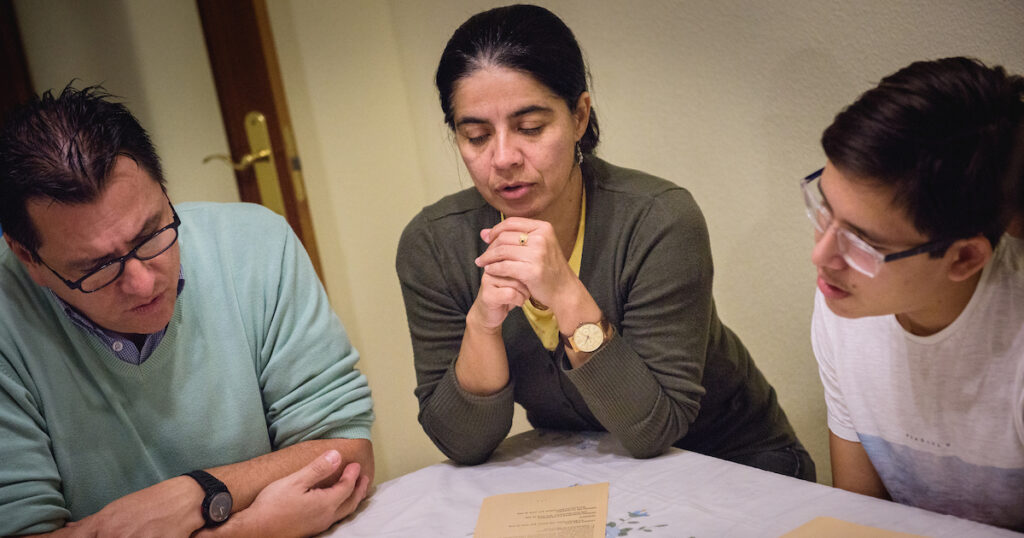
Third, God has also settled you into a family and a community. Talk with your family, with your pastor, with wise members of your congregation. What advice do they have? What have your parents noticed about your abilities and interests, or about your potential compatibility with a spouse or a career?
And with all this advice in mind, make the best decision you can. Know that God will work through you. When trial and struggle come — as they most certainly will — this is not a sign from God that you should stay or go. For that, turn to God’s Word. In marriage, conflict is not an opportunity to depart but to grow in love toward your spouse. In your career, trial can be the best opportunity for growth. Jumping from career to career is often not what’s best in serving your neighbor.
Making the right choice, in the end, is not a matter of discovering a hidden plan, secreted away in the mind of God, but rather of being in the Word. Hear it preached. Read it regularly. In this beautiful gift, you are being formed and the new man who lives before God in righteousness and purity is being strengthened. From this place, make your decisions. And He who began a good work in you will bring it to completion.
[1] Luther’s Small Catechism with Explanation (St. Louis: CPH, 2017), 16.
Photo: LCMS Communications/Erik M. Lunsford.
This article originally appeared in the March 2026 issue of The Lutheran Witness.


“Oh, the depth of the riches and wisdom and knowledge of God!
How unsearchable are his judgments and how inscrutable his ways! (Romans 11:33 ESV).”
It would be cruel of God to require that we grasp his hidden will concerning the particulars of our temporal lives and then leave us groping to find the one way forward that would please him, when so many options appear to be permissible. Rather, he invites us to rely on him — the one who orchestrates the entire universe — in a trusting relationship.
Rather than fretting over whether we will make precisely the best choice, we would do better endeavoring to approach each decision in the most God-pleasing way. For the affairs of God concern heart and soul, mind and spirit, and eternal destiny. And about those things he has provided a great deal of guidance.
“Trust in the Lord with all your heart, and do not lean on your own understanding.
In all your ways acknowledge him, and he will make straight your paths” (Prov. 3:5-6).
“The heart of man plans his way, but the Lord establishes his steps” (Prov. 16:5).
“Commit your way to the Lord; trust in him, and he will act” (Ps. 37:5).
“Lord, take my hand and lead me Upon life’s way;
Direct, protect, and feed me From day to day.
Without Your grace and favor I go astray;
So take my hand, O Savior, And lead the way” (LSB 722).