


By Harold L. Senkbeil
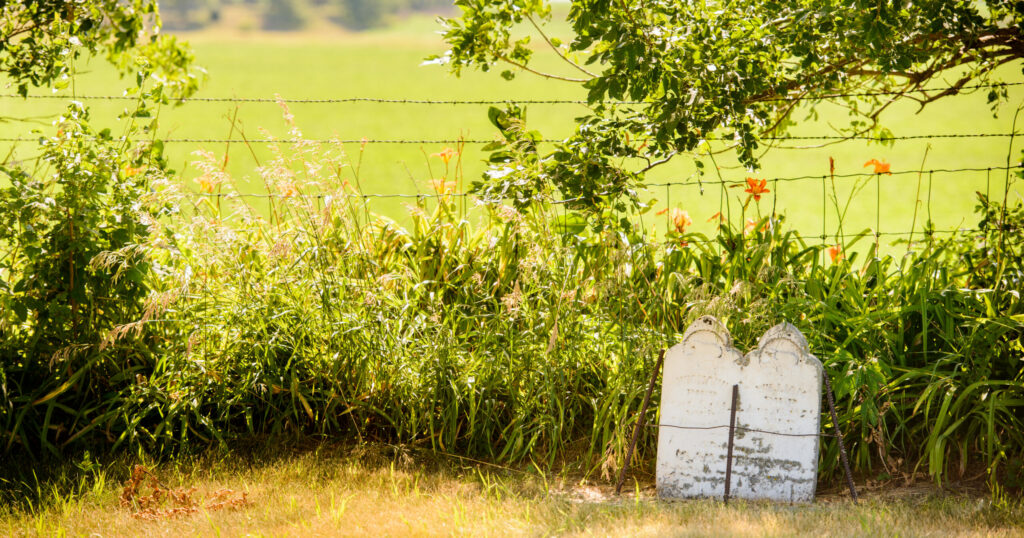
Ever since Eden, life ends in death. That’s true for people, and also at times for congregations.
It was a bright Sunday afternoon in early autumn 1971 when we were wed. I remember the light in Jane’s eyes as she answered the pastor’s question, “Will you love, honor and keep him in sickness and in health and, forsaking all others, remain united to him alone, so long as you both shall live?”
“I will,” she promised.
And she did.
When we celebrated our golden wedding anniversary with family and friends in 2021, Jane had already been in home hospice care 12 months. Not four months later, she died. We buried her late in December amid gently falling snowflakes — in joyful anticipation of her resurrection on the day when Christ returns to claim His own.
All life long Jane was faithful to the Lord who claimed her in the waters of Baptism as an infant. She was faithful to me for more than a half century, and then she died. Was Jane a failure? Of course not.
In this fallen world, all who are born will die. But in Holy Baptism, Christians are reborn in Christ Jesus. All life long they live in Him as He lives in them. It’s a good thing, that life. But good things come to an end in this world of ours.
Death stings (1 Cor. 15:56). It’s no fun to say goodbye to someone we love. I can tell you that from my experience. But whether we live or whether we die, we are the Lord’s (Rom. 14:8). So when Christians die, we bury them. We do grieve and mourn, but not as those who have no hope (1 Thess. 4:13).
That little church on the prairie where Jane and I were married so long ago holds a special place in my heart. I was baptized in its font. Before its altar I was confirmed, ordained and married. Thank God, it’s still going. But just barely. Someday it might be forced to close, God forbid. It could happen, though, because churches have a natural lifespan too. Of the seven churches mentioned in the Book of Revelation, only one still exists today. Things change. Cultures shift. Congregations come and go, but Jesus said His church continues forever. The power of hell itself cannot overcome it (Matt. 16:18).
When my home congregation was planted in 1884, new settlers were breaking prairie sod and starting generational farms. With an average of four families per square mile, each with five or more children, people were everywhere. When I was a child three-quarters of a century ago, 50 kids were in Sunday school. Things have shifted dramatically in rural America. My dad raised his family on 160 acres. That’s no longer possible. Farms today commonly have thousands of acres under cultivation.
When many LCMS congregations were planted 150 years ago, churches were built six to 10 miles apart. Three miles was about as far as you could travel to church on a Sunday morning with horse and buggy. Those days are long gone. Likewise, our great cities today are not what they were when urban churches were planted.
Maybe your home congregation will grow and thrive, but it could also shrivel and die. God alone knows. Let’s get ahead of the curve, read the signs and be prepared. We need to proactively reach new people groups in every era. There may be individuals you’ve been overlooking. Remember, though, that when churches are dying, it’s cruel to extend their lives artificially. We tenderly cared for Jane all through her long final illness. But when she breathed her last, we lovingly gave her into God’s hands, confident of the joyful resurrection ahead for all Christ’s own (Rom. 8:18).
For centuries, pastors have prepared the faithful to live for Christ — and die in Him. That blessed end is always the goal; in this life we want to finish well. We all must be prepared to commend ourselves confidently into God’s hands when that time arrives.
People who die are never failures. They are God’s gifts to us as long as they live. But when they die, we bury them in hope. So too, when congregations die a natural death, we commend them to God with joy. They haven’t failed, and there’s no shame in realizing it’s time to say goodbye with thanksgiving.
Church Leader Checklist
Some things for you to consider as your congregation numbers its days and applies its heart to wisdom for rigorous mission and ministry:
- Track your church’s spiritual vital signs (attendance, membership growth, Baptisms, Communions, funerals, giving) over the last 50 years. What trends do you see?
- How have the demographics in your community shifted over the generations? What is its current population compared with 50 years ago? What ethnicities and languages surround you now, compared to when your church was first planted?
- What can you do to actively connect with new people groups and cultures in your vicinity? How can you better utilize the social and business relationships your members already have built? How can you be better neighbors to your neighborhood? What new evangelization efforts will you begin?
- Who are the “invisible” people living in your area (renters, shift workers, immigrants, etc.)? How will you connect with new residents using both social media and in-person events?
- How can you better position your congregation’s building and property to serve their proper mission: linking your community to Christ and His gifts?
- As vital signs (see #1) fade, which sister churches in your area can you partner with for meaningful mission? How can you make that partnership more about ministry than mere finances?
- If your church reaches the end of its natural life, how will you plan for a blessed end?
a. Transfer remaining members to congregations holding your same confession.
b. Sell real estate to entities that serve your community’s best interests.
c. Hand over corporate assets to your church body, its congregations and missions.
d. Hold a service of thanksgiving and decommission your sanctuary and its furnishings.
e. Gift your sacred vessels and objects to sister churches or mission congregations.
f. Celebrate your church’s mission lifespan; gather past and present members for a celebratory meal to share stories of God’s grace
in times of both joy and sorrow.
Congregations may come and go, but the church as she really is lives and abides forever!
Photo: LCMS Communications/Erik M. Lunsford.
This article originally appeared in the February 2026 issue of The Lutheran Witness.

I am an elder in the Lord’s house of Redeemer Lutheran Church and School. I find your message to be frightening, hopeful, lonely but with compassion. Thus, all these together
makes what I read real! I have been with Redeemer for 30+ years, seen the pastor of 40+
years retire, replacement pastor pass into the Lord’s arms from a heart attack. Our congregation has dropped from 140 or more for two services to 60-80 with one service.
Had an interim pastor who divided us more with the word of the sword, instead of the work
of God. Thankful to have an interim pastor now who is addressing exactly what you stated,
the slow death of a Church and it’s congregation. We are studying the Autopsy of a Deceased Church and working to understand why and how we are dying. We have a school which is
non-denominational, about 238 students. Only four of which attend Redeemer. The Church
use to be the dominant factor of the two, now the roles are reversed. Demographics, Church
vision, older congregation with limited youth growth, all the things you mention, are exactly what we are seeing happening here. I pray we will find our vision again and engage
with the community to stay and grow. Say a prayer for God’s house of Redeemer.
Thank you for your message.
Roger
Great article, but is still sad.