


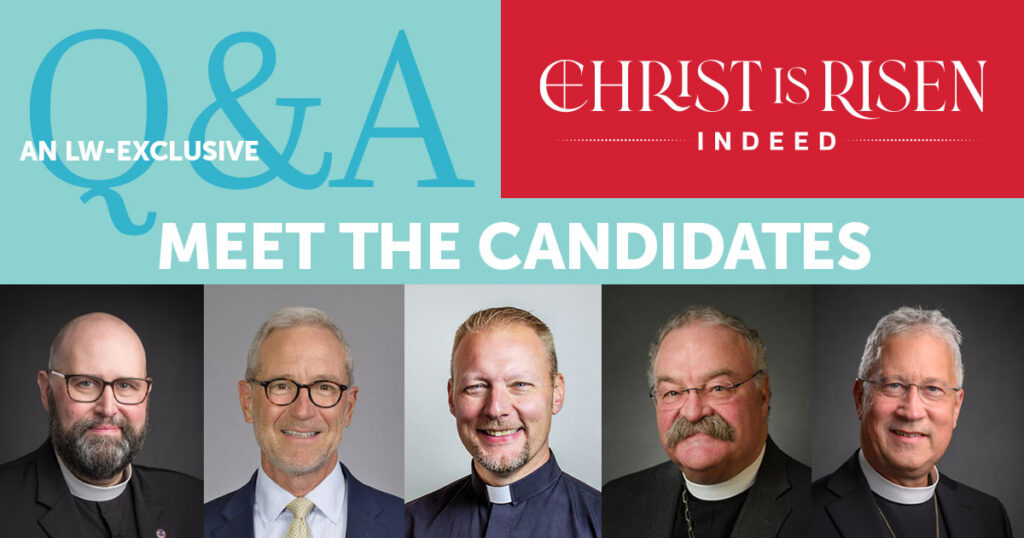
Our editorial staff developed six questions, which were sent to the five candidates for LCMS president with the request that they limit their responses to 100 words. Read their responses below.
1. Tell us what you love about the LCMS.
Benjamin T. Ball
I love the people of our Synod. Everything I have has come from God through the Synod’s people. From my parents and maternal ancestors who were members of LCMS congregations, to my wife (we met on my vicarage), to my education provided by our congregations, all my daily bread has come from God through the people of the LCMS. I love that the people of our Synod love the Word of God and the doctrine of the Evangelical Lutheran Church. I love that they want it to be shared in their communities and around the world.
Joel D. Biermann
I have been nurtured and shaped into the follower of Christ that I am in the LCMS. At the heart of that formation is our solid doctrinal foundation grounded in the Book of Concord. For two decades, the Synod has entrusted me with the task of inculcating a love for our doctrine into future servants in the church. There is no greater joy than encouraging our church’s leaders faithfully to confess the reality of Christ with their words and through their lives. Our Synod’s unifying common confession of God’s truth — the truth that formed me — is what I most appreciate.
Brady L. Finnern
I love how everything we do in the LCMS centers on giving sinners a clear conscience before God in Christ (Rom. 5:1). Our congregations, schools and missions are committed to proclaiming the full counsel of God’s Word: calling sinners to repentance (Luke 24:44–47), comforting hearts with the Gospel (2 Cor. 5:21), exhorting one another to sanctified living (Eph. 5:8–9), and bringing everything to the feet of Christ in prayer (1 Thess. 5:17). Freed by the blood of Christ, we love and serve our neighbors (Mark 12:30–31). The LCMS faithfully confesses the unchanging, inerrant Word of God, which soothes the terrified conscience (Heb. 9:14).
Matthew C. Harrison
Warts and all, she’s the best thing goin’. I’ve seen every corner of the LCMS, all its global work. I love our salt-of-the-earth people who love Jesus and show it in myriad ways. I love our congregations and workers committed to their communities, our schools and staff, our seminaries and universities, our youth. I love our dedicated clergy who are true shepherds and missionaries. I love our mercy work. Most of all, I love what drives it all, the inerrant Scriptures, our Book of Concord and our profound theology. All for this: “For God so loved the world, that He gave His only Son” (John 3:16).
Peter K. Lange
I love its shared commitment to biblical, Christ-centered preaching and teaching; its serious confession of and commitment to the entire Book of Concord in both doctrine and practice; its culture of and commitment to a well-formed clergy; its culture of strong lay participation in receiving God’s gifts through worship and in congregational life; its commitment to national and international mission; its long-held commitment to parochial, secondary and higher education; its strong engagement with church bodies of a shared confession around the world; its emphasis on assisting and developing those partner churches; and its rich tradition of liturgy and hymnody.
2. Church membership is declining in the LCMS, as in most church bodies in America. What should the congregations of the Synod do to address this, and how should the Synod support them?
Ball
Lutherans across our Synod want their congregations to grow. They want more people to believe in Christ and confess His name, and are working to spread God’s Word. Congregations should judge whether their preaching, teaching and activities are faithful to God, His Holy Word and our Confessions. Where they have fallen short, they should repent. The Synod should encourage all members to live faithfully in Christ and trust in His provision. Also, we should encourage faithful, diligent work. We must not sit back in apathetic despair, but recommit ourselves to the Word, and show Christ’s love in all we do. We leave the results to God.
Biermann
Living in a post-Christian culture is hard, and the demographics paint a bleak picture. Nevertheless, a faithful church is not measured by numbers, but by her witness to the world as she follows Christ. Congregations must gather often not only to worship but to encourage and form one another through shared meals, service, sorrows, celebrations and ordinary life. The Synod should provide teaching and exemplary leadership that reinforces the centrality of Christ’s church for the lives of her people. Congregations that are vibrant communities of faith witness the reality of Jesus to the world — and trust God for the growth.
Finnern
Our only hope is in the Lord who brings faith by His Word (Mark 4:26–29). Pastors — keep preaching (2 Tim. 4:2). Commissioned workers — faithfully serve in Christ’s name (Phil. 2:3–5). Priesthood of all believers — stay strong in the Lord (Eph. 6:10). Earnestly pray for those who have walked away from Christ’s gifts. The community surrounding your congregation is your mission field. How can your church extend Christ’s mercy and be ready to defend the hope we have in Christ (1 Peter 3:15)? Synod supports our congregations by assuring that we are faithful to the Scriptures and strengthening the church through visitations.
Harrison
Good news! There has been a significant bounce in adult Baptisms/confirmations. Yet we’ve faced two huge factors (and more) for a half century: 1) The birth rate has plummeted, now at another record low. District attendance numbers mirror the decline of the local birth rate. 2) Our wretched culture has lured our brothers and sisters, sons and daughters away from the church. Answers? Retention. Evangelism/outreach. Youth work. Healthy pastors/workers. Schools (new tax law — huge opportunity). All Nations Ministry (527 LCMS ethnic groups!). Families/discipleship. Church planting. Quality preaching. Substantive worship. Our Office of National Mission is flat out on helping congregations in all this and more.
Lange
Pastors should continually strive for excellent preaching and teaching, inspire and equip increasingly more laity to give witness to the Gospel of Jesus Christ in their daily vocations, and lead by example. Congregations should be intentional with local outreach efforts and work with neighboring congregations to make the best use of decreasing resources. Those that are able should seriously consider church plants. The national office of Synod provides resources for the things listed above. Furthermore, the national office of Synod can support congregations by redoubling its efforts to listen to the needs expressed by congregations and districts and respond appropriately as resources allow.
3. What does it mean to be Lutheran?
Ball
To be a Lutheran is to be a Christian. To be a Christian is to follow Jesus Christ and His Word. A Lutheran, having been justified by faith alone, renounces the devil; believes in the Holy Trinity; holds all the prophetic and apostolic Holy Scriptures as the inspired, inerrant Word of God; and confesses the doctrine of the Small Catechism to be faithful and true. By the grace of God, a Lutheran lives according to the Word of God and in faith, word and deed remains true to God, Father, Son and Holy Spirit even to death.
Biermann
Lutherans follow Jesus Christ. Lutheran is not a denomination or one version of Christianity. Lutheran is the name we give to those who rightly confess with their words and lives that Jesus is Lord. Normed and directed by the Bible, Lutherans teach the fullness of God’s truth that the apostles taught. To be Lutheran is to know the wonder of God’s forgiveness in Christ, to have purpose in daily life grounded in the vocations God gives, and to wait with eager expectation for the arrival of Christ’s kingdom in its full glory on the Last Day.
Finnern
As Lutherans, we have confidence that we are received into God’s favor and forgiven for Christ’s sake, entirely apart from our own merit or worthiness. We believe, teach and confess that salvation is in the shed blood and resurrection of Christ by grace alone and through faith alone (Eph. 2:8–9), brought to sinners through the external means of Word and Sacrament. In a world of uncertainty, Lutheranism delivers the sure promise of the forgiveness of sins (Col. 1:13–14) and the hope that by the work of the Holy Spirit, we can live in holiness as His living sacrifices (Rom. 12:1–2).
Harrison
“The gospel is the power of God unto salvation,” not my works, decision, nothing in me. “He was put to death for our sins, raised for our justification” (Rom. 4:25). Our catechism teaches: The Commandments convict us of sin (Rom. 3:21). The Creed tells us who God is and who we are. He redeemed us and “calls, gathers, enlightens” the whole church. We live as His. He “tenderly invites us to pray.” “He saves us through the washing… .” We confess. He forgives. He gives “His true body and blood … for forgiveness.” We cling to the inerrant Word and live for Him through others.
Lange
Being Lutheran is to confess faithfully the truth of God’s Holy Word according to all the Lutheran Confessions contained in the Book of Concord of 1580. This includes rejecting all false teachings that the Confessions reject. Central to the Lutheran confession is Christ for us, earned on the cross and delivered through His Holy Word and blessed Sacraments.
4. How would you describe the proper relationship between the church and the government/politics?
Ball
The church should preach the truth of God’s Word to the governing authorities. We must call them to fidelity to their offices and remind them of their duties. The Augsburg Confession reminds us that both the church and the governing authorities are established by God and are to “be honored and acknowledged as God’s gifts and blessings” — but that confusing the power of the church and of the state “has produced great war and riot” (AC XXVIII). Lutheran citizens have a duty not just to obey the governing authorities (Rom. 13), but particularly in our country, to participate in making decisions for the good of our neighbors.
Biermann
Jesus is Lord over His entire creation. He exercises a twofold rule through the church and the government. With the sword, government thwarts evil and cares for those in need. With the Word, the church delivers the Gospel that makes creatures right with their Creator. While church and state must be kept distinct, they cooperate to accomplish God’s purposes until Christ returns. A good government adheres to God’s Law, helping creatures to live well together. A faithful church proclaims the Gospel and seeks neither to control government nor to curry its favor but encourages it to uphold God’s justice.
Finnern
Governed by our Lord’s desire for all people to believe in Christ and live according to His way (1 Tim. 2:1–4), we pray for and submit to those in authority as unto the Lord (Rom. 13:1–7). The church calls the baptized to engage faithfully in civic life for the good of our neighbor and to speak God’s truth humbly yet clearly when authorities promote sin (Acts 5:29). Our goal is not to seize earthly power, but to reflect Christ’s mercy and righteousness in the public square.
Harrison
“Render unto Caesar what is Caesar’s and to God what is God’s” (Mark 12:17). Secular government and church “must not be confused” (Ap XXVIII 12). Pulpits are for proclamation of the truths of Scripture, especially the Gospel. Our people serve. We vote (AC XV). We have First Amendment protections. Government is to keep order and control evil (Rom. 13). Law and order is good. Where government fails, we have spoken (abortion, racism, negative aspects of DEI, homosexuality and trans ideology). We have also advocated compassion for immigrants. We are not a political party. We are all about Christ and His Gospel and the “whole counsel of God.”
Lange
The Lord instituted the church and commanded her to minister His Word and Sacraments through which He blesses those who receive His gifts and equips them for their vocations. The Lord also blesses the people of this world through earthly governments which receive their authority from God and exist to maintain peace and order. Christians live as citizens of both realms and are free to participate in government and politics through which they can be a salutary leaven on society as they participate in accord with their conscience formed by the Word of God.
5. In an ideal world 30 years from now, what does the LCMS look like? What is the same? What is different?
Ball
In an ideal world, the LCMS would be the largest church body in America — indeed, the only church body in America — because everyone would join together with us in unified confession and life! I pray that Scripture and our Book of Concord will be preached and taught among us. That congregations will be full of people hearing God’s Word and living by it; families strong; Christians showing love for their neighbors and zealous in outreach. I hope that we may grow more united in our confession and practice — for example, that all congregations will be practicing closed Communion and singing God’s Words from the same hymnal.
Biermann
If we are faithful and choose to do the necessary work, the LCMS will be blessed with a future that is marked by unity; a determination to use insights, gifts and resources from all in the Synod; and an unwavering commitment to build one another up into mature followers of Christ. Anchored in God’s grace, we will eagerly worship together, generously serve our neighbors, and provide the world with a vibrant witness of the joy that comes when we walk in the truth of God’s Gospel. We will be a people who show the world the reality of new life in Jesus.
Finnern
In 30 years, we pray the Lord keeps our foundation unshaken: that every church, school and mission confesses the inerrant Scriptures (2 Tim. 3:16) and Jesus as the only Savior (John 14:6), and stands steadfast with a quia subscription to the Book of Concord. That week by week, the saints still hear the voice of their Good Shepherd (John 10:27; SA III, VIII). My prayer is that, regardless of size, we have robust, purposeful visitations to every congregation, school, circuit and district each triennium, ensuring that we remain steadfast in the one true faith and grow together in Christ’s kingdom (Acts 15:36–41).
Harrison
You can bet there won’t be an “ideal world.” But Jesus is the same yesterday, today and forever (Heb. 13:8). We shall be what the church has always been. “We have this treasure in jars of clay, … the surpassing power belongs to God and not to us. We are afflicted in every way, but not crushed; perplexed, but not driven to despair; persecuted, but not forsaken … always carrying in the body the death of Jesus, so that the life of Jesus also may be manifested in our bodies” (2 Cor. 4:7ff). I pray we remain faithful, biblical Lutherans, growing, planting and serving.
Lange
The LCMS is unified in its clear, Christ-centered confession of God’s Word according to the Lutheran Confessions. It is unified in its public worship, ministry and mission, having worked through former divisions and agreed upon God-pleasing limits to the variety of practices in its congregations and schools. Its universities and seminaries are cherished by all; supply all the needed pastors, missionaries, teachers and other church workers that can be supported; and are boldly Lutheran, full of students learning from excellent curricula. Every congregation, school and agency vigorously reaches out to those who do not know Jesus with Christ’s Word and Sacraments through which He grows His church.
6. What actions would you like to see come out of this upcoming Synod convention?
Ball
I hope that all our resolutions would extol Christ and His doctrine and be helpful for the lives of our congregations. We should leave the convention unified and resolved to stop bickering, which hinders our witness and diverts our attention away from kingdom work. To that end, the matters surrounding pastoral formation need to be resolved. I hope that a resolution is passed to begin the reform of our dispute resolution and ecclesiastical supervision processes. I believe these have been shown to be broken and are hampering our ability to live and serve together.
Biermann
Paul’s exhortation to the Colossians provides excellent direction: “We preach Christ, instructing everyone and teaching everyone with all wisdom, so that we may present everyone complete in Christ” (Col. 1:28). Accordingly, we should: encourage faithful practices in worship and daily living that form people to be fully human creatures of God; embrace the church’s defining purpose to deliver God’s truth revealed in Christ to the world around us, and sharpen this focus by rebuking petty disputes or fears that hinder our work together; and determine to proclaim the Gospel to everyone. Proclamation is not an option — Christ died for everyone.
Finnern
I pray that the convention reaffirms our joyful commitment to Scripture and the Lutheran Confessions and that, through us, the Lord would strengthen the baptized to proclaim Christ’s excellencies (1 Peter 2:9), equip families to teach the faith diligently in the home (Deut. 6:4–9), celebrate and bolster our universities and seminaries as they form servants for the harvest, and remind every believer that they are not alone in a divided world. Christ still reigns (Luke 24:5–6). Nothing can overcome His church (Matt. 16:18). The Lord sends us forth knowing that Christ is risen, risen indeed!
Harrison
Strong, biblical resolutions that confess Christ in a world of chaos. Continued commitment to the priority of strong residential seminaries, with faithful flexibility to serve the needs of congregations. Focus on congregations and pastors. Focus on Set Apart to Serve and our increasing numbers of church work students. Continued aggressive domestic and international mission. Thanksgiving that we have no debt and no guarantees on any debt. Upcoming catechism and Augsburg Confession anniversaries. Improvement of reconciliation bylaws. More authority for mission boards. Luther said the Gospel passes from a people for thanklessness. “Thank the Lord, for He is good, and His mercy endures forever!” (Psalm 136).
Lange
Regarding pastoral formation, I would like to see the members of Synod recognize and appreciate the years-long conversations and processes that have led to this convention (as human and imperfect as those processes are) and then live peacefully with whatever decisions emerge from the convention whose delegates represent every member of Synod. Regarding disputes as well as the mutual encouragement, instruction and admonition that are to take place among rostered members of Synod (Bylaw 4.8.2), I would like to see clarification and simplification of the process(es) by which concerns may be addressed so that these agreed-upon processes are more easily navigated and widely used.
This article originally appeared in print in the May 2026 issue of The Lutheran Witness.

One aspect of retaining and energizing existing members that seemed to be glossed over (see question #2) is that Christians who get involved in whole book Bible studies (doesn’t matter much whether OT or NT) will grow their faith and depend more on it. Those with stronger faith are a lot likely to leave or drop out per some superfluous nit or perceived slight. They won’t get riled up about carpet colors or the style of new chairs for a meeting room.
The two basic paths to growth & retention are: Focus on the Bible, solid preaching, adult education focused on Bible book studies, solid hymns that feature good music and sound theology, prayer and devout worship. OR the focus can be on making people feel good, offering promises of wealth and happiness that Jesus did not and would not offer. Offering a litany of blame-free misquotes of the Bible, happy songs that imply that “I found Jesus”, trying to convince people that “all is well” and that the Christian life is easy may boost attendance for a while but it will not solve anyone’s problems for long. These counterfeit outfits often fail to acknowledge that happiness is a temporary balm based on human whims and that joy is a gift of God that lasts.
The churches that rely on devaluation or dilution of the Gospel (because a lot of the Gospel is hard to hear) will fail because they do not offer what Jesus has always offered. His Church is founded on what has been revealed to us in the Bible and prayer. When, as is likely, the seas get rougher in the future days our task is to stand fast with our Lord, don’t bow to or knuckle under satan’s current rendition of what life should be. We have the Bible and 24/7 access to our Divine Triune God via prayer. That’s all we need.
Remember what Jesus said about the Church at Laodicea!
I would like each candidate to answer, “Was Charlie Kirk a racist?” Yes or No.
Many have left the LCMS, because Harrison chose to put out a statement that Kirk was not racist. It was heartbreaking to lose both my congregation and my denomination, but I couldn’t stay in a synod that refuses to call out racism. So this is my litmus test. If the LCMS elects a president who will say that Kirk was a racist, I can return.
I have followed the questions and answers keengly and really enjoyed all of the candidates. I know they were given time limits and could not have spoken much.
Thus, I can only say I wish them well.
Thanks 😊
The 36 million in debt that the LCMS had when Harrison took over seemed to be here to stay. The Lord brought us out of that mess and since 2019, we have been debt free. I thank the Lord for President Harrison’s leadership.
All have good answers, but in reading what Bierman has to say, he would be my choice for a new leader of the LCMS!
Excellent questions and mostly good answers. One candidate mentions Jesus by name more often and provides a reasonable answer to Question #4 on the church and government relationship. In 1963, the church failed miserably when the Supreme Court ruled 8 to 1 in favor of Madalyn Murray O’Hair ruling that Bible reading and prayer in the public schools was unconstitutional. We see the results. The late Austrian intellectual, Erik von Kuehnelt-Leddihn, loved America more than most US citizens. Erik often commented, “The great problem in America is that the half-educated are in charge of the education and the news.” So, it affects all disciplines including the clergy. Erik traveled the globe seeking out the human condition. He found that Right is right and Left is wrong in all languages, including the Ural-Altaic or at least has that connotation. Likewise it is true in the Bible, see Ecclesiastes 10:2. Also, Jesus was not being a relativist placing the sheep on His right and the goats on His left. Education has become so bad for so long that the Left is quite certain it is Right. The Left is quick to assert “separation of church and state” meant to silence Christian input. It works judging by some LCMS candidates answers.
Since the claim that one candidate mentions Jesus by name more often was not accompanied by data, I fear that I have been nerd-sniped. I absolutely don’t condone endorsing candidates based on word counts, but just for fun and out of personal curiosity, I counted some things.
Word count (calculated using the tool in Google Docs):
Benjamin T. Ball: 606
Joel D. Bierman: 598
Brady L. Finnern: 613
Matthew C. Harrison: 641
Peter K. Lange: 568
Surprisingly, some word counts came out to more than 600, which would be the maximum word count of 100 for each response, times six. Perhaps they determined what counted as a word differently.
Since saying more words gives candidates more opportunities to say things (and there was a total swing of 641-568 = 73 words), I have put in parentheses the percent of words and phrases from each candidate’s total response. These were calculated by dividing by the word count, multiplying by 100, and rounding to the tenths place (a fairly arbitrary choice).
Here is the number of times each candidate said “Jesus”:
Benjamin T. Ball: 1 (0.2%)
Joel D. Bierman: 5 (0.8%)
Brady L. Finnern: 1 (0.2%)
Matthew C. Harrison: 4 (0.6%)
Peter K. Lange: 2 (0.4%)
Here is the number of times each candidate said “Jesus”, “Christ”, “Lord”, “Son”, “Savior”, or “Good Shepherd” (these are the names and titles I identified in these responses for the second person of the Trinity; I am counting “Jesus Christ” as 1, and not counting “Christian” or “Christianity”):
Benjamin T. Ball: 6 (1.0%)
Joel D. Bierman: 20 (3.3%)
Brady L. Finnern: 23 (3.8%)
Matthew C. Harrison: 8 (1.2%)
Peter K. Lange: 8 (1.4%)
Number of total mentions of God (including “God”, “Holy Trinity”, “Father”, “Son”, “Holy Spirit”, “Jesus”, etc., not counting pronouns that refer to God [e.g. “His”], counting “Savior” and “Good Shepherd”, not counting “Word” except when it clearly refers primarily to the second person of the Trinity [i.e. Jesus is the Word, but Jesus is not the Bible], but counting “Word of God” because it contains “God”):
Benjamin T. Ball: 23 (3.8%)
Joel D. Bierman: 31 (5.2%)
Brady L. Finnern: 31 (5.1%)
Matthew C. Harrison: 15 (2.3%)
Peter K. Lange: 13 (2.3%)
Number of direct scriptural references from each candidate (i.e. named chapters/verses or quotes in quotation marks, not general references to “Word” etc.):
Benjamin T. Ball: 1 (0.2%)
Joel D. Bierman: 1 (0.2%)
Brady L. Finnern: 26 (4.2%)
Matthew C. Harrison: 10 (1.6%) (Harrison’s manner of quoting makes counting difficult [which is obviously nothing against him], so different people might count differently)
Peter K. Lange: 0 (0.0%)
Number of references to the Lutheran Confessions (“Book of Concord”, “Augsburg Confession”, and so on, including not just references to specific passages this time):
Benjamin T. Ball: 3 (0.5%)
Joel D. Bierman: 1 (0.2%)
Brady L. Finnern: 3 (0.5%)
Matthew C. Harrison: 10 (1.6%) (counting also difficult)
Peter K. Lange: 5 (0.9%)
Any errors are my own.
Erik von Keuhnelt-Leddihn didn’t like democracy. He believed in monarchy. He thought truancy laws were “totalitarian.” He was a far-right nutjob.