


This is the latest installment of “Life in the Church Year,” a series by Dr. Kristen Einertson and Tessa Muench of All the Household. This series will provide guidance for living out the seasons of the Church Year at home with your families. Find month-by-month lists of Lutheran feasts, festivals and commemorations here.
Abiding in Jesus is what life in the church is all about. Like the branch connected to the vine, so the church is connected to her Lord (John 15). Christ should always be a part our lives: Our eyes should always be focused on Him and His cross. Many of the most beloved hymns in our hymnal remind us of this, such as “Abide with Me,” which implores, “Hold Thou Thy cross before my closing eyes; Shine through the gloom, and point me to the skies” (LSB 878:6).
However, being close to Christ is more than just going to church on Sundays and claiming the title of “Christian.” We should also wish to stay near to Him every other day of the week and to constantly give ourselves the opportunity to behold His glory, even visually with our eyes. As the old hymn states, we pray that even in the midst of darkness and death (“through the gloom”), we might see what truly matters. Indeed, life in the church should make provision for what our eyes witness and ensure that the visuals we come into contact with every day always point us to Jesus.
Gifts for the Sight
The sense of sight has long been a point of interest for Christians, including for St. John Chrysostom, a church father and late-fourth-century bishop of Constantinople. He likened sight (as well as the other senses) to the port of a city. Whatever enters the opening can either edify or corrupt the kingdom. Of course, the same is true for us as individuals — Christians must be wary of the easily accessible and maliciously corrupting material that constantly surrounds us.
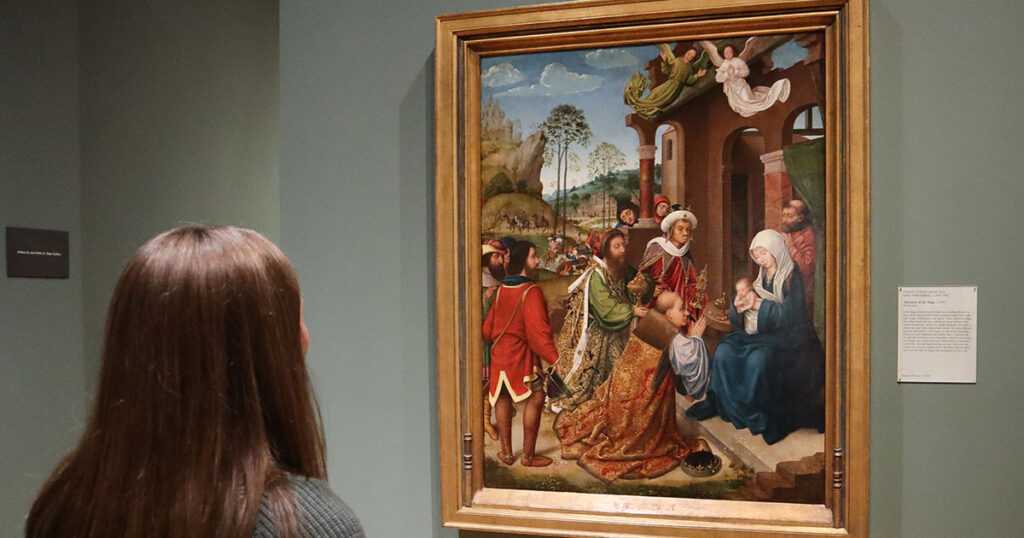
Thankfully, the church offers an antidote to this ailment. She has given us manifold images that place beauty before us and encourage us in our faith. Over the millennia, she has commissioned some of the most remarkable visual art that our world has ever known from masters such as Michelangelo, Rembrandt, Cranach the Elder and Dürer. She has utilized architecture in her buildings to present Christians with complex symbols of the faith: from lecterns shaped like eagles to baptismal fonts with eight sides. And she has filled her sanctuaries with visuals that teach: altarpieces that proclaim the Gospel; stained glass that tells the story of salvation; and embroidered paraments, stoles and chasubles that preach the significance of the church’s seasons. All of these adornments glorify God and attune Christians’ minds and hearts to the beauty of the faith.
Yet this is not all! The church gives to us and houses for us the principal place in which we can see with our eyes the essence of the beauty of Christianity: the Divine Service — the place where heaven and earth meet.
Art for the Everyday
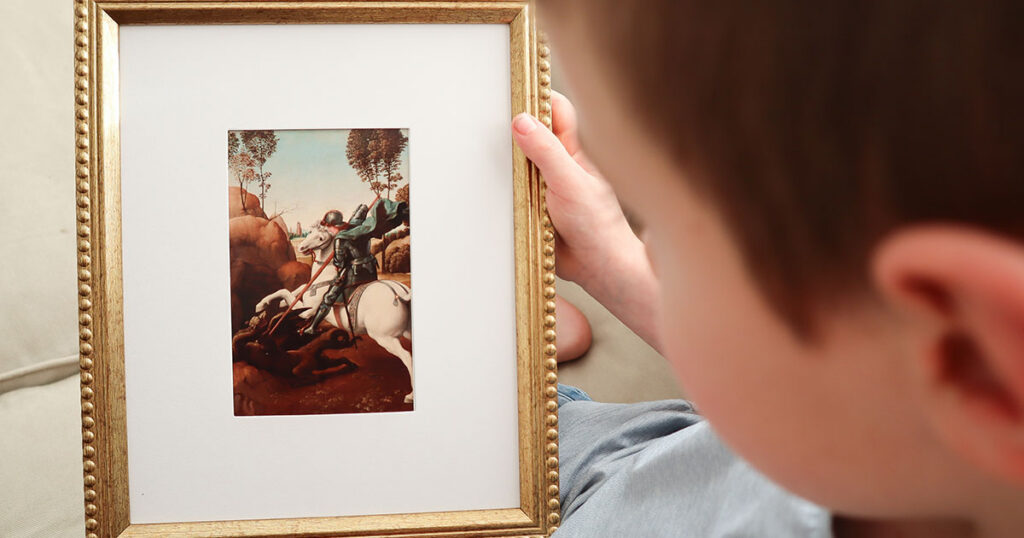
And there is more! Beyond the things found inside her buildings, the church has given us many other ways to keep this beauty before us. God is certainly with us in our congregations — but He also makes His dwelling with us in our everyday lives. Therefore, consider your home as a place that might point you toward Christ. Beautiful Christian artwork in the home reminds and invites us to pray and meditate — just as a home altar can (as we described in the LW February issue).
Our art selections should certainly include crucifixes that direct us to the central image of faith: Jesus dying on the cross to save us once and for all. However, many other sorts of Christian art can be edifying in the home as well. Perhaps we select a piece that reminds us of the faithful who have gone before us such as St. Mary, St. Peter or St. Paul. Perhaps we line the hallway with beautiful baptismal certificates to remind each member of the home of their identity in Christ. Perhaps we adorn the dining room with images such as da Vinci’s “Last Supper” or Rublev’s “Holy Trinity”. We might even select certain pieces because of the way they accompany the holy days of the Church Year.
As we see in these examples, art in the home can both place Christ in front of our vision and also teach important lessons of the faith. Consider, for instance, what artwork centered around the events of the church in our current month and season can tell us.
A Seasonal Example
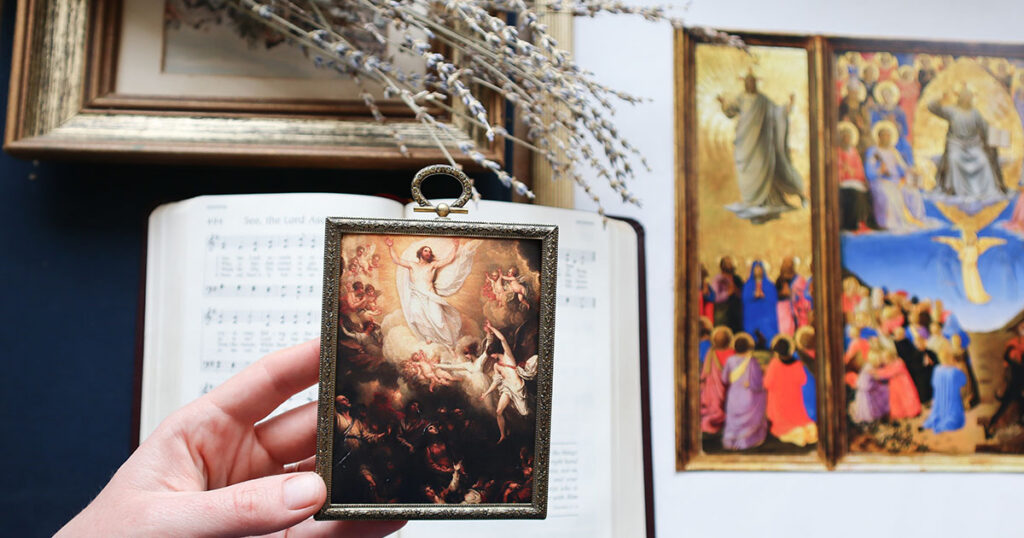
Right now, in the month of May, there are two monumental events in the life of the church that especially direct our eyes toward Christ and shape our “vision” of Christianity: Jesus’ Ascension and the Day of Pentecost. In the first, Jesus departs this earth in a visible way into the skies, where He becomes concealed from our human eyes. In the second, the Helper comes and gives us eyes to see Him — the person of God who “will teach you all things and bring to your remembrance all that I have said to you” (John 14:26).
In artistic renderings of these events, one common theme is that in the Ascension Christ becomes veiled from our eyes, while in Pentecost He is revealed again by the Spirit. Fra Angelico’s triptych depiction of the Ascension and Pentecost together beautifully communicates this “now, but not yet” understanding of the faith.
In studying this piece and the thousands of others you might select to adorn your church and home, you can be reminded not only of the beauty of God’s creation but also of the Spirit’s continual work through the church to reveal Christ to us. As you select art for your home, think about what will present Christ and His cross to you and “shine through the gloom, and point [you] to the skies,” using the following questions:
Questions for Using Artwork Devotionally
- How does this piece help teach me and others about the story of salvation?
- What specific biblical event, doctrine or promise is depicted here? Where is this found in Scripture?
- What details in this image draw my attention first? Why might the artist have emphasized these elements?
- How does this artwork connect to the Church Year or to the Divine Service?
- If I were explaining this piece to a child or a guest in my home, what would I say about what it means?
- What aspect of the faith does this image help me see more clearly than words alone might?
- How might this piece shape my prayers?
Images: Tessa Muench


RE: “Abiding in Jesus is what life in the church is all about.”
From what I understand of Scripture, this abiding is largely about being mindful of what Jesus said.
• “Let what you heard from the beginning abide in you. If what you heard from the beginning abides in you, then you too will abide in the Son and in the Father. And this is the promise that he made to us — eternal life” (1 John 2:24-25 ESV).
• “If you keep my commandments, you will abide in my love, just as I have kept my Father’s commandments and abide in his love” (John 15:10).
• “Everyone who comes to me and hears my words and does them, I will show you what he is like: he is like a man building a house, who dug deep and laid the foundation on the rock” (Luke 6:47-48).
• “Take my yoke upon you, and learn from me, for I am gentle and lowly in heart, and you will find rest for your souls” (Matthew 11:29).
So as disciples we have two sublimely compelling sets of reasons to abide in Jesus — to keep paying attention:
• His atoning work: He has dearly paid the price to redeem our lives.
• His enlightening word and example: He dearly wants us to continue to learn from him, and by faith aspire to fulfill our lives on earth as he has taught us — that “my Father is glorified, [as] you bear much fruit” (John 15:8), and “that my joy may be in you, and that your joy may be full” (John 15:11).