
By Andrew Steinmann
Read Psalm 41 and John 13:12–38.
In Psalm 41, David begged God not to allow his enemies to prevail over him. Verse 9 says, “Even my close friend in whom I trusted, who ate my bread, has lifted his heel against me.” This verse appears to speak about an experience that David had. Yet Jesus quoted it as Scripture that must be fulfilled, clearly referring to Judas’ betrayal. Jesus made a point of telling His disciples of Judas’ treachery before it happened so “that when it does take place you may believe that I am He” (John 13:19). But how is Judas’ disloyalty a fulfillment of Psalm 41?
Of all the prophecies about the Messiah in the Old Testament, perhaps none is more prominent than those that connect the Savior to David. The promise of being an ancestor of the Messiah was given to Abraham, Isaac, Jacob and Judah. Yet it is the promise to David that is recorded twice (2 Sam. 7:1–17; 1 Chron. 17:1–14). David was promised that “your house and your kingdom shall be made sure forever before Me. Your throne shall be established forever” (2 Sam. 7:16). The promised Redeemer, David was told, would come from his line. Because of this promise, the prophets point to David as the recipient of God’s pledge to save the world through one of his descendants (Psalm 89:4–5; 132:11–18; Isaiah 9:5–6; Jer. 23:5–6; 33:20–21; Amos 9:11). The promise of a coming Savior was so closely associated with David that at times the prophets simply called the Messiah “David” (Jer. 30:9; Ezek. 34:23–24; 37:24–25; Hos. 3:5).
Jesus, the ultimate Prophet, took this one step further. He fulfilled all that David could not do. Where David failed, Jesus succeeded. While David’s ancient kingdom of Israel would cease to exist, Jesus’ kingdom would be eternal. Jesus would be the ruler greater than David but would also suffer far more than David. And like David, He, too, would experience the devastating betrayal of someone close to Him. David’s experience led him to pen Psalm 41 to speak about the pain of being betrayed by a close friend. His anguish, however, was only a shadow of the sorrow Jesus would feel over a betrayal that would lead to His horrible death on the cross. John indicates Jesus’ grief as he tells us, “After saying these things, Jesus was troubled in His spirit, and testified, ‘Truly, truly, I say to you, one of you will betray Me’” (John 13:21).
Jesus’ heartache was so palpable that all the apostles were shaken to the core and began to say to Jesus, “Is it I, Lord?” (Matt. 26:22; Mark 14:19). Simon Peter was so troubled by Jesus’ words that he prevailed upon John, the disciple whom Jesus loved, to ask Jesus which apostle would betray Him (John 13:23–25). There could be no more hurtful act than that of Judas selling Jesus for 30 silver coins. Yet all of this happened so that Jesus would fulfill God’s Word as the greater David.
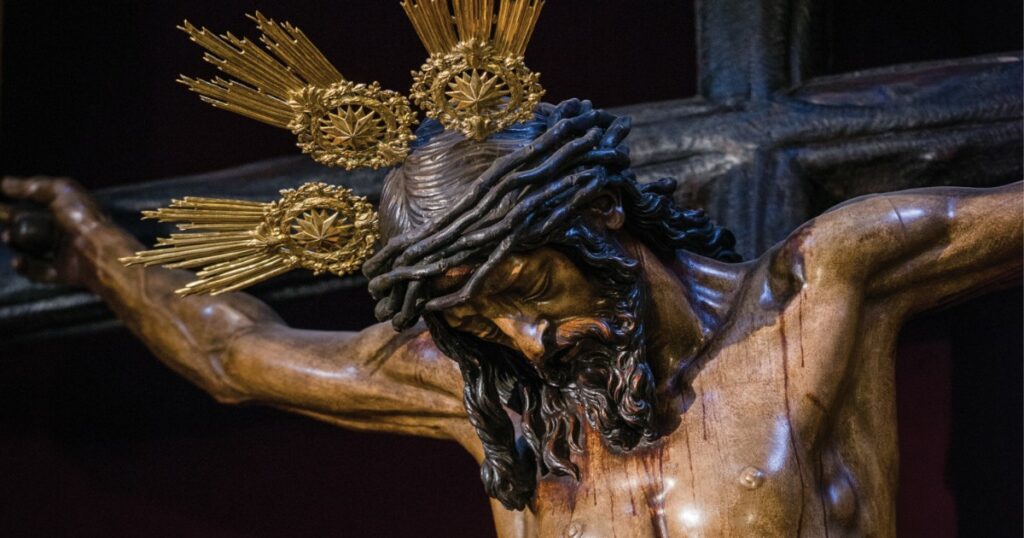
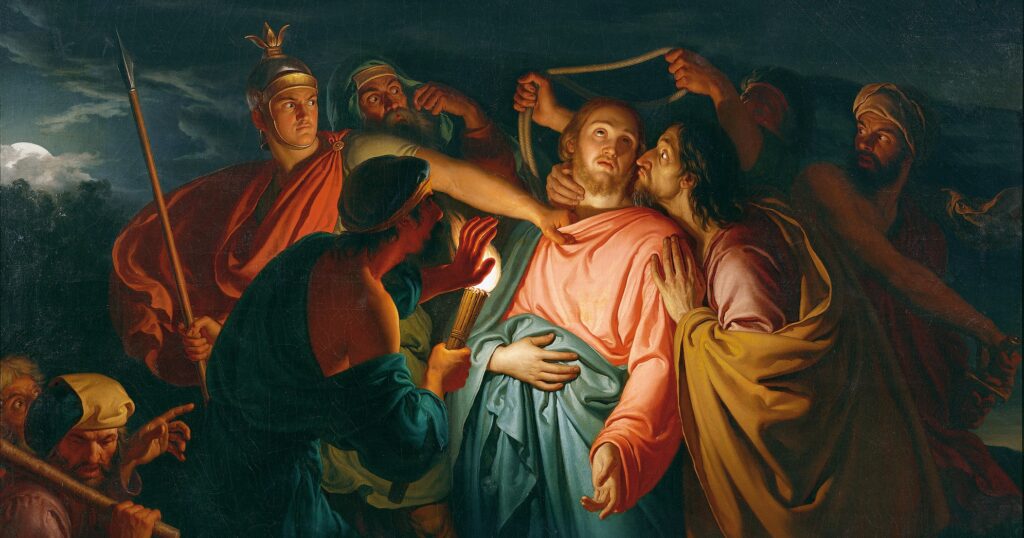
The rest of the apostles saw all of this unfold before their eyes as Judas betrayed Jesus with a kiss (Luke 22:47–48). Our Lord was arrested, scourged, mocked and crucified — the bitter fruit of the unfaithfulness of one of His apostles. Yet even as this was fulfilled, Jesus looked after His disciples (John 18:8–9; see John 17:12), and He remained determined to drink the cup that His heavenly Father had given Him (John 18:11). Thus, Psalm 41’s words were fulfilled in Jesus, who knew that David’s anguish foreshadowed His own agony on the cross compounded by Judas’ traitorous act.

This devotion originally appeared in the April 2025 issue of The Lutheran Witness.
Find the rest of LW‘s Holy Week devotion series here.