


I first met my wife some 45 years ago in German class. When I walked into the college classroom that day, I found an open seat next to a beautiful new transfer student named Kim. For me, it was love at first sight. For her, it was, “Hmm, he may have potential.” But when it came time to share a textbook and practice German dialogues for the next session, we naturally fell together as study partners.
We soon became more than study partners. As I began to court Kim over the next few months, I uncovered some delightful qualities about her. She was beautiful, intelligent and outgoing, with a kind and deeply empathic personality. She was a Missouri Synod “PK” (“pastor’s kid”) who had grown up on the mission field in Taiwan. Most interesting and intriguing to me, however, was her remarkable ability to recite hymns from The Lutheran Hymnal (TLH) from memory.
I don’t remember how we stumbled upon this gift of hers as we were getting to know each other, but I do remember that I could open up TLH to most any familiar hymn, read her the first line of any stanza from that hymn, and listen as she completed the remainder of the stanza and most of the rest of the hymn from memory. It’s not that Kim has a photographic memory; rather, the words of these hymns had become ingrained in her through much repetition — by singing them again and again in church and at home.
“Let the word of Christ dwell in you richly,” declared St. Paul, “… singing psalms and hymns and spiritual songs, with thankfulness in your hearts to God” (Col. 3:16). The New Testament church was full of song — from the psalms of the Old Testament, to the hymns and canticles of the New Testament (e.g., the Song of Mary, Luke 1:46–44; the Song of Simeon, Luke 2:29–32; etc.), to newly composed spiritual songs that sang of Christ. Through the songs that we sing even today, the Word of Christ comes to dwell in us richly.
Luther and Lutheran Hymnals
Martin Luther understood this as he set about reforming the worship of the church in his day, where congregational singing had become virtually nonexistent. Between 1523 and 1524, Luther tried his hand at writing hymns of all sorts (nearly two dozen) “so that God’s Word and Christian teaching might be instilled and planted in many ways,” as he wrote in his “Preface to the Wittenberg Hymnal.” Regarding Colossians 3:16, Luther noted in his 1525 sermon for Epiphany 5, “‘Spiritual songs’ … are those songs that one sings concerning God that do not appear in Scripture and that one can write even today. … So Paul wants our songs [today] to sound forth concerning spiritual things, which are able to teach us something or to admonish us, as he says here.” For Luther, the chief purpose of such newly composed hymns or “spiritual songs” was to proclaim the Gospel to the hearts and minds of those who sang and heard them. In other words, the hymns we sing proclaim the precious Gospel into our souls, offering comfort and forgiveness by the Word of Christ.
Luther’s two dozen hymns ignited a virtual “hymn explosion” in the Western Church, with thousands and thousands of hymns to follow. Those hymns were soon assembled into books of hymns called “hymnals.” The first Lutheran hymnal was called the Achtliederbuch — the “eight-hymn book,” which, as you might have guessed, contained eight hymns. (You have to start somewhere.) By the end of the 18th century, Lutheran hymnals came to include hundreds and hundreds of hymns, serving as rich resources of prayer and song for the believing heart.
The Advent of Lutheran Service Book
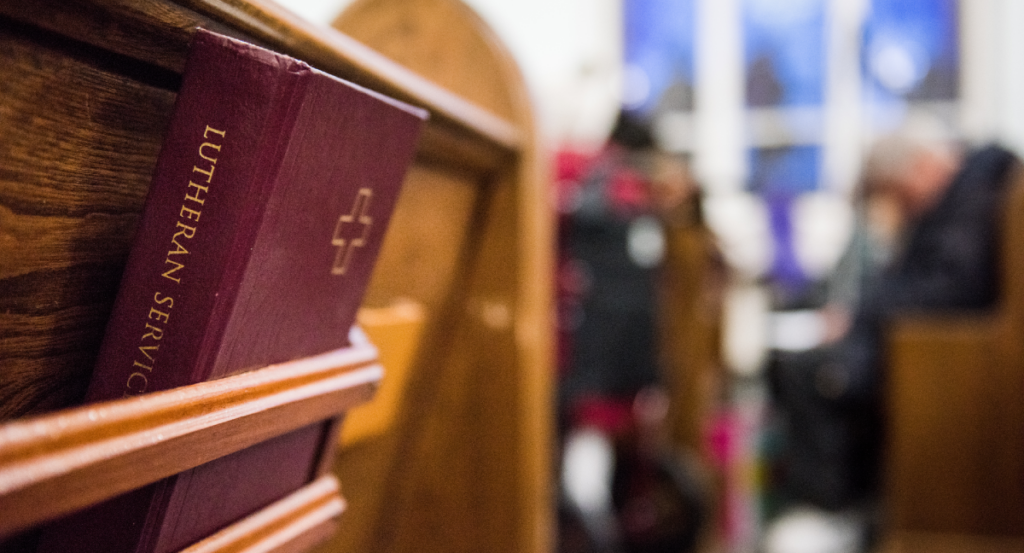
We in the LCMS are heirs of an astonishingly rich tradition: more than five centuries of Lutheran hymns and hymnals. The Missouri Synod’s first and only German-language hymnal was published just months after its founding in 1847. Since then, we have had four English-language hymnals and two supplements along the way. Our most recent hymnal, Lutheran Service Book (LSB), observed its 20th anniversary this past summer. More than 90% of LCMS congregations are currently using LSB as their primary worship resource.
Our congregations were not so united in their hymnal usage when we began the hymnal project that produced LSB. A survey taken in 1999 revealed that 58% of LCMS congregations were using Lutheran Worship (LW, 1982) as their primary hymnal, while nearly 36% of congregations were instead still using The Lutheran Hymnal (TLH, 1941) as their primary hymnal. It was clear to the Commission on Worship that it was time to begin working on a successor hymnal to LW that would bring the congregations of the Synod together around a single resource. In the summer of 1998, the Synod in convention concurred and “encouraged the Commission on Worship to begin the task of developing and testing materials … for a new hymnal” (1998 Res. 2-12).
The development of a new hymnal for a church body like the Missouri Synod invites its members to step back and reconsider with fresh eyes what happens on Sunday morning. During the period of formation and field testing for a new hymnal, pastors, musicians, church workers and lay persons alike are invited to examine anew the hymns we sing, the prayers we pray and the orders of service we follow — many of which we may simply take for granted each Sunday.
For those of us tasked with assembling LSB, perhaps the chief challenge was determining how best to wed the cherished hymns and services of TLH with those that had become beloved from LW. LW and TLH shared many hymns in common, but the texts in LW had, in many cases, been unnecessarily updated to eliminate the older “thees and thous” language. Thus, “My Faith Looks Up to Thee” became “My Faith Looks Up to You” in LW. The committees that worked on LSB resolved to return many of these texts to their original wording — instead of updating, to “downdate” (as they called it) back to the older language. This included such hymns as: “My Faith Looks Up to Thee” (LSB 702), “I Am Trusting Thee, Lord Jesus” (LSB 729) and “We Give Thee But Thine Own (LSB 781). Such “downdating” was received well by TLH congregations and eventually encouraged many of them to adopt LSB as their new hymnal.
There were also a number of newer hymns in LW that had not appeared in TLH — among them, “Lift High the Cross” (LSB 837), “Christ Be My Leader” (LSB 861) and “My Song Is Love Unknown” (LSB 430). Some of these hymns were already being sung by many TLH congregations, albeit on photocopies with complicated copyright permissions not easily acquired. The publication of Hymnal Supplement 98 toward the beginning of the LSB project introduced the Missouri Synod to a number of hymns new to our tradition which have since become much beloved, including “Christ Has Arisen, Alleluia” (LSB 466), “Go, My Children, with My Blessing” (LSB 922), “God’s Own Child, I Gladly Say It” (LSB 594) and “What Is This Bread” (LSB 629). And then LSB itself brought forward a number of new hymns now treasured in our churches, including “We Praise You and Acknowledge You, O God” (LSB 941), “Water, Blood, and Spirit Crying” (LSB 597), “All Christians Who Have Been Baptized” (LSB 596) and “Father Welcomes” (LSB 605).
Through all of these hymns — old and new — the Word of Christ comes to dwell in us richly as we sing them, teaching and admonishing one another, with gratitude in our hearts to God (Col. 3:16). They are the songs that accompany us from cradle to grave, through sorrow and suffering, to joy and exaltation.
In the End
Kim isn’t the only Lutheran who has found comfort for her soul in the rich heritage of Lutheran hymnody. Our dear friend, Maggie Karner, beloved LCMS Life and Health Ministries director, had a beautiful voice and loved to sing hymns. In 2014, Maggie had just been diagnosed with an aggressive form of brain cancer.
At the midweek Lenten service that evening, we sang a beloved evening hymn from LSB, and after the service, Kim texted Maggie:
“Just sang a nighttime hymn — 880 … Praying for you and love you, Mags.”
“What hymn is 880?” Maggie wrote. “I might know the verse. Listening to good hymns on my phone.”
“It’s ‘Now Rest beneath Night’s Shadow,’” Kim replied. “I thought of you, and I got choked up and couldn’t sing stanza 4, when the organist dropped out and the congregation sang it a cappella.”
“I LOVE that one! My mom used to sing it to me at bedtime! Sounds beautiful. Wish I coulda been there.”
After choir rehearsal that evening, Kim texted again: “I hope this doesn’t wake you up. We just finished rehearsal and had a nice prayer for you in choir tonight. Here’s the hymn verse I wanted to send earlier. Sleep well!”
Lord Jesus, since You love me,
Now spread Your wings above me
And shield me from alarm.
Though Satan would devour me,
Let angel guards sing o’er me:
This child of God shall meet no harm.
(LSB 880:4)
Over the next year and a half, the ups and downs of Maggie’s diagnosis drew everyone who knew her and loved her closer to the Lord and to one another. At Maggie’s funeral we sang another hymn she knew and loved:
Life eternal! Heav’n rejoices:
Jesus lives who once was dead.
Shout with joy, O deathless voices!
Child of God, lift up your head!
Life eternal! Oh, what wonders
Crowd on faith; what joy unknown,
When, amid earth’s closing thunders,
Saints shall stand before the throne!
(LSB 671:3)
By God’s grace, Maggie is still singing hymns, even now. At least, that’s the picture we get from the Revelation to St. John — that great multitude from every nation and every language, crying out with a loud voice: “Salvation belongs to our God who sits on the throne, and to the Lamb!” (Rev. 7:10). They’re singing hymns to the Lamb! And that’s the one thing you and I are doing here on earth that you can be sure we will be doing forever in “the life of the world to come.”
This article originally appeared in print in the September 2026 issue of The Lutheran Witness.
Cover image: LCMS Communications/Erik M. Lunsford


It was not mentioned that our hymnal also contains some “non-Lutheran” hymns including some Spirituals.
RE: “[T]he hymns we sing proclaim the precious Gospel into our souls, offering comfort and forgiveness by the Word of Christ.”
Moreover, many of our hymns joyfully address God himself, acknowledging and celebrating his divine goodness and marvelous work! Perhaps one of the most compelling reasons we have to sing hymns of praise to God is simply because he is altogether and always worthy of our praises! His great glory is in his great love, and we have ample reason to praise him because of what he, out of his great love, has already revealed to us and achieved for us:
“In [Christ] we have redemption through his blood, the forgiveness of our trespasses, according to the riches of his grace, which he lavished upon us, in all wisdom and insight … to the praise of his glory” (Eph. 1:7-14 ESV)!
We have redemption, and “our citizenship is in heaven” (Phil. 3:20). That is here and now and ongoing. So, “I will bless the Lord at all times; his praise shall continually be in my mouth” (Ps. 34:1)!