

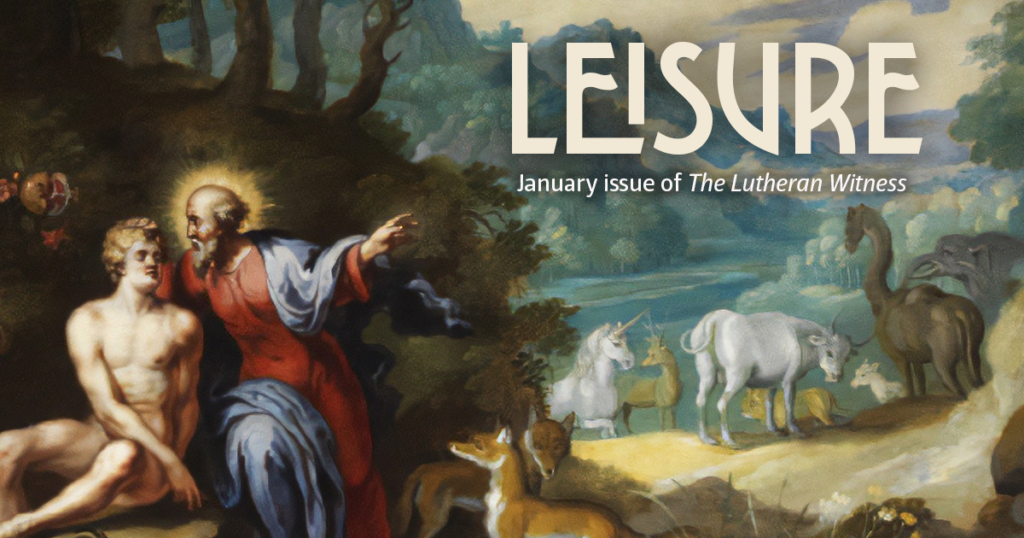
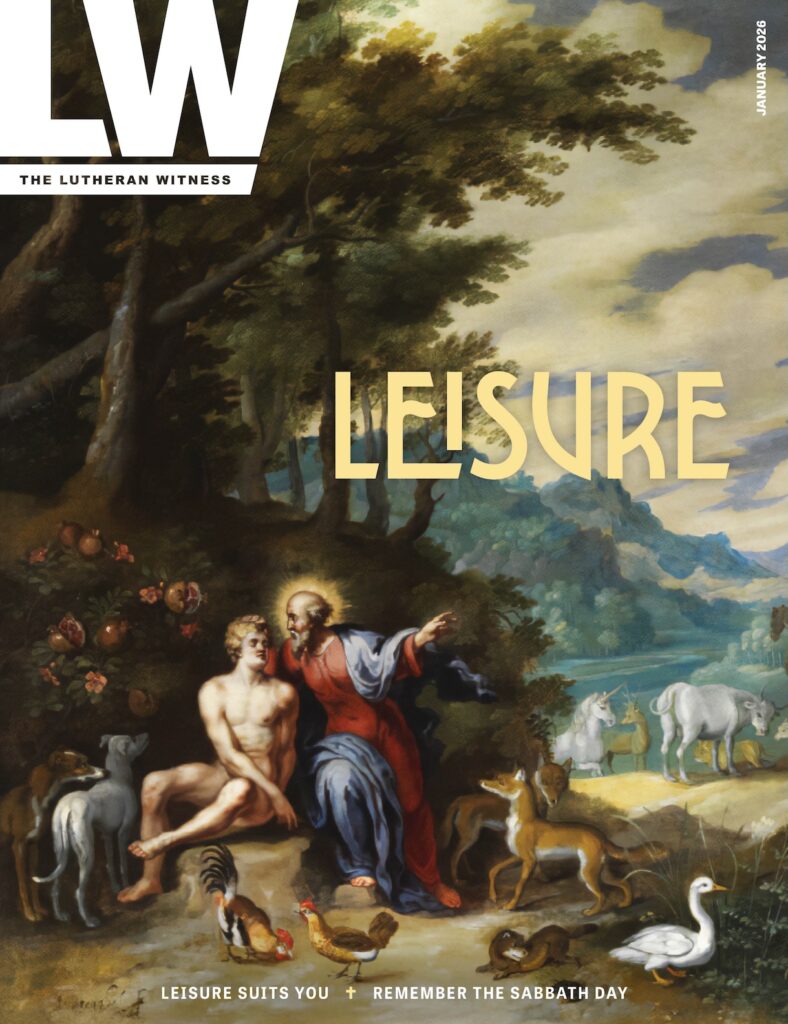
The January issue explores Christian leisure, the Sabbath and the Third Commandment.
- From the President: ‘Abounding in the Work of the Lord’: Looking Forward
- Life in the Church Year: Leisure in Our Lord: Twelfth Night Feast
Features:
- Leisure Suits You: Learning to celebrate what God gives — Joel Biermann
- Rest for Our Labors, Rest from Our Screens?: Evaluating the “digital Sabbath” trend — Joshua Pauling
- Remember the Sabbath Day: A reflection on the Third Commandment — Daniel Grimmer
- Hands, Channels and Means: Leisure and love of neighbor — Jason Dulworth
Departments:
- Snippets: News from around the LCMS and the world
- Commonplaces
- The Contemporary World: The Right to Die or the Right to Kill?
- The Road to Convention: Why ‘Synod’?
- Searching Scripture: Following the Formula: Article I: Original Sin
From the editor:
“Come unto Me, all who labor and are heavy laden, and I will give you rest. Take My yoke upon you, and learn from Me, for I am gentle and lowly in heart, and you will find rest for your souls. For My yoke is easy, and My burden is light,” says our Lord (Matt. 11:28–30).
Our culture understands life as centered around the self: self-fulfillment, self-actualization, self-love. We are encouraged to build our whole lives around ourselves, to “protect our peace” even at the cost of family and friends. It might seem that a whole culture full of people seeking rest for themselves in the most prosperous and affluent society in human history might be able to find it. But counterintuitively, people report ever-rising levels of anxiety, stress and depression.
For Christians, this counterintuitive reality should come as no surprise. Our God’s commands are not arbitrary — He commands those things that are good for us. And His command is that we should build our lives primarily around love for Him and for one another. “You shall love the Lord your God with all your heart and with all your soul and with all your mind. … [And] you shall love your neighbor as yourself” (Matt. 22:37–39). “For the commandments … are summed up in this word: ‘You shall love your neighbor as yourself.’ … Put on the Lord Jesus Christ, and make no provision for the flesh” (Rom. 13:9, 14).
In this area as in so many others, our culture is “finding out the hard way” the suffering that ensues from straying from God’s commands — turning from God and neighbor to self; from duty to preference; from a “restrictive” path by still waters to an aimless desert wandering.
In seeking our own pleasure above all else, we have lost a biblical sense of genuine leisure or rest. As Joel Biermann writes, true Christian leisure means “living in tune with the Creator and with the rest of creation. [It] is all about learning to celebrate what God gives, embracing the joy of being His creature in His world” (p. 10). This issue explores Christian leisure — that reveling in God and His creation, and in our status as His creatures, which frees us to serve our neighbor without weighing the cost, secure in that great peace that comes only when our will is conformed to God’s (p. 22). This issue also looks at the related topic of Sabbath rest and the Third Commandment (p. 16) and evaluates the recent trend of “digital Sabbaths,” or fasting from digital devices on Sundays (p. 11).
Looking for ways to practice Christian leisure this year? Consider inviting family and friends to a Twelfth Night feast on Jan. 5 (see p. 24). Throughout 2026, LW’s “Life in the Church Year” series by Kristen Einertson and Tessa Muench, which our readers greatly enjoyed throughout 2025, is being expanded to a two-page column. Check out this column each month in print and online for more ideas about how to live lives shaped by the church and its seasons.
We are also launching a new series this year, “The Contemporary World,” which will feature commentary on current events, books, movies and more. This month, read a reflection by Gene Veith on troubling legislation recently passed in Illinois (p. 15).
As you begin this new calendar year, may it be filled with the true peace of Christ, which passes human understanding (Phil. 4:7).
In His Peace,
Stacey Eising
Managing Editor, The Lutheran Witness