


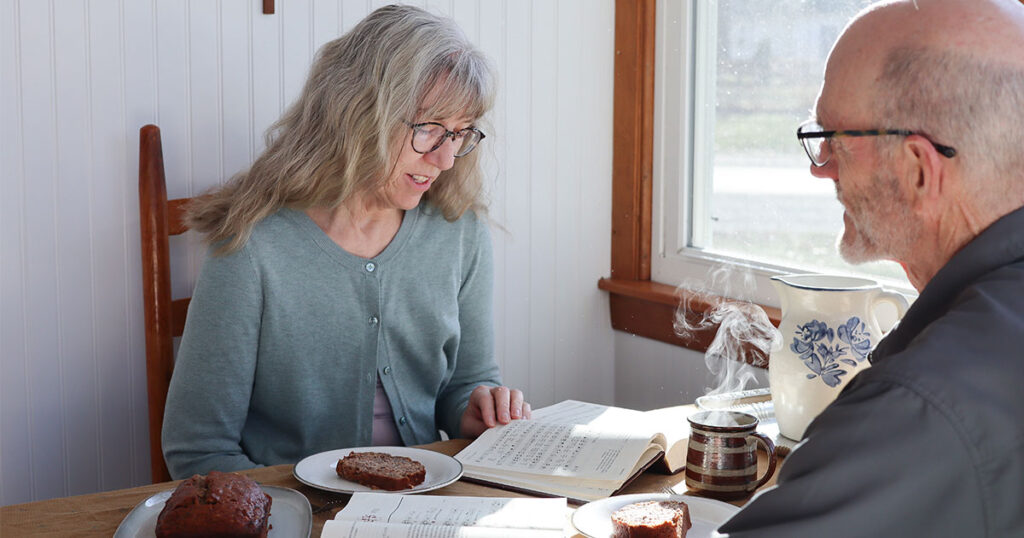
This is the latest installment of “Life in the Church Year,” a series by Dr. Kristen Einertson and Tessa Muench of All the Household. This series will provide guidance for living out the seasons of the Church Year at home with your families. Find month-by-month lists of Lutheran feasts, festivals and commemorations here.
This month, the church and her people continue their Lenten journey toward Christ and the cross. More than any other season of the Church Year, Lent places prayer at the center of Christian life, encouraging believers to renew their attention to God’s Word and to pursue habits that shape faith and vocation over time. Last month, we considered the importance of setting aside a dedicated place for prayer in the home. Yet even with the best intentions and a carefully prepared space, Christians may still wonder what to pray and how to order their prayer faithfully. This month we turn our attention to an especially fitting topic for this penitential season: the church’s gift of prayer itself, especially the devotional practices that Christians have inherited.
Our Inheritance of Prayer
As with so many wonderful aspects of the Christian life, we are blessed by the fact that we do not need to reinvent prayer. One of the church’s central tasks is to teach her people how to pray. Christ Himself gave us the Lord’s Prayer, which stands at the center of all Christian prayer and teaches us to how to “pray, praise, and give thanks.”
From this foundation, the church has, over time, handed down additional prayers drawn from Scripture, including not only brief collects but also complete prayer rites that give structure to regular, daily devotion. One familiar example is the Service of the Word within the Divine Service. Scripture readings, psalms, versicles and appointed prayers shaped by the season of the Church Year are arranged in a way that teaches the congregation both how to listen to God’s Word and how to respond.
What is often less recognized is that the church provides similar patterns for use beyond Sunday morning. Lutheran Service Book includes several daily prayer offices — such as Morning Prayer, Evening Prayer, Matins and Vespers — that mirror this same structure on a smaller scale. These are designed for regular use in the home and support the vocation of the Christian layperson by removing the burden of deciding what to say or how to say it. During Lent, prayers such as the Litany may be incorporated into this daily rhythm as well, giving voice to the church’s penitence and dependence on God’s mercy.
The Daily Office
Further, the church’s prayers are a gift not only because they provide words but also because they shape time itself. From the earliest days of the church, Christians have recognized that certain hours of the day are fitting times for prayer, echoing the psalmist’s confession (Psalm 55:17). Martin Luther reflects this rhythm in his catechism, teaching Christians to begin and end each day in prayer while remembering their Baptism. Long before him, the church developed this pattern in what is known as the Daily Office or the canonical hours — a cycle of prayer that marks certain “hours” of the day with Scripture and petition.
While Christian households today may not observe all seven traditional hours of prayer associated with this pattern, the principle remains important: Time itself is ordered toward God. By praying at set moments, Christians learn to receive each portion of the day as a gift from Him.
Lenten Prayer and the Forty Martyrs of Sebaste
Most centrally, regular prayer keeps us mindful of Christ’s promises. Through the Church Year and its commemorations, Christians are given concrete examples of faithfulness that bear witness to God’s sustaining grace across generations. Especially during Lent, these remembrances invite reflection on suffering, perseverance and the cost of discipleship.
One such commemoration that aptly falls during Lent is that of the Forty Martyrs of Sebaste, traditionally remembered on March 9. These soldiers, martyred in the early fourth century for refusing to renounce their Christian confession, endured exposure to freezing conditions rather than abandon their faith. This commemoration gives us a concrete example of a time and place where our Lord’s promises were kept and in which strong faith in Christ — that same faith for which we pray in this Lenten season — was given to others.
Remembering such stories in our prayers can help us recognize that a life of faith is not lived in isolation, expanding our appreciation of the ways that God has worked through His people in our lives and throughout history. For younger Christians, tangible practices that accompany these prayers can help the lessons take root. One such practice associated with the Forty Martyrs is baking simple rolls shaped like skylark birds. The image recalls the martyrs’ steadfastness and our hope that we, too, will one day soar upwards to heaven to be with Christ.
When paired with prayer, practices like these serve a catechetical purpose. They help connect the church’s calendar and our prayer lives to ordinary experiences of daily life, reinforcing that Christian faith is sustained through steady attention to God’s Word and prayer. By receiving the prayers handed down by the church, ordering our days and seasons around these petitions, and remembering those who have gone before us in the faith, we can more deeply live out our Christian vocation and embrace the opportunities that the penitential season of Lent provides us to grow in our faith.
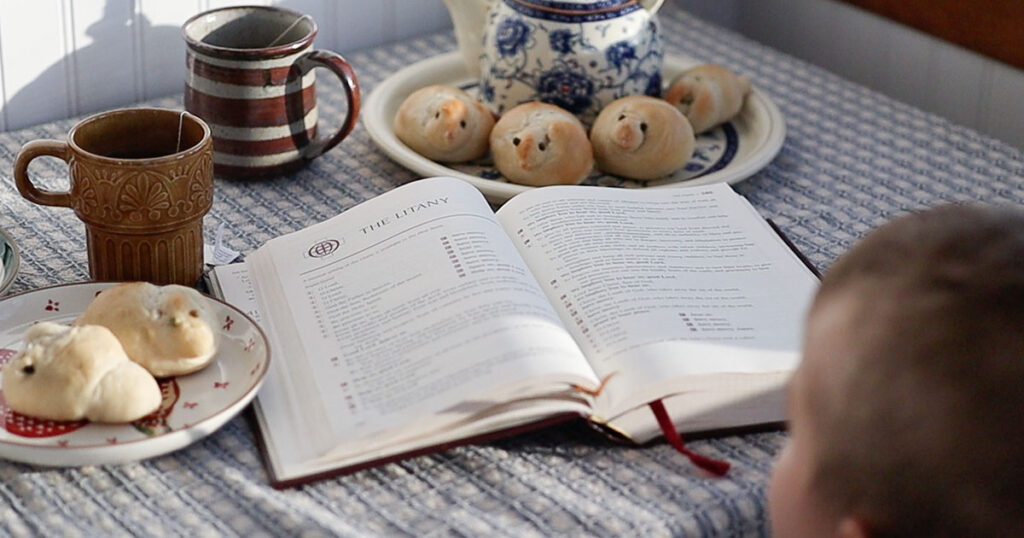
Forty Martyrs of Sebaste Skylark Rolls
Ingredients:
- 2 cups warm water
- 2 tsp. active dry yeast
- ⅓ cup olive oil
- ⅓ cup honey
- 2 teaspoons salt
- 4½–5 cups all-purpose flour
- 80 peppercorns or raisins
- 1 egg
- 1 Tbsp. water
Instructions:
- In the bowl of a stand mixer fitted with a dough hook, combine the warm water, yeast, olive oil, honey and salt. Mix briefly to combine.
- Add the first 2 cups of flour and mix on low speed. Continue adding flour, about ¼ cup at a time, until the dough becomes tacky and begins to pull away from the sides of the bowl.
- Turn the dough out onto a lightly floured surface and knead briefly until smooth. Place the dough in a greased bowl, cover, and let rise until doubled in size, about 1 hour.
- Once risen, divide the dough into 4 equal portions. Divide each portion into 10 small pieces to make 40 total pieces.
- Roll each piece into a short rope. Twist into a simple knot, pinching one end to form the beak and flattening the opposite end to form the tail. Press two peppercorns or raisins into each roll for eyes. Place the shaped rolls on a parchment-lined baking sheet, cover lightly, and let rise for 20 minutes. Meanwhile, preheat the oven to 350°F.
- Whisk together the egg and 1 Tbsp. water to make an egg wash. Brush each roll lightly with the egg wash.
- Bake for 18–25 minutes or until golden brown. If desired, brush lightly with butter while warm. Enjoy fresh!
Cover image: Tessa Muench
RE: “[W]e are blessed by the fact that we do not need to reinvent prayer.”
Certainly many of us have also been blessed by praying extemporaneously with family members and friends about the particular people we love or about wider matters of concern, or at church about the particular decisions at hand at the beginning of a leadership meeting.
In my small group Bible study, it is a joy to routinely close with a time of extemporaneous prayer. The prayer of one brother or sister may sound confident and eloquent; the prayer of another may sound awkward and simple. No matter. As we each take a moment to unclasp our hearts to God — conveying a request or an expression of thanks in our own words within one another’s hearing — trust and understanding grow and gratitude for our fellowship in the Lord increases.
Printed prayer materials can certainly be useful and often are. But also, “[t]he word is near you, in your mouth and in your heart” (Romans 10:8). And whether our speech is fluid or halting, the Spirit intercedes on our behalf in ways that none of us is able to express (Romans 8:26-27).