

By Christopher Maronde
In the beginning, there was no city, only a Garden. This is not to say anything against cities — yet the soil, growing things and the abundance of the fruits of the earth are foundational, essential, in a way that bricks and mortar perhaps are not. The original occupation was gardener: The man was to tend the earth, to steward it, as God’s image and likeness and as His representative. What could there be to do in a perfect garden, where there were no weeds, no predators, no competition for resources? It is hard for those who work the earth after the fall to comprehend. But there was work, there were tasks, there was gardening, and it was very good, not laborious at all.
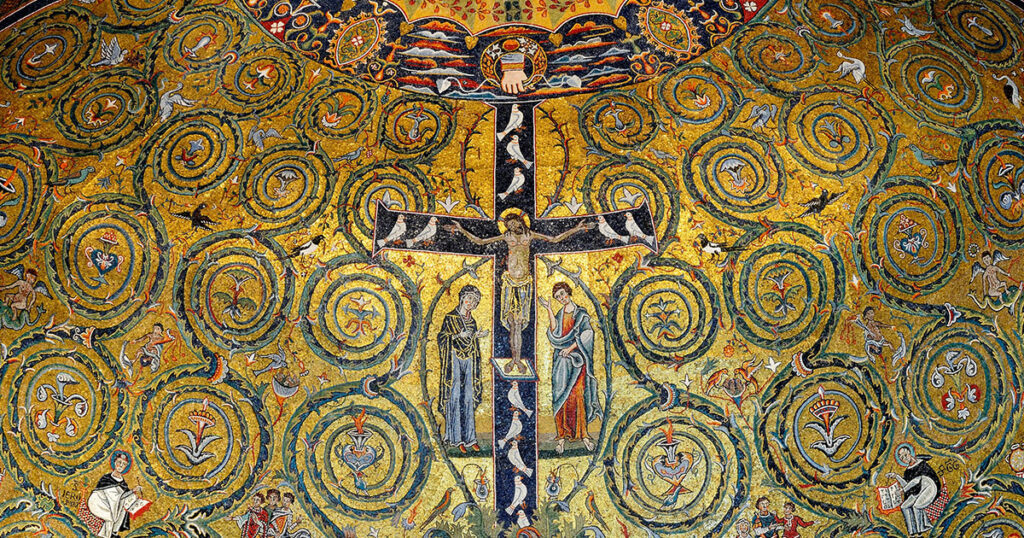
The Tree of Life stood in the midst of the Garden, a testament to God’s rich abundance, a witness that all of creation was for the life of His beloved creatures, and every plant, every green tree gave of its abundance willingly, freely, without labor or cost. But the Tree of the Knowledge of Good and Evil also stood in that Garden, and in eating of its fruit, the man and the woman plunged all of creation into sin and death. We were cast out, access to the Tree of Life denied by the flaming sword of the cherub, and the rest of history is the story of man’s quest for a return to the Garden.
But man cannot return to the Garden on his own; the way is shut, and none can pass that deadly sword. Only God can open that path. And so God Himself promised that the corruption that fills the earth would be overcome by the woman’s Seed, that this Seed would lead us back into the Garden (Gen. 3:15). But the journey will not be easy. God’s chosen, beloved people set the pattern. They were brought forth from slavery in Egypt and promised a land of abundance, a picture of the Garden still denied them, flowing with milk and honey; but first they had to pass through the wilderness. Then followed 40 years of privation, for the land did not yield up its fruit willingly or easily, and only through God’s miraculous provision were His people fed and watered. Their journey, a 40-year slice of history, was a picture of humanity’s exile and return, the sojourn of mankind in the wilderness. But the God who sets a table in the desert is leading all people back to the Garden from whence they came.
Isaiah is the preacher of the Garden, the “ecological prophet.” While we find in his prophecies many metaphors to describe the coming salvation of our God, including the restored city on Mount Zion, his favorite is that of a creation renewed, the return of the Garden. His Spirit-inspired words give us a vision of streams in the desert, of blooming abundance in the wilderness (Isaiah 35:7; 41:18; 43:19). And the same imagery is employed to show us the Messiah, the One appointed to lead us back to the Garden. God’s chosen agent of deliverance is described as a growing plant, first the Branch from the stump of Jesse (Isaiah 11:1; Jer. 33:15) and then also as Jesse’s Root (Isaiah 11:10). The two natures of the woman’s Seed are here shown in the imagery of natural growth: He who is the source of Jesse’s line is also of his offspring, true God and true man. This Root and Branch of David, the Savior of the world described as a growing plant, would be the One to lead us back to the Garden. How would He do this? Isaiah, again, preaches the answer: suffering and death. He grew up like a young plant, like a root out of dry ground, but He had no form, majesty or beauty that we should look at Him (Isaiah 53:2), and He would be pierced for our transgressions, crushed for our iniquities (Isaiah 53:5). The Root and Branch would bring us back to the Garden by giving Himself up into suffering and death.
Even Ezekiel, whose climactic vision of the new heavens and the new earth is of a city and a temple, has his own “ecological” moment: From the threshold of the new temple, there flows a river, and it makes its way through the blessed city, traveling even into the wilderness (Ezek. 47:1–12). Here, in an image we would expect to find in Isaiah, the waters flow even into the Dead Sea and transform it, making it sweet and full of life. What more beautiful picture of God’s coming salvation can we have than the Dead Sea no longer “dead” but filled with plants and animals?
When the Son of God, the Root and Branch of Jesse, took on flesh and walked this earth, He told stories, He used metaphors and similes. Many, but certainly not all, were from the earth — imagery of growing things, of planting and harvesting. Some would say that this simply reflects the more primitive, agricultural society of which He was a part. Fair enough. But there is a deeper reason for this imagery. The kingdom of heaven can be described as a garden because it literally is a garden, a return to the Garden — not the same literal Garden, of course, but a new Garden, the Garden renewed and restored. The kingdom grows unexpectedly, like a tiny mustard seed emerging as the greatest tree in the garden (Luke 13:19). It grows without man’s aid, as he sleeps, growing through God’s work alone (Mark 4:26–27). God’s people can be described as a garden, or a field, or a vineyard, for the Garden was their first home, and it will be their final home, the eternal Promised Land to which the Root and Branch of Jesse is leading them. Therefore, the call of the Gospel is pictured as summoning workers to a vineyard (Matt. 20:1–16), and the abuse of corrupt religious leaders as disobedient farm tenants (Mark 12:1–11; see also Isaiah 5:1–7). The Word of God, proclaimed throughout the world, is a seed, and it brings forth a harvest when and where He pleases (Matt. 13:3–9).
Just as He is the Good Shepherd and the Lamb of God, so Jesus is the Sower and the Branch. He is both gardener and plant. The same Jesus who casts seed into the world, anticipating a harvest, will also describe Himself as the Vine to which all of His beloved are connected, drawing life from His root and His branch (John 15:1–7). He carries this image of Himself as a plant, as Isaiah did, to His own sacrifice. Jesus wants us to see death and resurrection, His death and resurrection, in every dried and “dead” seed that is cast into the ground, bringing forth new life as a green plant pushes toward the sun (John 12:24). Yes, indeed, the One who is both the Root and the Shoot of Jesse, who stands before and after David, rises from His grave as a triumphant flower comes up from the ground, the firstfruits of them that have fallen asleep. We, too, who are planted into the ground when our sojourn in the wilderness is over, will one day rise up, a blessed garden in His sight forever.
In the beginning, there was no city, only a Garden. In the end, there will be a garden in the City. The two great pictures of eternity given in the Scriptures, the restored Garden and the beautiful City, are brought together as one in Revelation’s triumphant vision (Rev. 22:1–5). The Root and Branch of Jesse has led His people back into the Garden; the cherub’s flaming sword has been put away. The tower of Babel was man’s attempt to build a city, bereft of garden, that reached to heaven; the New Jerusalem will be God’s city, with the Garden at its heart, where He dwells with man. The Tree of Life, denied to sinful man since the fall, will then be given freely to all the faithful; it stands in the midst of the city, and its leaves are for the healing of the nations. There we find also Ezekiel’s river, flowing from the throne of God. No more thorns, no more thistles, no more sin, no more death. The garden in the midst of the City is where God dwells with His people, who themselves were planted in the ground and came forth as beautiful flowers. The mustard seed has grown into a mighty tree, and we will dwell under its branches forever.
This article originally appeared in print in the April 2026 issue of The Lutheran Witness.