
By Andrew Steinmann
Read Isaiah 53 and John 12:20–50.
The Gospels are filled with miracles our Lord performed. He healed the sick, gave sight to the blind, fed the masses with only a few loaves and fishes, and even raised the dead to life. With all this evidence pointing to Jesus’ identity as the promised Savior, we would expect that the entire crowd who surrounded Jesus following His triumphal entry into Jerusalem would have believed in Him.
However, John tells us this was not the case. Instead, John points out that Isaiah had prophesied that many would not believe. In Isaiah 53:1 the prophet began one of his most well-known prophecies about the Messiah with these words: “Who has believed what he has heard from us? And to whom has the arm of the Lord been revealed?” These questions lead into a description of the Messiah as having “no form or majesty that we should look at Him, and no beauty that we should desire Him. He was despised and rejected by men, a man of sorrows and acquainted with grief; and as one from whom men hide their faces He was despised, and we esteemed Him not” (Isaiah 53:2–3). Yet, despite His own people rejecting Him, Isaiah saw that Jesus would nevertheless fulfill His mission as Savior: “Surely He has borne our griefs and carried our sorrows; yet we esteemed Him stricken, smitten by God, and afflicted. But He was pierced for our transgressions; He was crushed for our iniquities; upon Him was the chastisement that brought us peace, and with His wounds we are healed” (Isaiah 53:4–5).
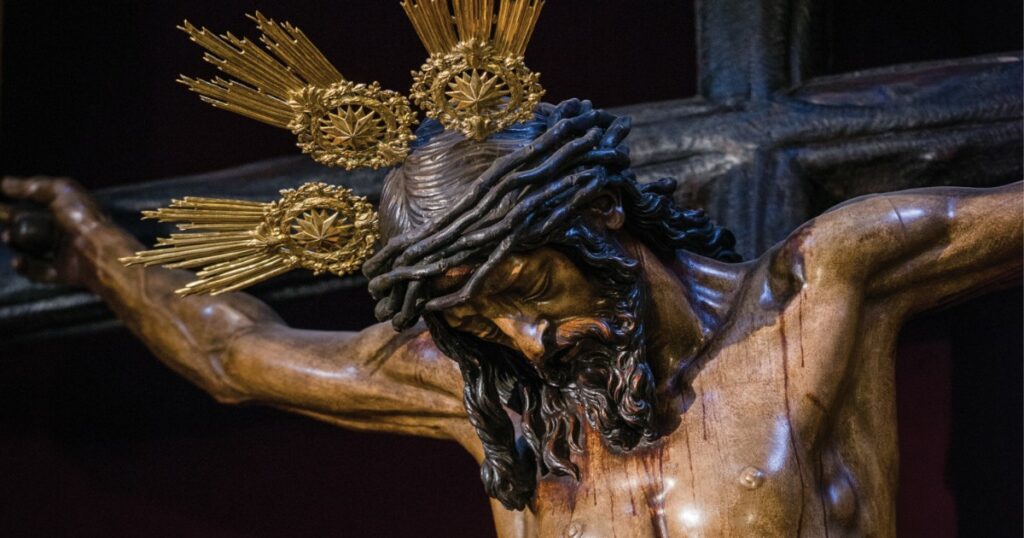
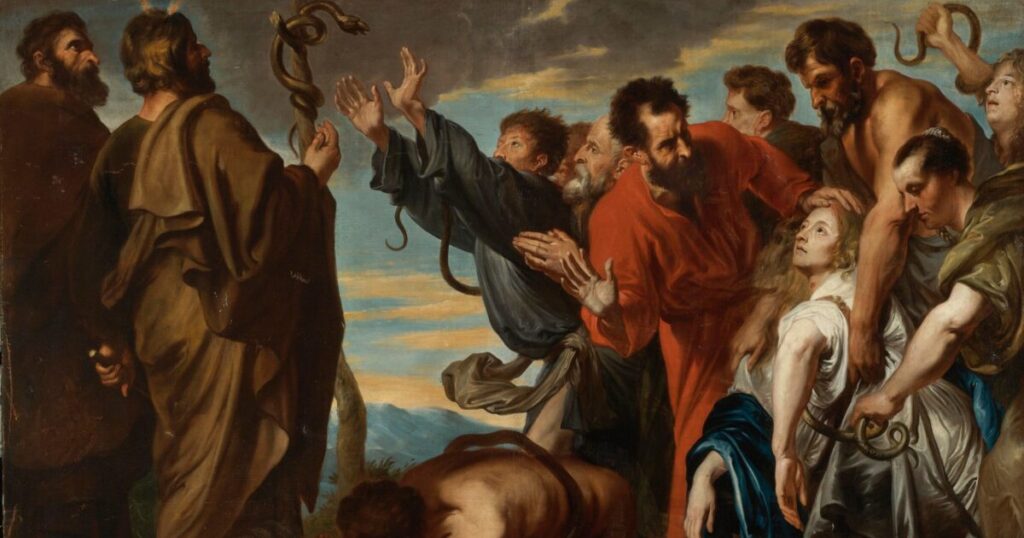
Jesus told the crowd He would accomplish His mission: “And I, when I am lifted up from the earth, will draw all people to Myself” (John 12:32). Of course, Jesus was referring to His imminent crucifixion where He would be lifted up on the cross. He had mentioned this at the beginning of His ministry when He told Nicodemus, “And as Moses lifted up the serpent in the wilderness, so must the Son of Man be lifted up, that whoever believes in Him may have eternal life” (John 3:14–15). Isaiah was not the only one to prophesy about the Messiah’s death — Moses also prefigured it when he made a bronze serpent in the desert so that those who were bitten by venomous snakes could look to it and live (Num. 21:5–9).
Many in the crowd, however, refused to believe that Jesus could be the Savior. They most likely understood that Jesus was prophesying His death. They rejected Him on this basis, citing the Scriptures that the Messiah would have an eternal kingdom: “So the crowd answered Him, ‘We have heard from the Law that the Christ remains forever. How can you say that the Son of Man must be lifted up?’” (John 12:34; see Psalm 89:36–37; 110:4; Isaiah 9:7; Ezek. 37:25; Dan. 7:14). However, they did not understand what Isaiah saw — that the Messiah would establish His everlasting kingdom through His suffering and death. As the prophet had proclaimed, “It was the will of the Lord to crush Him; He has put Him to grief; when His soul makes an offering for guilt, He shall see His offspring; He shall prolong His days; the will of the Lord shall prosper in His hand” (Isaiah 53:10).
Jesus gave the crowd every reason to believe in Him — not only with His miracles but also in His proclamation of God’s Word. He pointed them to the declarations of the prophets who preceded Him, which He would go on to fulfill in only a few days in His death and with His resurrection.

This devotion originally appeared in the April 2025 issue of The Lutheran Witness.
Find the rest of LW‘s Holy Week devotion series here.