



In 1891, Pope Leo XIII issued an encyclical on the industrial revolution. In 2026, his namesake, Pope Leo XIV, issued an encyclical on the AI revolution. Unfortunately, AI is more of a revolution than the American-born pontiff seems to realize.
The title of papal encyclicals comes from their first words: Magnifica humanitas is Latin for “magnificent humanity” — “the grandeur of humanity.” Indeed, the encyclical has more to say about humanity than about what artificial intelligence might do to humanity.
The document is, of course, very Catholic. It speaks much of “the Gospel” in ways that will puzzle Lutheran Christians. For example, “The Gospel remains relevant because it provides the criteria for recognizing what humanizes or dehumanizes and what liberates or oppresses in ever-changing situations” (par. 36). This is clearly not referring to the Gospel of the forgiveness of sins through the atoning work of Jesus Christ. Rather, this is the gospel according to the Catechism of the Catholic Church: “The New Law or the Law of the Gospel is the perfection here on earth of the divine law, natural and revealed. It is the work of Christ and is expressed particularly in the Sermon on the Mount” (par. 1965). Thus, Leo’s emphasis throughout is on attaining “perfection here on earth,” rather than personal salvation or spiritual growth.
Before addressing AI, Leo begins with two long chapters on the development of Catholic social doctrine, explaining concepts like equal dignity, human rights, the common good, the “universal destination of goods,” subsidiarity, solidarity and social justice. These familiar ideas are updated somewhat with contemporary progressive terminology around diversity, power, the environment, colonialism and marginalized people groups.
The pope is clearly trying to apply the insights of his namesake and of the Catholic tradition to the new challenges of AI, but that does not always work. For example, he says, “To speak of the universal destination of goods means finding ways of ensuring universal access to both technologies and the education needed to use them” (par. 109). But the problem is not getting access to AI, but that the technology is becoming ubiquitous! The problem is not educating people about how to use AI, but that AI is replacing education!
The pope worries that the rich will use AI to exploit workers. That was a concern of the 1891 encyclical. Under industrialism, workers were replaced by machines. But AI is now threatening to replace the professional class (lawyers, doctors, journalists, administrators, teachers, coders, etc.). Some pundits project that under AI, manual laborers may have the only job security. The pope treats AI like any other product of the industrial revolution. But forcing the industrialized model addressed by Leo XIII onto this postindustrial technology prevents Leo XIV from fully engaging with many of the specific challenges that the new technology poses.
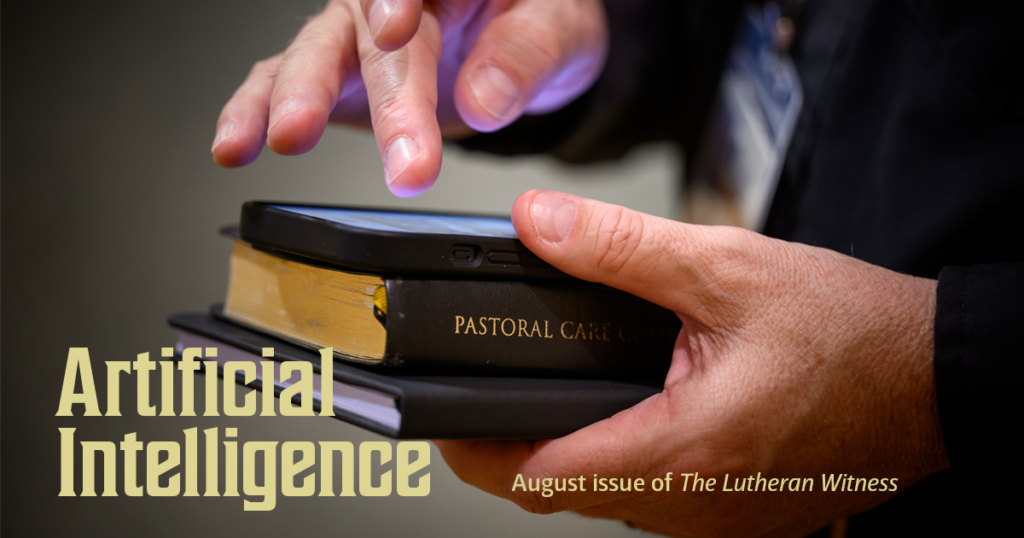
The pope gives no guidance about AI issues that churches are already struggling with: AI-written sermons, AI chatbots giving pastoral counseling, AI-written prayers and liturgies, and other technological usurpations of the pastoral office. Nor does he address the bigger issues that may be looming in the future: AI that removes the need for anyone to work; AI that destroys the human race; AI that comes to be functionally worshiped as an omnipotent, super-intelligent deity.
The biggest danger that emerges from the document is what AI might do to our sense of what it means to be human. Here the pope is perceptive. He stresses that personhood is more than “intelligence”; that instead of trying to be more than human, we should accept “the limits and weakness of humanity without considering them an error to be corrected” (par. 12); and that ordinary human work is connected to God — a point that sounds almost Lutheran.
Cover image: Getty Images
The Pope failed to address every issue that arises from AI. Moreover he addresses the issue from a Catholic rather than a Lutheran perspective. The horror!
As a Catholic in a mixed marriage, I do not understand the Lutheran obsession with the pope. So many sermons and writings are negative toward the Catholic Church without being prompted. Besides the misunderstandings of the Catholic Church, this writer also seems to not understand AI. AI is here and humanity must learn how to adapt and handle its usage, including the education of it. Very disappointed in this article and its unnecessary attacks on the Catholic Church.
I will be glad to join in the criticism of other church bodies and their leaders just as soon as my own church body (the LCMS) is purged of all its faults. However correct we may be in seeing errors in the doctrine and thinking of others who have also been baptized in the Lord, if we are motivated by an eagerness to find fault we commit errors of the heart by our pride and combativeness.
Let the representative of the church that is without sin hurl the next brickbat (John 8:7).