


A literary reflection by Joshua Pauling on E.M. Forster's "The Machine Stops."
This is one installment of a monthly series providing reflections on works of literature from a Lutheran perspective.
In 1909, English author E.M. Forster penned a short story entitled “The Machine Stops.”[1] In it, he envisions a future in which human beings can no longer live on the surface of the earth but instead live underground within a machine network that provides air, food, water, entertainment, and every other need or want at the push of a button.
Forster’s only futuristic work is very different from his better-known novels like A Room with a View (1908) and Howards End (1910). Industrialization and urbanization, together with the massive social and technological changes that accompany them, form the background of all his writing. Yet somehow, in this prophetic tale, Forster had the capacity to envision something even more pervasive, more consuming, more enveloping — something he called “the Machine.”
The people in Forster’s story have come to hate in-person presence and touch while enjoying the illusion of community through a vast, interconnected web of gramophones. Through this web, they have become addicted to receiving and transmitting information, including proto-social media posts called “ideas.” They even enjoy a type of AI, listening to lectures on the sea that are “compiled out of other lectures that had already been delivered on the same subject.”
What Forster keenly perceived sooner than most was how the machine age was already changing us — our relationships, our religion, our reality, even our bodies.
Adoration: “You Are Beginning to Worship the Machine”
The story’s plot circles around Vashti and her son Kuno, who live on opposite sides of the earth. Kuno wants his mother to visit him, but Vashti wonders why a trip is necessary. Addicted to the web of gramophones, she worries that she might miss something if she leaves her room. Kuno responds, “I want to see you not through the Machine.” Vashti scolds him: “Oh hush! …You mustn’t say anything against the Machine,” to which Kuno retorts, “You talk as if a god had made the Machine.”
Kuno’s words strike Vashti’s heart for a moment, but she is quickly pulled back into the lull of the Machine through rituals of adoration: “She generated the light, and the sight of her room, flooded with radiance and studded with electric buttons, revived her.” By returning to these “spiritual” practices, she avoids dealing with Kuno’s convicting challenge.
Later that night, again bothered by Kuno’s words, she engages in another ritual to the Machine. She consults her only remaining book: the “Book of the Machine,” which contains “instructions against every contingency. If she was hot or cold or dyspeptic or at a loss for a word, she went to the book, and it told her which button to press.”
“She took it reverently in her hands,” Forster writes, and “half ashamed, half joyful, she murmured ‘O Machine! O Machine!’ and raised the volume to her lips. Thrice she kissed it, thrice inclined her head, thrice she felt the delirium of acquiescence.” These liturgical acts bring her a sense of religious joy: “the strange feeling of peace that came over them when they handled the Book of the Machine … the ecstasy of touching a button, however unimportant, or of ringing an electric bell, however superfluously.”
Kuno eventually prevails upon Vashti to make the trip, and as Kuno shares his questions about the growing power of the Machine and his desire for an alternative, Vashti asks in horror why he dares to question such things. Kuno responds, “You are beginning to worship the Machine.”
We must confront the same possibility today. Are we beginning to worship the Machine? Is the majority of life mediated to us through a screen? Do we consult our devices for everything? Do we always have them in our hands as if they are religious objects of devotion? Do we start the day with our screens rather than Scripture, with our phones rather than prayer? And, perhaps even more concerningly, are we coming to seek connection and communion, advice and therapy, from chatbots?
Acedia: “A Growing Quality in That Accelerated Age”
On Vashti’s trip to see Kuno, we also see how the Machine nurtures listlessness, distraction and a lack of self-control. The Greeks and the early church fathers called this phenomenon acedia or sloth. In Acedia and Its Discontents, R.J. Snell explains it like this:
Sloth is not laziness, although the term in time does come to mean mere inactivity. Rather it reveals a frustration and hate, disgust at place and ‘life itself.’ In acedia [one] abhors what God has given, namely, reality and the limits of order, especially the limits of one’s own selfhood.[2]
The Rev. Dr. Harold Senkbeil provides a helpful take on acedia as well:
We’re not just talking about habitual laziness or being a slacker at work. Our spiritual ancestors saw beneath superficial sloth and laziness to its underlying spiritual cause: a disappointment with and disaffection from God’s divinely ordained gifts, be they in the realm of creation or redemption. Acedia means lack or absence of care. And that’s deadly.[3]
Vashti exhibits these characteristics as she increasingly lives through the Machine. Her patience and attention span are disappearing, along with her ability to withstand temptation. She simply wants to be surrounded by her buttons in her room, which is “filled with the noise of bells, and speaking-tubes. What was the new food like? Could she recommend it? Has she had any ideas lately? Might one tell her one’s own ideas?” All these questions and amusements predispose her to “irritation” — “a growing quality in that accelerated age.” The constant “hum” of the Machine breeds acedia.
Vashti’s listlessness, distractibility and irritation are even more clearly manifested on her trip aboard what Forster prophetically calls an “airship” on her way to visit Kuno. “Spasms of rage” shake her because she fails to get the best seat. Vashti and the other passengers respond angrily to simple things beyond the attendant’s control, even getting annoyed by a simple ray of sunlight that manages to sneak through the blinds in the cabin. “A spasm of horror” overtakes her, and, being trained in sloth, she doesn’t know how to fix it. She rings for the attendant.
Talking with people, moving her body — things central to being human — are an inconvenience, catalysts for the feelings of anger and impatience that come to dominate her trip. Controlling everything via the Machine causes Vashti to lose skills and virtues as she succumbs to acedia.
Are we also being driven toward acedia? Do our technologies offer such frictionless and immediate gratification that we have forgotten how to develop virtue and discipline through struggle and challenge?
Atrophy: “The Sin Against the Body”
Another danger of life inside the Machine is the way it can lead to rejecting physicality. Hints of this come through on the flight, when the attendant reaches out to prevent Vashti from falling. Vashti responds in anger, “How dare you!” and the confused attendant apologizes “for not having let her fall.” Forster explains, “People never touched one another. The custom had become obsolete, owing to the Machine.” More than this, he exposits:
By these days it was a demerit to be muscular. Each infant was examined at birth, and all who promised undue strength were destroyed. … It would have been no true kindness to let an athlete live; he would never have been happy in that state of life to which the Machine had called him; he would have yearned for trees to climb, rivers to bathe in, meadows and hills against which he might measure his body.
Kuno is one of the few people remaining who is “possessed of a certain physical strength,” and he finds a way to go to the surface of the earth without the Machine. There Kuno discovers something surprising, and he messages Vashti with the words “the Machine stops.” This is blasphemy to her. Yet she too begins noticing glitches in the Machine. And her son’s vision for a humane life outside the Machine begins to overcome both her adoration of the Machine and her Machine-induced acedia. As the failures of the Machine begin to spiral out of control, people escape to the surface of the Earth to grasp a breath of freedom and embodied life together, only to die from exposure. Amid the chaos and suffering, their weeping — for “the sin against the body … the centuries of wrong against the muscles and the nerves, and those five portals by which we can alone apprehend”— grows louder.
Yet there is also joy as Kuno embraces Vashti: “I am dying — but we touch, we talk, not through the Machine. … We have come back to our own. We die, but we have recaptured life. … Humanity has learnt its lesson.”
I pray humanity has learned its lesson. Looking about me, though, I have my doubts.
Thanks be to God that we as God’s people do not live under the Machine, but under the shadow of the cross, for Christ brings us back to our own. He has recaptured life. He does not come to us through the Machine, but in real human flesh and blood in His incarnation and in His sacramental presence with us even now. And it is the incarnate Christ who constitutes a renewed humanity in His own Body, given to us through water, Word, bread and wine. And in His true Body, the church, we touch, we talk, not through the Machine, but as humans fully alive, now and unto the ages of ages.
[1] First published in 1909 in the Oxford and Cambridge Review, “The Machine Stops” was later republished in Forster’s 1928 book E. M. Forster, The Eternal Moment, and Other Stories (New York, NY: Harcourt Brace & Company, 1928), 3–38.
[2] R.J. Snell, Acedia and Its Discontents: Metaphysical Boredom in an Empire of Desire (Kettering, OH: Angelico Press, 2015), 10.
[3] Harold L. Senkbeil, The Care of Souls: Cultivating a Pastor’s Heart (Bellingham, WA: Lexham Press, 2019), 210.
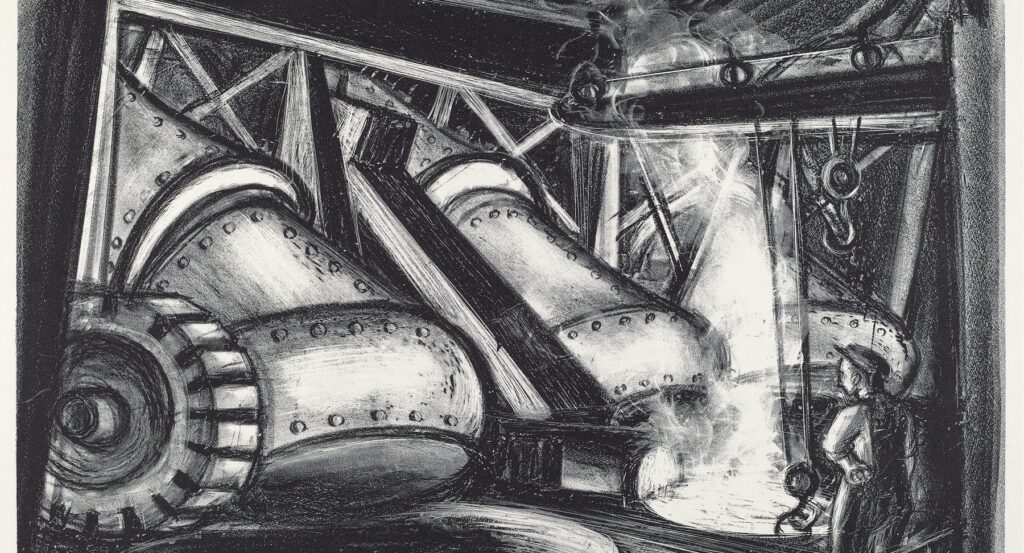
[Cover image: “Copper Smelters,” by David Burke, 1939. ]

Recognizing, detesting and resisting the Machine is today central to the living of the sanctified life in Christ.
The Machine is anti-human and is thus anti-Christ, for God intentionally formed man from the dust, breathed into his nostrils the breath of life, loved, preserved, and redeemed humanity.
But more than that, Christ “came down from heaven, and was incarnate by the Holy Ghost and of the Virgin Mary, and was made man”. Having triumphed over death, the God-man Jesus “ascended into heaven, and is seated at the right hand of the Father”. To him all authority has been given, and it is to his eternal wedding feast that we, having been made righteous by him, have been graciously invited, and at which we feast forevermore.
From the breath of life in the garden throughout this this age and the age to come, humans–the restored and glorified sons of the first Adam and especially the second Adam, The Man whom we behold seated at the right hand of the Father–are the telos of creation, both of this world and the new heavens and the new earth.
The Machine stands against Humanity itself–now, and always.
It is well and good to consider the Christian faith as the story of God’s forgiveness of sin through Christ’s work on the cross. But more broadly, forgiveness is not the telos, not the end. Rather, the Christian faith is the story of the creation, restoration, and deification of humanity.
Human life is what the Machine targets for destruction: ending of life in the womb, refusal to procreate life, refusal to embrace biological reality, violent ending of life of self or others, sub-human “living” in idolatry soft or crass, refusal to receive life-sustaining daily bread through the natural world where we “touch grass”, denial of dignified living for the poor that are hotly pursued, and of course despising Christ, the life of all the living who gives us his lifegiving body and blood unto our eternal life.
Christ, the firstborn from the dead, not only assures us of our resurrection through our baptism into his death but also promises us life everlasting in our glorified bodies where we humans will forever dwell bodily with The Man, the God-man Jesus Christ.
The Machine would have us not only loose our faith in God, but would have us literally reject the glorious humanity with which God has endowed and glorified us. Our rejection of our God-given humanity is in the end our rejection of Christ.
From both the standpoint of our individual striving in our sanctification and as our bold proclamation in this world where “On every side the wicked prowl, as vileness is exalted among the sons of men.” (Psalm 12:8 RSV) we must embrace and treasure our humanity and that of our fellow man and contend for it at all cost.
The Machine is not just a dangerous distraction; rather it is the mechanism of Evil itself.
Note: “Against the Machine–On the Unmaking of Humanity” by Paul Kingsnorth (2025) is a great contemporary revelation of the Machine. Once you see it you can’t unsee it.