

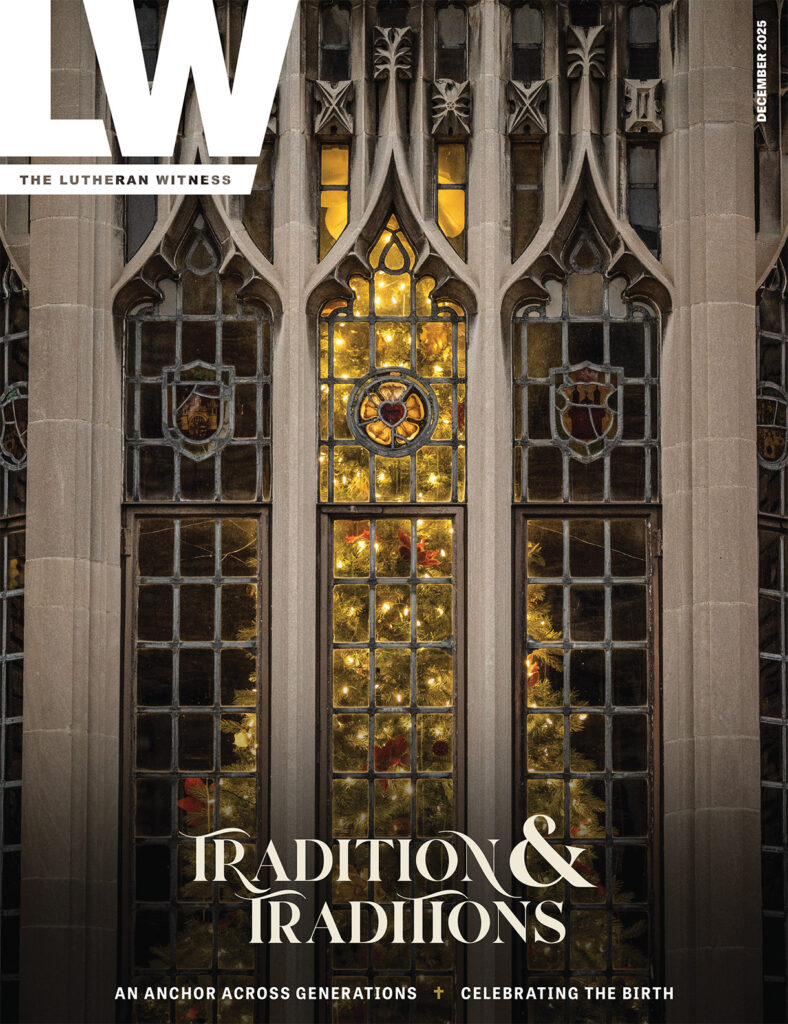
The December issue considers family traditions and church tradition in light of Advent and Christmas.
- From the President: ‘I Delivered to You What I Also Received’: Tradition and the Gospel
- Life in the Church Year: Advent and Christmas: Mincemeat Pies
Features:
- An Anchor Across Generations: The value of Christ-centered tradition — William Weedon
- Tradition: Blessing, Burden or Both?: Engaging with tradition as Lutherans — Hans Fiene
- Celebrating the Birth: Christmas traditions in LCMS history — Mark Loest
- Traditions Around the LCMS: From our readers
- Written on the Heart: The blessing of memory work — Jocelyn Benson
- The Thing Around Which Everything Else Must Move: Building our lives and congregations around God’s Word — Jonathan Conner
Departments:
- Snippets: News from around the LCMS and the world
- Commonplaces
- Formula of Concord Reading Plan: December: Other Factions & Sects
- Worship: Living Always in the Day
- Walking Together: Yesterday, Today and Forever
- Searching Scripture: Opening the Old Testament: Son of David, Son of God
From the editor:
These memories are written deeply on many of our hearts: Lighting the candles on an evergreen wreath as the weather got colder and Christmas approached. The sparkling lights from the Christmas tree making the sanctuary festive as we sung the familiar carols, the sanctuary warm with light against the cold darkness outside. A closet full of fraying cassocks, robes, halo headbands and rope belts, donned while nervously practicing a memory verse one last time. The familiar readings on Christmas Eve and Christmas Day. The palpable excitement and joy forever associated with the coming of Christ.
For those raised with faithful, Christ-centered traditions that rightly confess God’s Word, these things are a great blessing — foundational, core memories, images, words and songs that shape our hearts and affections, pointing them toward our Savior. Those raised in other traditions, however, do not have that blessing. They may have had to forsake the false and yet dear traditions of another religion in which they were raised. The hymns and songs that have an irreplaceable childhood familiarity to them may be doctrinally vapid or even completely false. We can all relate to an extent, amid a consumerist culture that has leeched some beloved and yet distracting traditions into our church’s own holy seasons. Even Christian parents raised in the church may find themselves having to sort out the wheat from the chaff in passing on Christmas and Easter traditions to their children.
Traditions have great power. They “anchor us,” as William Weedon writes in this issue (p. 8), providing us with a solid foundation that can last even after our senses and reason fail us. They help us to organize our life together and can promote unity in the church, even with those who are far away in both space and time. But, as Hans Fiene notes, the extent to which a tradition is old and established does not necessarily correspond to its truth or faithfulness (p. 10). Because of tradition’s power, the church must continually evaluate her traditions, ensuring that they are grounded in God’s Word and point people to Christ. She must also teach those connections to God’s Word to each new generation.
And even faithful traditions must be kept in perspective. “The righteousness of faith is not a righteousness bound to certain traditions” (Ap VII and VIII 31). As Jonathan Conner writes, the church must make sure that it is making the Word of God “the thing around which everything else must move” rather than anything else, including beloved traditions and customs. This may mean letting go of congregational traditions and entrenched practices for the sake of the proclamation of the Word, as when two or more congregations partner together to carry on ministry in that place.
We must handle with reverence and care those good traditions that have been handed down to us by the church. However, we should keep in mind always that our traditions and customs “are a shadow of the things to come, but the substance belongs to Christ” (Col. 2:16–17).
In Him,
Stacey Eising
Managing Editor, The Lutheran Witness