


A literary reflection by Rachel Bomberger on J. M. Barrie's Peter Pan.
This is one installment of a monthly series providing reflections on works of literature from a Lutheran perspective.
“All children, except one, grow up.” — J. M. Barrie
Sadly, I was not that one. I know this because, for a full calendar year after I first read J. M. Barrie’s Peter Pan at the age of 11, I kept the window next to my bed cracked open two inches, summer and winter, rain or shine, just in case.
If Peter Pan ever came to fetch me, I’d be waiting.
What was it about Barrie’s novel that so intoxicated my young mind? Was it the thrill of Neverland — that magical private island where make-believe becomes reality, where children are at once completely in charge of their own lives and completely free of adult responsibility? Was it Peter himself — cocksure, capable and capricious, the epitome of rowdy boyhood? Was it the fairies? The fairy dust? The flying? Or was it simply the idea that, if Peter ever did come for me, I wouldn’t have to grow up?
My sweet mother could have called me out on my utter lunacy and made me save the heating bill and shut the window, but she never did. Somehow, she understood that, during the toughest 12 months of my pubescent young life, I needed to keep believing that escape to Neverland was possible.
Mom understood me. She loved me. She nurtured me. And by doing so, she — not I — lived out the true beauty of Peter Pan: a mother’s love.
A book about childhood?
But isn’t Peter Pan a paean to childhood? It’s about kids, right? Kids who stay kids, who never grow up, who enjoy the fun and innocence of their youth forever? As a child, I certainly thought so. Rereading the book as an adult, I’m not so sure.
Barrie understands children, but he doesn’t idolize them. The way he depicts them, they are cruel, selfish, violent and heartless — “little beasts,” even. Peter Pan enjoys his playmates (mostly), but he does not love them. He “thins out” the lost boys (presumably with the sword) whenever they start to act too grown up. He takes his devoted Tinker Bell totally for granted and quickly forgets her when her short life is over. In context, his confident declaration, “I don’t ever want to be a man. I want always to be a little boy and to have fun” rings hollow. Peter may remain a youth forever, but his is a withered half-life, devoid of ultimate meaning or purpose, with no sense either of the past (which he doesn’t remember) or the future (which he cannot imagine). Until he meets Wendy.
A book about motherhood
Once I started noticing mothers and motherhood in Peter Pan, I saw them everywhere.[1] The first character we really meet in the book isn’t Peter, but Wendy’s mother: “Until Wendy came her mother was the chief one.” (It is compelling, by the way, that “Wendy’s mother” is the only name Barrie gives her, and even Peter addresses her directly by this name.) And it is Wendy, not Peter, who is arguably the true protagonist of the story.
For most of the book, Barrie’s authorial spyglass is firmly fixed on Wendy Darling, and she is easily the most dynamic character — the only child who demonstrates any real personal growth. It is Wendy’s choices that shape the plot, as she chooses first to travel to Neverland (to be mother to Peter and the Lost Boys) and then home (to reunite with her own mother). It is Wendy’s mere existence and maternal status that sparks the climax of the book: “The game’s up,” Hook sighs when he discovers her arrival. “Those boys have found a mother.” Before Wendy comes, the Lost Boys play at war with Hook’s pirates and Tiger Lily’s Red Indians; after Wendy arrives, they all play house.
Wendy’s presence softens all the boys — but especially Peter, who is immediately appointed husband and father of their ragtag Neverland household. Mother Wendy makes Peter take his medicine; she holds him at night when his dreams torment him; she gives him the only taste of family life he’s ever known. She also brings out the protector in him. It is care for Wendy particularly that spurs Peter on to fight and kill Captain Hook in a dramatic showdown.
Even after Wendy returns home, Peter continues to value her more highly than anyone else in his world. Fairies and Lost Boys come and go and are quickly forgotten, but Peter keeps flying back to the nursery window year after year (when he remembers — and he does remember) to bring first Wendy and then her daughter and granddaughter back to Neverland for “spring cleaning” and a teacup dose of motherly care.
“He does so need a mother”
As I continue to reread Peter Pan through the lens of motherhood, I am startled by one of the book’s most striking underlying messages: That motherhood and manhood are closely intertwined. We see it on Neverland, where Wendy’s desire to play mother gently ensnares Peter, leading him to try on the role of husband and father (which he finds very pleasant so long as it’s all in fun). We also see it in the nursery, where Peter, locked in a battle of wills with Wendy’s mother, ultimately repulses her open-armed attempt to adopt him: “Keep back, lady, no one is going to catch me and make me a man.”
We talk a lot these days, and rightly so, about the need for fathers. In an age where so many children have been and are being raised by single mothers, this is good and right. Children absolutely need their fathers. But they need their mothers, too — desperately. Modern reshufflings of marriage norms, gender identities and roles, and family structures (and especially the paid surrogacy arrangements that so often facilitate those modern families) are predicated on the idea that mothers are optional — that a couple of overgrown lost boys can raise a child without a mother’s involvement.
Peter Pan reminds us of the foolishness of this notion. Wendy’s mother isn’t optional. Wendy knows this, and the knowledge brings her flying back from Neverland. Wendy herself, the “little mother,” isn’t optional either, and Peter remembers her and the role she has played in his life even after everyone else in the story has long slipped his mind. The self-sacrificing love that these two women show for their children, real or imagined, is an anchor to those children’s souls, a nurturing foundation upon which they can build their future lives.
“The Never Bird”
As it happens, the truest, most idealized mother in Peter Pan is neither Wendy nor her mother. It is the Never Bird. Though this mama bird is mentioned elsewhere, the strange little chapter bearing her name falls exactly in the middle of the book — chapter nine of 17. Her backstory is mildly tragic: After her nest falls from a tree into the lagoon, the Never Bird remains with it, floating slowly around as she continues faithfully to tend her precious eggs. Yet when Peter, too injured by Hook to fly or swim, is stranded on Marooners’ Rock with the tide coming in, the Never Bird shows him just how selfless a mother’s love can be. Paddling awkwardly over, she climbs out, trusting that Peter will care for her eggs as he borrows her buoyant nest. Acknowledging the avian mother’s ultimate sacrifice, Peter first carefully rehomes the eggs into a pirate’s broad brimmed hat before floating safely to shore on the twiggy raft she has provided.
Here we see the beauty of a mother’s love: first for her own children, then for all helpless young things that need nurture and protection. It’s a love ordained by God in the creation of Eve, the “mother of all living,” without whom mankind would not exist. It’s a love sanctified by God in the womb of the Virgin Mary, “blessed among women,” who not only bore the Savior but nursed and nurtured Him throughout His young life. And it’s a love reflected even today in the holy Christian church, which Luther called “the mother that conceives and bears every Christian through God’s Word” (LC II 42).
“When Wendy grew up”
As desperately as I wanted Peter Pan to come for me all those years ago, I’m glad he didn’t. Puberty wasn’t easy, but once it was over … oh, what joy! I met and married a godly man who shared my desire to raise a family. I became the mother of four children, who have brought wonder and delight to every day. Over the course of our life together, I’ve watched my husband grow from an overgrown Peter Pan into a loving husband and father; I’ve watched myself move on from playing house with my dollies to managing a household and nurturing young people to adulthood.
If, as Peter says, “to die will be an awfully big adventure,” how much bigger and better is the adventure I have myself been on since the day I finally shut the open window: growing, loving, dying to self, living to God, and raising up the next generation to grow and love, live and die in the Lord in their turn.
[1] Credit for this discovery must be shared with my daughter Evalyn, whose speech on Peter Pan as a high school freshman first drew my attention to motherhood as a key theme in the book.
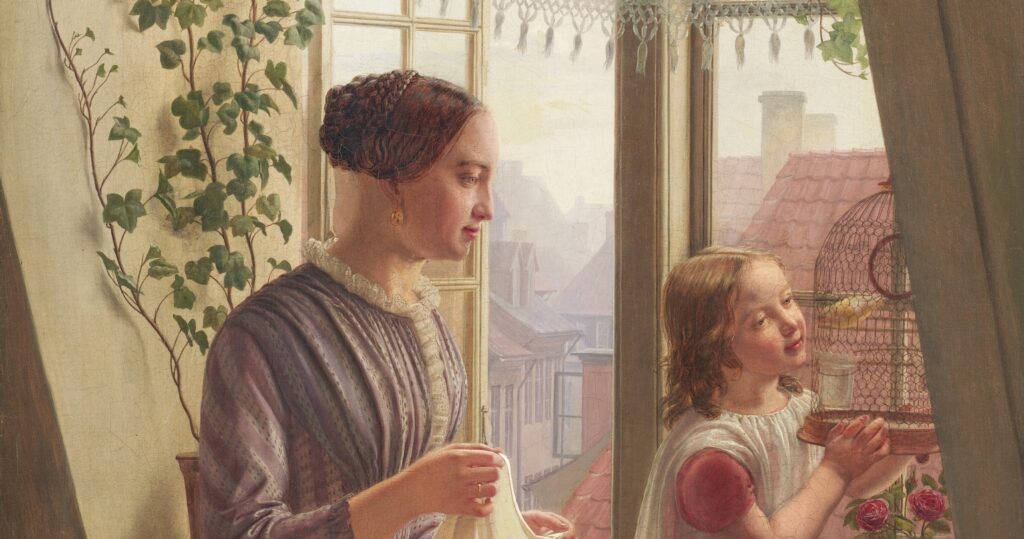
Cover image: “Interior with mother and daughter at the window,” by Ludvig August Smith, 1853.



This is a beautifully written piece that brings comforting insights into a classic story and is encouraging to mothers who deal very much in a reality that can feel daunting with its pressures of perfectionism. It leaves me wanting to reread Peter Pan alone and hear the theme of motherhood lauded, but also wanting to read it to my children, as we will enjoy together the flight of fancy that ultimately keeps us grounded in the real world. Please keep including articles like this for moms raising our kiddos as children of God in this modern society. This down-to-earth viewpoint feels like a friend encouraging our efforts and offering practical resources, while not demanding a perfect household. Let us first be Mary at Christ’s feet with ears listening and hands folded. The dishes can wait. The children grow up fast and will be the parents of tomorrow.