


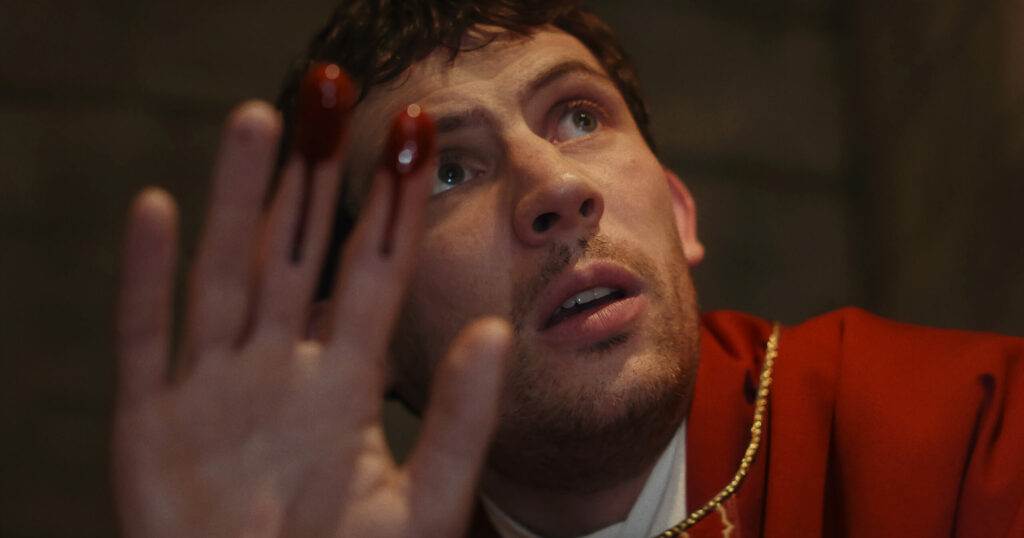
[A review of Wake Up Dead Man (2025); rated PG-13 for violent content, bloody images, strong language, some crude sexual material, and smoking; runtime 144 minutes; directed by Rian Johnson; stars Daniel Craig and Josh O’Connor.]
Disclaimer: Please be advised that this review should not be taken as a recommendation to watch the film, which contains crass sexual language and other scenes that may be disturbing to Christian viewers. Rather, this piece analyzes some of the theology presented in the film, to explore how Christianity is viewed in popular media. Spoilers ahead!
The Case of the Missing Christ
It doesn’t take a detective to know that something is deeply wrong at Our Lady of Perpetual Fortitude.
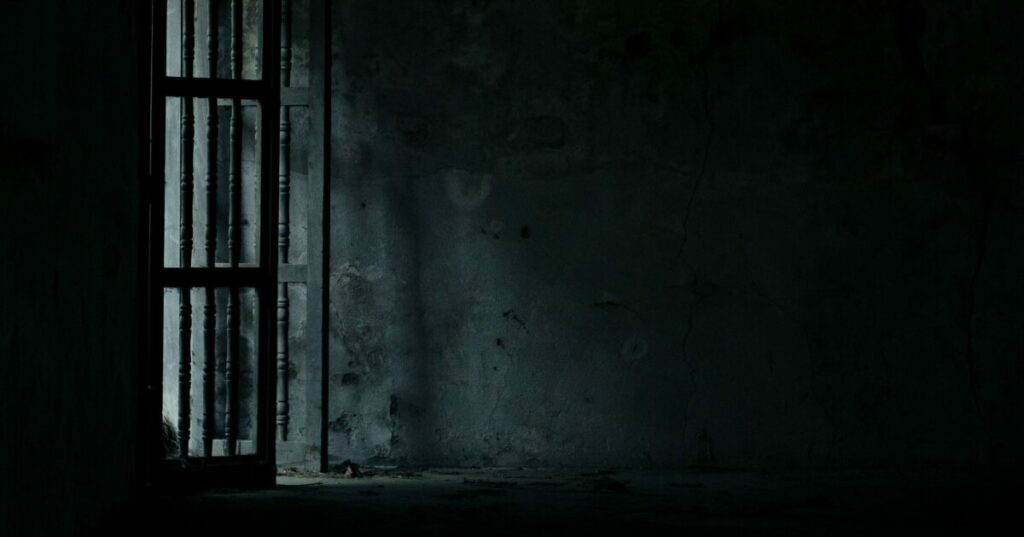
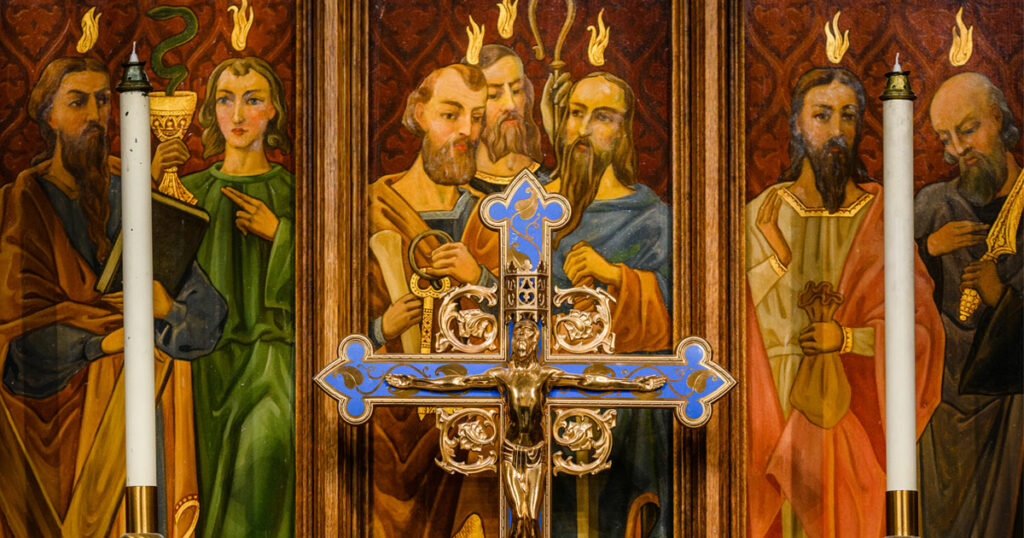
The first “red flag” is waving behind the altar, in the form of what isn’t there: a crucifix or a cross. Behind the altar is … nothing. Or rather, the pointed absence of something — of someone. Three lingering nails in the wall tell the story that while Christ had once been at the heart of the sanctuary, He has been removed.
There is a gaping hole at the center of this church. And if it’s not the pierced side of the Savior, what exactly do parishioners gather around?
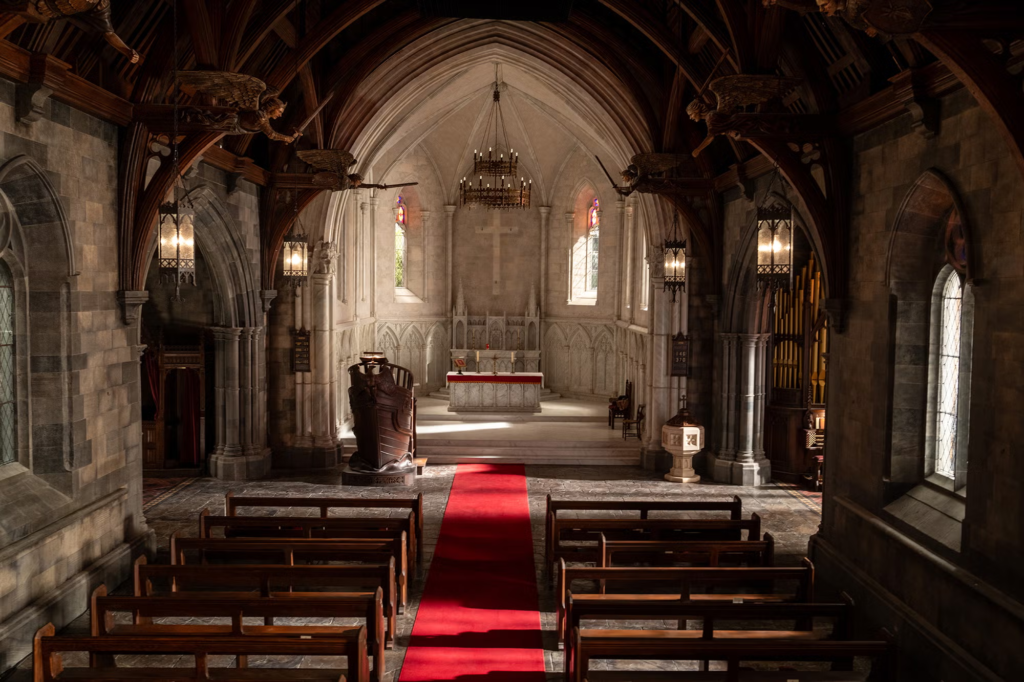
Led by the corrupt and wicked Monsignor Wicks, the members of Our Lady of Perpetual Fortitude do not gather around Christ’s light, but around darkness. The shadow of the once-present crucifix memorializes a heinous sin against the church, and it is the remembrance of this sin that forms their spiritual foundation.
Years back, a woman tore apart their sanctuary, destroying icons, statues and crucifixes, driven on by the temptation of Eve’s Apple: L’Eveil Appel, an $80 million jewel that she believed was hidden somewhere in the church. Thus, Eve’s Apple and this woman’s sin form the new center of this church’s story. Her destruction is continually called to mind by the void on the wall and pounded home by the priest in the pulpit. Over time, the congregants’ fists become habitually clenched in anger, too.
The Clue of the Clenched Fist
The film begins with a clenched fist: Father Jud Duplenticy, a boxer turned priest, clocks a deacon in the face, triggering the disciplinary action that results in his banishment to Our Lady of Perpetual Fortitude.
“We [the church] need fighters today … to fight the world,” encourages one of the senior priests during the disciplinary hearing.
Duplenticy respectfully disagrees: “Christ came to heal the world, not fight it,” he says, referencing Christ’s iconic posture of arms spread wide on the cross, embracing sinners, as opposed to an image of Him putting up His holy dukes to beat sinners down.
The juxtaposed closed fists and open arms, at play throughout the film, seem to present an either-or framing of Christianity — Christianity is either a hateful religion that relishes bashing those outside its rules, or it’s an all-accepting, unconditional embrace of this world.
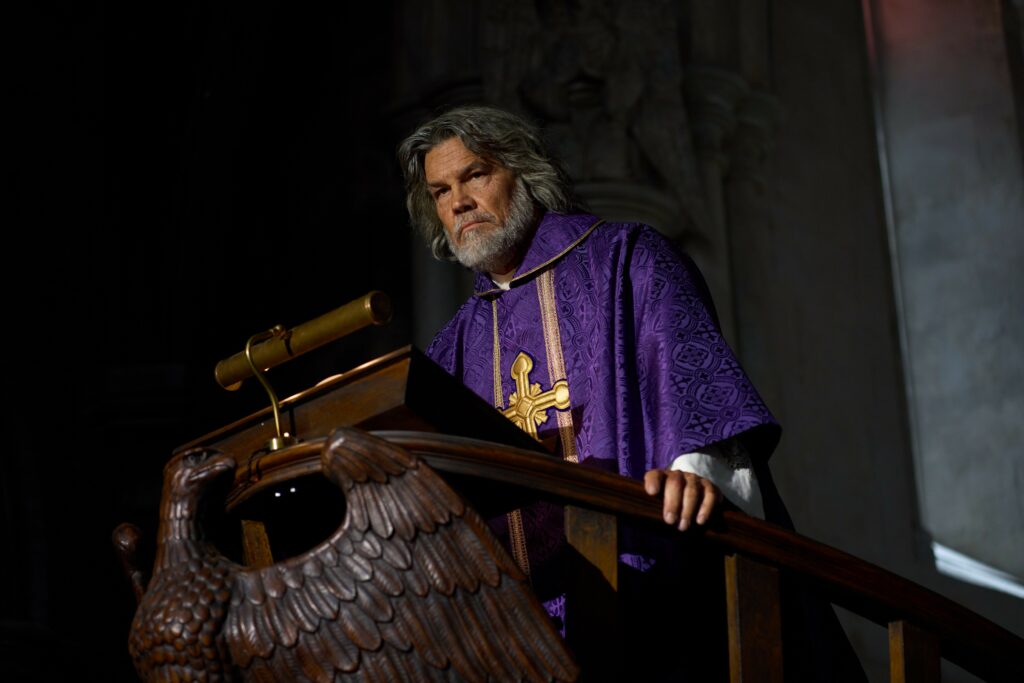
“The world is a wolf,” says Wicks. “The world wants to destroy us.” He uses the world’s hatred of the church as justification for forming angry and paranoid “warriors for Christ” in his congregation, whose hearts are hardened against the world.
So, is this juxtaposition set up in the first half of the movie accurate? And if so, which are Christians called to be — anti-world warriors or whole-world embracers?
What would it truly look like to be a warrior for Christ, modeled after Christ’s example? Wicks and his fist-raising crew wish to take arms on behalf of a Christ who comes in judgement, smiting the world for its sin. How disappointing, then, is a Warrior who instructs His followers to offer the other cheek to their assailant (Matt. 5:39)? How disappointing, then, is a Warrior who “humbled Himself by becoming obedient to the point of death, even death on a cross” (Phil. 2:8)? How disappointing, then, is a Warrior who came “not to judge the world but to save the world,” by having all the weight of the world’s sin nailed, along with His outstretched arms, to the cross (John 12:47)?
God so loved the world. God loved the world, even while it hated Him. Even while it killed Him. So, of course, Christian warriors are called to love the world, too — arms open wide.
Yet we also must make a distinction between embracing the world and embracing its sin. Jesus did not extend His arms in agony for us on the cross because our sins “don’t really matter” or “aren’t that bad.”
In our eagerness to embrace the world with the love of Christ, we must be careful not to assert that Christ loves sin. His arms are wide open to us sinners, but shall we continue sinning that grace may increase? By no means! (Rom. 6:1–2). To do so would be to continue punching our loving Lord, even as His arms are open to us.
The Body in the Sacrament
Armed with only the Law and ignorant of the Gospel, the parishioners of Our Lady of Perpetual Fortitude attempt to take things into their own clenched hands, rather than trusting the nail-scarred palms of their Savior.
Wicks’ grandfather, Prentice, who was a priest at the parish long ago, began this particular cycle of sinners trying to steal the role of savior. Years back, in what he claimed was an attempt to prevent “the sin of Eve,” in this case, greed, he swallowed L’Eveil Appel. Claiming to be protecting his own daughter from the corrupting influences of wealth (but actually displaying a glut of greed himself), he literally swallowed the hefty $80 million jewel, standing before the altar, in a blasphemous perversion of the Lord’s Supper. He replaced the body of Christ with the jewel, revealing where his true values lay; and, in the process, he tried to make his own body a Christ-like vessel for the removal of sin.
Since “only God can cover sin,” our wretched attempts at self-covering and self-saving only serve to inflict more damage (LSB 572:1).
The first murder of the film is triggered by the will of someone to save — to save the church from embarrassment, and to save the world from the unleashing Eve’s Apple. Choosing to cover up, though, rather than come clean, has devastating consequences: four bodies drop by the end of the film.
Rather than delving into the nitty-gritty of the murders, though, which can be solved by the ever-rational detective, Benoit Blanc, let’s contemplate the one mystery his rationalism cannot explain: grace.
The (Sacred) Heart of the Mystery
Whodunits and murder mysteries generally operate through the lens of cold justice, and, for a while, Father Duplenticy is swept up in the chase for the culprit. That is, until he has a “road to Damascus” moment, where the scales fall from his eyes, and he realizes: “My purpose is not to fight the wicked and bring them to justice — it’s to serve them and bring them to Christ.”
As a minister, his job isn’t to place the perpetrator in handcuffs and lock them up — it’s to lead them to repentance and to the Savior’s embrace.
“[God] loves me when I’m guilty,” confesses Father Duplenticy. And this is not a sentence that makes sense to the world. It’s radical — radical in a way that recalls Hosea’s marrying a prostitute in demonstration of God’s radical love for those who sin against Him: “While we were still sinners, Christ died for us” (Rom. 5:8).
Whodunits Blanc can understand, but for Father Duplenticy, the more important question is whosavedus, and the answer, of course, is Jesus — and He died on the cross for the culprit, too. Can the culprit be saved?
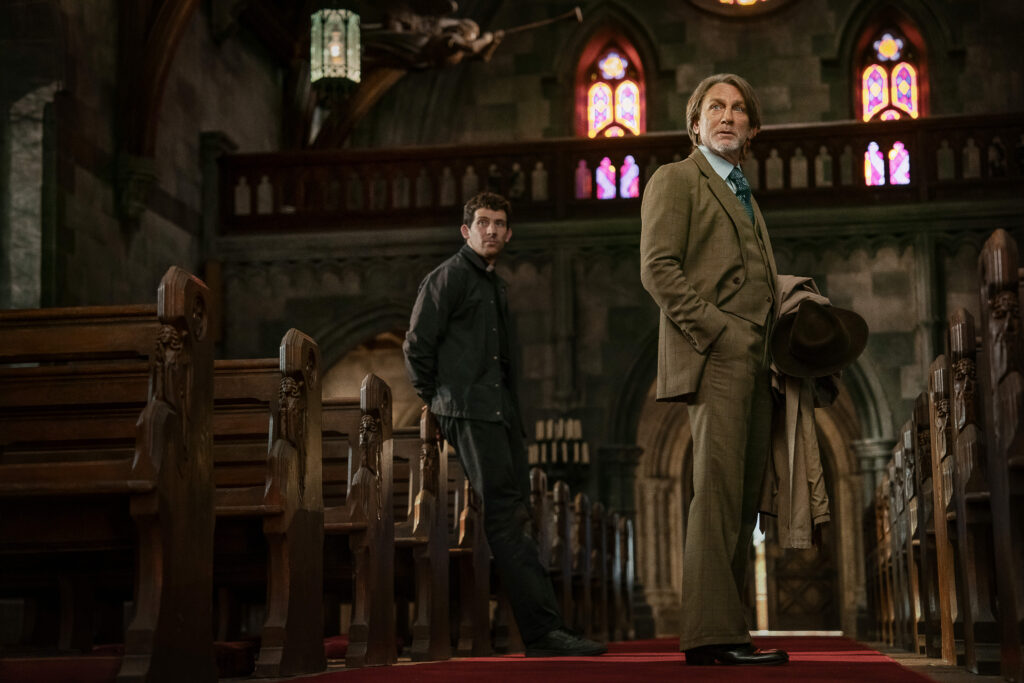
The murderer confesses, and that is a good start. She owns up to her plan to “save the church” by committing a murder, and she repents the deaths that followed. Father Duplenticy, holding her in his arms as she dies, gives a masterclass in Law and Gospel teaching.
He doesn’t soothe her conscience or pretend what she’s done is OK. In fact, he hits her with the Law, helping her see the true extent of what she has to confess: not just these murders, but her self-righteous and prideful worldview which allowed her to look down on others and cast herself in the role of Savior for decades of her life. Her eyes fill with tears: “My vanity — so wicked.”
The Law can feel like a gut punch. It forces us to see our own ugliness and inadequacy, and thus it can be tempting to take an eraser to parts of the Law in an attempt to soften the blow. Yet any such softening only serves to keep sin alive in us, when, in reality, our sinful self needs far more than a punch: Christians confess that our sinful self is put to death, dying with Christ through our Baptism, which allows us to walk in newness of life, alive in Christ (Rom. 6:3–4). Only once the sinful self is buried with Christ are we free to wake up, dead men that we are, and begin our lives as saints.
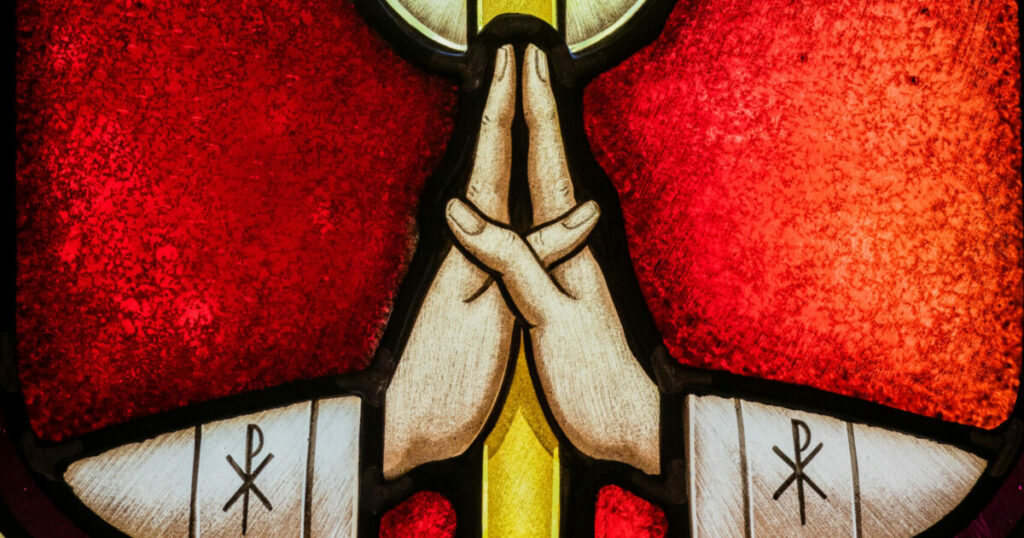
This call to awakening happens in our Baptism and the remembrance thereof, in the Sacrament of the Altar, and in Confession and Absolution. Jesus is the “call to awakening” (which, funnily enough, in French translates to L’Eveil Appel). By His death on the cross, He pulls us out of our graves and allows us to stop living as the walking dead. Resurrected daily by our Baptism, we can begin walking in the ways of righteousness, arms extended in love to our neighbor.
Upon the culprit’s repentant confession, Father Duplenticy pronounces absolution: “God, the Father of mercies, through the death and resurrection of His Son, has reconciled the world to Himself and poured out the Holy Spirit for the forgiveness of sins through the ministry of the church. May God grant you pardon and peace. I absolve you of your sins in the name of the Father and the Son and the Holy Spirit.”
The Restored Inheritance
After the main events of the film, Our Lady of Perpetual Fortitude takes on a new name: Our Lady of Perpetual Grace. The central pillar of the church is no longer the actions of fist-clenching men, but the emphasis is placed on the actions of our gracious God.
Behind the altar, Father Duplenticy installs a hand-crafted crucifix, with something very specific placed in the Christ figure’s chest, where His heart would be: L’Eveil Appel, signaling Christ as our true inheritance. He is the only Redeemer, removing our sins from us, even the sin of Eve, as far as the East is from the West. And in His death, we receive our call to awakening — our call to live in the waters of our Baptism and wake up from the deadly stupor of sin.
The film ends with arms open — Father Duplenticy hugs Benoit Blanc, a self-professed heretic, representing the world, and invites him to mass.
Blanc declines.
But Christ’s arms still are spread wide on that crucifix, open, and inviting Blanc — and all people — to receive their inheritance in His grace.
And Then There Were Questions
Although it’s evident at many moments in the film that someone with a solid understanding of Christian doctrine worked on the script, it cannot be said that this is a Christian film. For every moment where the light of Christ shines through, there are moments of extreme darkness and attempts to smear the church in filth. At worst, an unchurched viewer could walk into the film and see Christians as hateful, hypocritical, conspiracy-theory-believing bigots.
Yet, there is also hope that an unchurched viewer could see the love of Christ shown through the Christian at the film’s center: Father Jud Duplenticy. Though he’s far from a saint, yet he is a vessel for Christ’s love. This is especially shown in a very moving scene, where Duplenticy drops everything, mid-crisis, to selflessly show Christ’s love to a woman whose mother is dying of Alzheimer’s.
Duplenticy, like all Christians, is both a sinner and a saint through faith in Jesus, which presents another hard-to-swallow mystery for unchurched viewers. He has a double identity through Baptism, yet he isn’t duplicitous.
At best, maybe the film creates curiosity in the secular viewer — curiosity about a murderer priest who can be so sure God loves him, curiosity about what is truly at the center of Christ’s church. Perhaps it can even offer the opportunity for Christians to dialogue with secular friends who have seen the film about their impressions of the church, beginning to break down the barriers that keep the unchurched out of the pews.
Benoit Blanc is not ultimately interested in the mystery of God’s grace and righteousness, but maybe a viewer out there is — a viewer who receives the invitation to “Come on Up to the House.”
All images by John Wilson/Netflix,© 2025 Netflix, Inc.
A fascinating, insightful, in-depth review.