


A literary reflection by Mary Henrichs on William Shakespeare's Hamlet.
This is one installment of a monthly series providing reflections on works of literature from a Lutheran perspective.
“To be, or not to be —”
You can finish the sentence. It’s Shakespeare’s most famous line, and possibly the most quoted in all literature.[1]
Hidden in those words, Shakespeare captures something fundamental to our language: There is no unique word for the pure opposite of “to be.” You have to slap a “not” in front of “to be” in order to achieve anything close to “not being.” All possible synonyms for “not to be” — to die, to stop, to cease, to perish, to disappear — imply an initial state of being from which one departs. You cannot die without first living, you cannot stop without first starting, and so on. “Not being,” then, and the contemplation thereof, is only possible from the perspective and language of “being.” Existence is necessary to contemplate non-existence.
Tom Stoppard exposes the difficulty of imagining “not being” in his 1967 play about Hamlet’s friends, Rosencrantz and Guildenstern are Dead. Try as he might to comprehend death as an utter lack of existence, Rosencrantz cannot capture an image that expresses “not being”:
Do you ever think of yourself as actually dead, lying in a box with a lid on it? … I mean one thinks of it like being alive in a box, one keeps forgetting to take into account the fact that one is dead … which should make all the difference … shouldn’t it? I mean, you’d never know you were in a box, would you?[2]
Rosencrantz later continues his impossible quest to comprehend “not being,” asking Guildenstern: “Do you think death could possibly be a boat?”
Guildenstern brushes him off: “No, no, no … Death is … not. Death isn’t. You take my meaning. Death is the ultimate negative. Not-being. You can’t not-be on a boat.”[3]
You can’t not-be on a boat, or in a box — not with a fox, not in a house and certainly not with a mouse, since being “on,” “in,” or “with” something inherently implies a state of being, of existence.
Even Hamlet, who first spoke the famous line, is repeatedly reminded throughout Shakespeare’s play that “being” continues, even after death. He is visited by the ghost of his father, whose spirit continues to exist despite separation from the body. He holds in his hands the skull of a former friend, Yorick the jester, palpably witnessing that Yorick’s decaying body continues “to be” despite separation from the soul.
This evidence pointing to the continued existence of body and soul after death ought to show Hamlet a flaw in his “not being” proposal. Even after death, being continues. Soul and body may be temporarily separated, but they do not cease to be.
In fact, for us beings created by the “I AM,” there has never been a time when we have not been known by our Creator — He knew us intimately, even before we were born: “Your eyes saw my unformed substance; in Your book were written, every one of them, the days that were formed for me, when as yet there was none of them” (Ex. 3:14; Psalm 139:16). We existed to our omniscient Creator long before we drew our first breath.
Likewise, we confess that after death, though our bodies return to dust, our souls will be with Christ in Paradise until the Last Day, when we are resurrected in our glorified bodies (Gen. 3:19; Luke 23:43; 1 Cor. 15:51–53).
Thus, Hamlet’s question offers a false choice: “Whether we live or whether we die, we are the Lord’s,” writes Paul (Rom. 14:8). In both life and death, we abide in and are upheld by the eternal “I AM.” There is, therefore, no “not to be.”
“Let be.”
If there is no “not to be,” can we take a lesson from Hamlet in being?
In act five, Hamlet offers an answer to his famous question, landing on the side of “to be.” When Horatio advises Hamlet to postpone an ominous fencing match, Hamlet answers: “There is a special providence in the fall of a sparrow. If it be now, ’tis not to come; if it be not to come, it will be now; if it be not now, yet it will come. The readiness is all. … Let be.”[4]
Although some interpret this speech as Hamlet giving in to fatalism, his actions in the following scene are not those of a man who has given up: he asks forgiveness of Laertes, fights with all his might and exposes the treachery of his uncle, taking the action which he had long postponed.
Hamlet’s “let be” demonstrates a newfound trust in the Lord. Up to this point in the play, Hamlet has questioned the idea of an omnipotent, loving God. In his first soliloquy he refers to the world as “an unweeded garden / that grows to seed,” implying a kind of deistic faith, which holds that the Creator has abandoned His creation to rot — winding up the watch only to stand idly by as it breaks down.[5]
By confessing God’s hand even in the fall of the sparrow, though, Hamlet attests to the truth that the Lord is actively at work in the world, caring for the greatest down to the least of creatures: “Look at the birds of the air: they neither sow nor reap nor gather into barns, and yet your heavenly Father feeds them. Are you not of more value than they?” (Matt. 6:26).
Earlier in the play, Hamlet might have been scandalized at the idea of taking a lesson from a bird, enamored as he is with the “infinite” faculty of man.[6] Yet, Jesus commends the simple bird as an example in the Sermon on the Mount, and as Hamlet nears the end of his “mortal coil,”[7] he implicitly takes a lesson from the sparrow on what it means “to be.”
“The rest is silence.”
Hamlet’s dying words often come as a relief to audiences (and actors!). Finally, the character who speaks almost 40% of the play’s 4,000 lines can stop talking. Hamlet, ever occupied with worry, doubt and anxiety, has a problem keeping his “godlike reason”[8] (or, rather, “words, words, words”)[9] to himself. His thoughts shoot out of him like a firehose until he mercifully pronounces: “The rest is silence.”[10]
A popular interpretation of this line is that Hamlet is confirming the absence of existence after death — he is looking into the afterlife and announcing that the rest is nothing but silence, nothingness, non-existence.
For Søren Kierkegaard, a real-life Danish philosopher, silence is the first lesson offered by the birds (and lilies). And silence may be the lesson that Hamlet, falling sparrow that he is, finally learns at death’s door. “Make yourself nothing, become nothing before God, learn to keep silent,” writes Kierkegaard. “As the fear of God is the beginning of wisdom, so is silence the beginning of the fear of God.”[11]
Silence, he writes, “expresses respect for God,”[12] and when we go to meet our Maker, in one sense we will certainly be silent: Any attempt at self-justification utterly melts away before His righteousness. Our sinfulness leaves us at a loss for words, and our small pile of good works does not have the power to cover our mountain of sin.
Thanks be to God that one Traveller did return from “the undiscovered country”[13] of death: Jesus triumphed over sin and the grave and, having taken all our sin upon Himself, He does not keep silent but “indeed is interceding for us” to the Father (Rom. 8:34).
“Flights of angels sing thee to thy rest.”
Silence, Kierkegaard suggests, is a first step towards obedience, but it is not the end point. And Horatio does not let Hamlet’s “silence” be the last word, either, responding to him with a direct contradiction: “Flights of angels sing thee to thy rest!” [14]
As a starting point, silence allows us to recognize the presence of God: “Out there with the lily and the bird you perceive that you are before God, which most often is quite entirely forgotten in talking and conversing with other people.”[15]
How easily are we caught up by the cares of this world, which make us forget who we are! We are God’s beloved, baptized people. He has chosen us, called us by name and made us His precious children through our Baptism.
Being a child of God is not something we do — being a child of God is a free gift, given to us in Baptism. We aren’t children of God because we “seem” holy due to any outward piety or other “actions that a man might play.” We have “that within which passeth show” — we have “it is.”[16] We are beloved sons and daughters of our heavenly Father through our Savior, Jesus Christ.
After silence, Kierkegaard explains, the sparrow teaches obedience and, ultimately, joy, which he defines as being “present to oneself.”[17] Being present to oneself, for a Christian, is simply remembering who we are — created, sustained and redeemed children of God. We cannot remember who we are without remembering who He is.
As fallen sinners, we often forget who He is, forgetting ourselves in the process. We need constant reminding of His glorious deeds on the cross — we need to constantly return to the Lord, finding Him where He promises to be found: in His Word and Sacraments. When we receive these gifts, we richly participate on earth in our true life, which is “hidden with Christ in God” (Col. 3:3). This true life, true being, cannot be found apart from Him.
Our rest, the Bible assures us, will not be silence. We will join with the “flights of angels” Horatio mentions, singing the praises, not of Hamlet, but of the Lord. We will be for all eternity as He means us to be.
[1] William Shakespeare, Hamlet, ed. Ann Thompson and Neil Taylor (London: Bloomsbury, 2017), 3.1.55.
[2] Tom Stoppard, Rosencrantz and Guildenstern are Dead (New York: Grove Press, [1967] 2017), 64.
[3] Stoppard, Rosencrantz, 100.
[4] Hamlet, 5.2.197–202.
[5] Hamlet, 1.2.135–136.
[6] Hamlet, 2.2.270.
[7] Hamlet, 3.1.66.
[8] Hamlet, 4.4.37.
[9] Hamlet, 2.2.189.
[10] Hamlet, 5.2.342.
[11] Søren Kierkegaard, The Lily of the Field and the Bird of the Air: Three Godly Discourses, trans. Bruce H. Kirmmse (Princeton: Princeton University Press, [1849] 2016), 21–22).
[12] Kierkegaard, Lily, 26.
[13] Hamlet, 3.1.78–9.
[14] Hamlet, 5.2.344.
[15] Kierkegaard, 26.
[16] Hamlet, 1.2.76–86.
[17] Kierkegaard, 43.
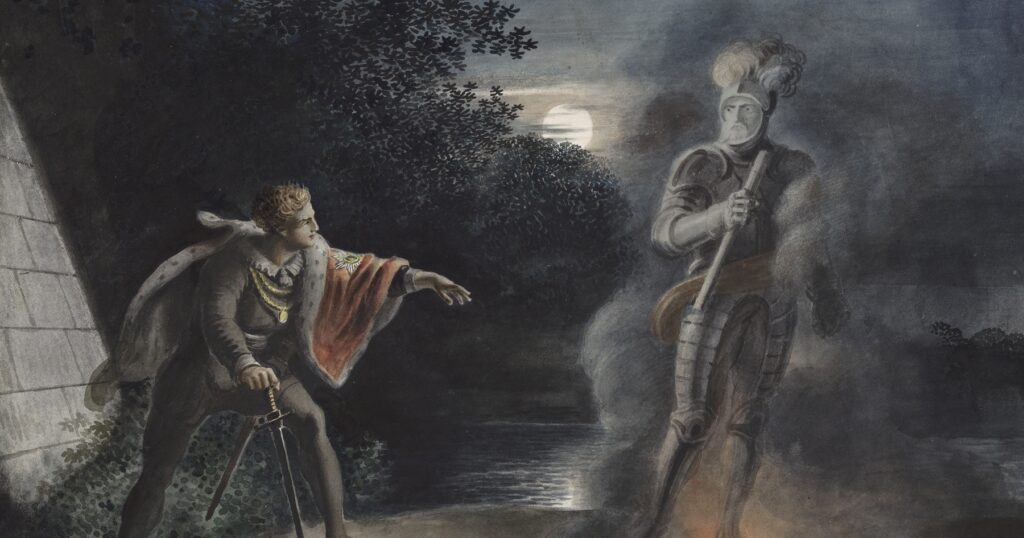
Cover image: “Ghost and Hamlet,” by Johann Heinrich Ramberg, 1829.


Thank you, Mary, for your excellent article. I will have to dust off my copy of Hamlet and read it again.
By the way, I have always thought there was more to Romeo and Juliet than a sad love story–estrangement, death, and reconciliation. Sounds a lot like Christianity to me. But then again, I wonder if I am reading into it what was not intended. But then, how do we know what Shakespeare intended? But, does it matter? (I had a friend who was a modern artist. We would look at a picture and I would say, “What is it?” He would reply, “It’s art. It’s whatever you want it to be.” I’m not sure Shakespeare was such a postmodern subjectivist.) It seems like the big human issues, such as “to be,” or estrangement, death, and reconciliation, are contemplated by many thoughtful writers. One does not need to be Christian to ponder such questions. But praise God, that in Christ we know the right answers. I hope Shakespeare did also.
Beautifully written, Mary. We do find God’s presence in everything, even the words of the Bard.
Thank you, Mary, for sharing your gift, among many others, of insightful, thoughtful writing with us. May our great Creator continue to bless you as you follow His direction.