
For many readers, summer vacation offers an opportunity to sample new literary treasures and revisit old favorites. The writers and editors on the LCMS Communications team are no exception. Here, three of them share the books they have read, are reading or plan to read this summer.
Do you have recommendations of your own to add to our list? Share them in the comments below!
Rachel Bomberger
Managing editor, The Lutheran Witness
I am reading …

‘Towers in the Mist’
Elizabeth Goudge
(Henrickson, 2015)
It’s now been more than 25 years since my (then) future mother-in-law first shared with me her deep love for the works of Elizabeth Goudge (1900–1984). To my shame, I never read any of Goudge’s novels until after Brenda’s funeral in 2021. Brenda was right, though. Goudge is exactly my kind of author: lyrical and luminous, with a warm affection for history and humanity and a soul forever open to moments of divine transcendence. Although a bestseller in her time, Goudge has now largely been forgotten — which is regrettable, since her wise-eyed wonder offers a refreshing antidote to the cynical malaise of our time. I now read at least one Goudge novel a year, often saving them for my vacations.
This summer, I’m enjoying Towers in the Mist, which tells the intertwining stories of orphaned prodigy Faithful Crocker and the large, motherless family of Canon Gervas Leigh in Elizabethan Oxford. Featuring moonlight serenades, an uproarious town-and-gown riot and colorful cameos by Philip Sydney, Walter Raleigh and Queen Elizabeth I, Goudge’s paean to her former hometown (her father was an Oxford professor of divinity) shines on every page.
I plan to read …

‘The Brothers Karamazov’
Fyodor Dostoevsky
Trans. Constance Garnett
(Wordsworth Classics, 2010)
Earlier this year, I made a bargain with a young friend: If he would read C.S. Lewis’s The Screwtape Letters for the first time, I would read or reread any book he chose by his favorite author (Fyodor Dostoevsky). We would then discuss both books together. The young scallywag did not hesitate or bat an eyelash as he assigned Brothers Karamazov for my half of the deal.
Perhaps it’s best not to look too closely at the relative page counts of these two great literary works (226 for Screwtape vs. 896 for Karamazov, in case you were wondering). Yet despite the mathematical disparity, I still can’t help feeling that I’ve made a very good bargain. Not only do I get to introduce a friend to one of my all-time favorite books; I also now have a compelling reason to revisit an icon of Russian literature which (unbeknownst to my fellow bookworm) has already been on my “to-read” list for ages. I cannot wait to dig in and savor all 900-odd pages.
I have read (and will soon reread) …

‘The Quiet Ambition: Scripture’s Surprising Antidote to Our Restless Lives’
Ryan P. Tinetti
(IVP Formatio, 2025)
I first meandered through this book late last year and will soon be experiencing it again with members of the Lutheran Ladies’ Book Club. I use the verb “experience” rather than “read” here, because the Rev. Dr. Ryan Tinetti’s book is one to be pondered and lived, rather than merely consumed.
In this volume, Tinetti (a professor of practical theology at Concordia Seminary, St. Louis) explores one of the most subtly paradoxical mandates in Scripture: “Make it your ambition to live quietly” (1 Thess. 4:11 NIV). Tinetti builds his little book around the ironic tension in this verse. People with ambition, after all, seek to do great things. They make a name for themselves. They go out boldly and change the world. They do not aspire to “downward mobility” or nameless obscurity. “What kind of ambition is quiet living?” Tinetti rightly asks. In his Gospel-soaked answer to this question, I find comfort for my weary heart and peace for my restless soul. I’m looking forward to my second experience even more than I did my first.
Mary Henrichs
Staff writer, LCMS Communications
I have read …

‘Sense and Sensibility’
Jane Austen
(Penguin Classics, 2014)
When I first read Sense and Sensibility in my early teens, I understood it, but I didn’t necessarily enjoy it — perhaps because I was girlishly hoping for it to be all romance, all the time. Instead, Austen imbues line after line with her sharp, hilarious voice and social commentary, which, though it went mostly over my head when I read it back then, had me laughing out loud page after page this time around.
Her ideas and themes are also — surprise, surprise — more complex than the movies make them out to be. I must admit that I picked this book up in a state of hubris, thinking it would easily fit into my pre-conceived plan for an LW Literary Reflection, only to find myself repeatedly challenged by a text that is far from open-and-shut. Even defining what exactly “sense” and “sensibility” are according to the text itself requires more detective work than one might think.
I have also read …

‘The Power and the Glory’
Graham Greene
(Penguin Classics, 2015)
Under an unforgiving sun, in unbearable heat and humidity, a river of sweat dripping slowly down your back: these are the ideal conditions for reading The Power and the Glory, so it’s a great summer read. Set in southern Mexico during the persecution of the Catholic church in the 1930s, this novel tells the story of the “whiskey priest,” a very imperfect servant of God, who seeks to minister to his people while running from those who seek his death.
Greene’s prose, shot through with searing similes and striking imagery, provokes reflection on the figure of Judas Iscariot, the nature of martyrs, the free gift of Baptism, the problem of suffering and the utopian impulse which seeks to dethrone God and put man in His place. It’s a fascinating read and an excellent testimony to our weakness and God’s power.
‘The Power and the Glory’ is recommended for mature readers.
I plan to read …

‘When Helping Hurts: How to Alleviate Poverty Without Hurting the Poor … and Yourself’
Steve Corbett and Brian Fikkert
(Moody Publishers, 2014)
One of the many things I love about our LCMS is that both nationally and internationally, our mercy work is done in close proximity to Word and Sacrament. When we serve our neighbors, we don’t only serve their temporary, physical needs — we point them to Jesus, who fulfills our every need eternally.
This summer, I traveled to Kenya for several stories that will appear in future issues of Lutherans Engage the World. We spent several days visiting the refugee camps in Kakuma and Kalobeyei, where over 300,000 people are living in heartrending conditions. Coming away from that trip, I added this book to my summer reading list as a means to deepen my understanding of how I can better love those who are living in poverty.
Cheryl Magness
Managing editor, Reporter
I have read …

‘Babette’s Feast’
Isak Dinesen
scribd.com/document/364202341/Babette-s-Feast
I have long been a fan of ‘Babette’s Feast,’ the Academy Award-winning 1987 Danish film based on a novella of the same name by Karen Blixen (pen name, Isak Dinesen). Blixen (1885–1962) was Danish but wrote in both Danish and English. “Babette’s Feast,” first published in Ladies’ Home Journal in 1950, was one of her English-language works. I recently decided that, rather than watching the film for the umpteenth time, I needed to read the story on which it is based.
As the tale opens in 1893, two aging, unmarried sisters, Martine (after Martin Luther) and Philippa (after Philip Melanchthon), are living out their days in a small, coastal Norwegian village named Berlevaag. Their father, now deceased, founded the dwindling pietistic Lutheran sect to which the sisters belong, so they are alone except for the other also aging sect members and their French maid, Babette.
How did two women whose ascetic existence centers on praying, doing good works and refereeing the various “sad little schisms” that persist in their sainted father’s congregation end up with their own French maid? (Spoiler alert: Babette is much more than a maid.) And what do they end up learning from her (and vice versa)? That, dear reader, is the meat and potatoes — or, in this case, the “Cailles en Sarcophage” — of this delightful exploration of vocation, duty, regret, forgiveness, grace, beauty and love. No wonder Lutherans love it.
I have also read …

‘Listening to the Law: Reflections on the Court and Constitution’
Amy Coney Barrett
(Sentinel, 2025)
As someone whose daily work constantly deals in language, two of my favorite chapters in U.S. Supreme Court Justice Amy Coney Barrett’s Listening to the Law are Chapter 13, “All About Words,” and Chapter 14, “Don’t Take It Literally.”
In Chapter 13, Barrett discusses the textual challenges of applying a brief, almost 250-year-old document to situations of which the writers could have never conceived; in Chapter 14, she explains why “textualists are not literalists” (228) and reviews the various tools judges use to arrive at meaning. I laughed out loud at Barrett’s observation that the U.S. Congress is not necessarily composed of grammarians and that recognizing this fact is sometimes helpful when figuring out what a statute is supposed to mean. It’s a truth applicable to many things — including overtures and resolutions written for Synod conventions — and we grammarians do well to remember it.
It’s not surprising that language would figure heavily in a book about interpreting the law, but it turns out that Barrett is also a woman after my own heart, one who, “since I loved to read … dreamed mostly about being an author or an English teacher” (3). She ended up not following that path, but her appreciation for the written word — and her passion for her subject — results in a wholly readable and accessible treatment of an intimidating subject. As she digs into topics of history and law and offers behind-the-scenes looks at Supreme Court rulings on cases like the Affordable Care Act and Roe v. Wade, she liberally intersperses stories about growing up in Louisiana, being a working wife and mother in Indiana, clerking for Justice Antonin Scalia, receiving her own appointments to the Seventh Circuit Court of Appeals and the Supreme Court, and collegially interacting with her colleagues, both on and off the bench.
I am reading …

‘The Betrothed’
Allesandro Manzoni
Trans. Michael F. Moore
(Modern Library, 2022)
I recently came across a recommendation to read Alessandro Manzoni’s I Promessi Sposi (The Betrothed), described by the reviewer as having “bad priests, saintly aristocrats, evil nuns, and repentant thugs: in other words, everything you could ask for in a work about the honest, real-world experience of faith.” Published in the first half of the nineteenth century, The Betrothed is apparently now the bane of many an Italian high school student’s existence — hundreds of pages of dense historical fiction, set in the early seventeenth century, about Renzo and Lucia, whose story embodies Shakespeare’s dictum that “the course of true love never did run smooth.”
Lured by themes of heroism, repentance and forgiveness, not to mention a Christian conversion and “the most powerful portrayal of a holy priest in all of Western literature,” I have decided to make The Betrothed — specifically, Michael F. Moore’s critically acclaimed translation — my summer reading project. By his own account, Moore spent 10 years aiming “to re-create a work that is as pleasurable to read in English as it is in Italian” (xx).
At this writing, I’m only one chapter in, but I’m already hooked: Will Don Abbondio, the priest who is set to marry Renzo and Lucia, resist the threats of bravi (paid thugs) who accost him on the road to menacingly whisper that “the marriage ain’t gonna happen … or else the man who performs it won’t have the time to regret it” (15)? Considering I have over 600 pages to go, I sort of doubt it.
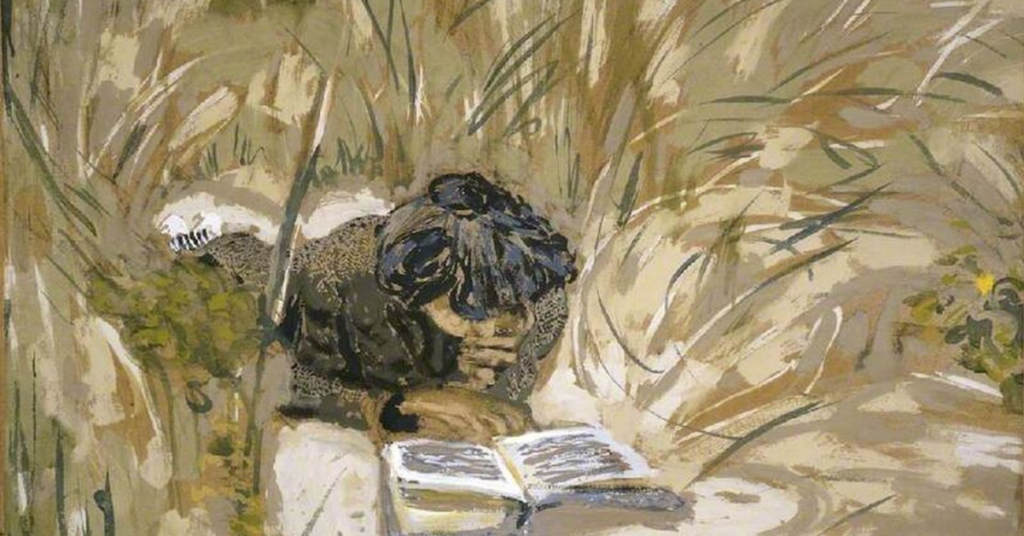
Cover image: “Woman Reading in the Reeds, Saint-Jacut-de-la-mer” by Edouard Vuillard, 1909.