


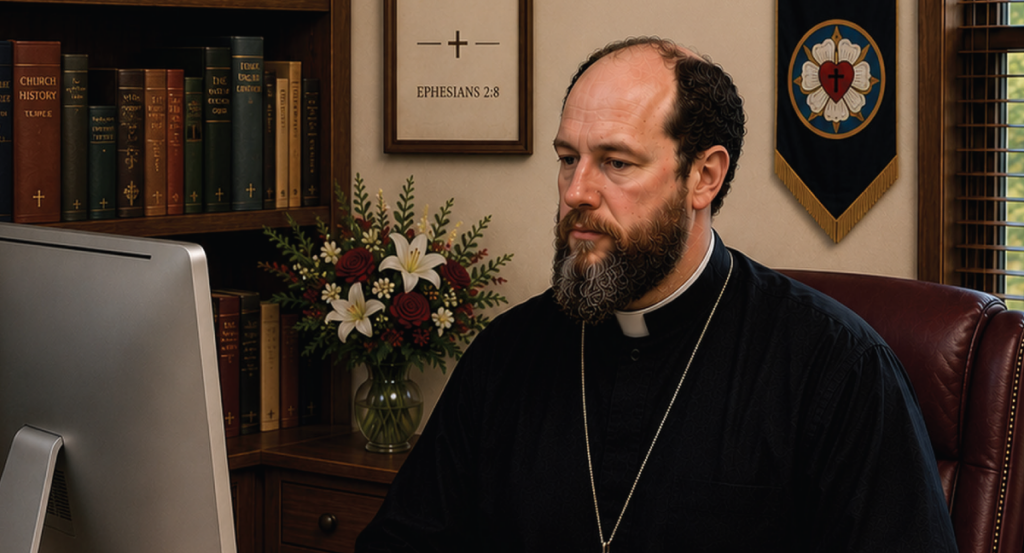
It all started with a dare. Earlier this summer, as members of the LW design team were brainstorming cover ideas for the August issue — all about artificial intelligence and the internet — I sent them the following note:
“This might sound silly to you (it definitely sounds silly to me), but if you’ve ever wanted to try designing a cover using AI, this would probably be the one and only time to do it. Doing so would make the cover a definite statement piece.”
I called the suggestion “silly” not only because our designers need zero help from AI bots to do their jobs well but also because sticking an AI cover on the front of the Synod’s flagship magazine would have been a flagrant violation of LCMS corporate policy. The Synod’s short, sensible AI policy document clearly states: “Final work products must be the worker’s own. Workers may not simply copy AI-generated content into work products.”
As I saw it, though, our August cover wasn’t just any old “work product.” It was an opportunity to show people — including ourselves — what AI could and could not do. Would AI be able to design a cover worthy of The Lutheran Witness? If it could, well, I would make whatever calls were necessary to carve out a limited exception to the stated AI policy guidelines.
I figured, even so, that each of our three staff designers would send back a polite “thanks, but no thanks” reply, and we would all go on our merry ways. Unbeknownst to me at the time, however, one of our intrepid artists, Carolyn Niehoff, actually took my suggestion seriously and spent a couple of eye-opening afternoons working with ChatGPT to produce two cover designs for the team to consider.
Designing a new cover for the magazine is always a highly creative and collaborative process. Each of our designers will take the cover text, the theme of the issue and a page of visual design ideas from me and create a handful of covers for the editorial team to consider. After the editors and designers have reviewed and talked through them together, we’ll choose one favorite to refine further for use in the magazine.
The process is not particularly efficient, nor is it what you might call an AI-friendly workflow. This is intentional. Quality art and design are rarely “efficient.”
An AI experiment
Our cover design meeting for the August issue began innocently enough. Lisa Moeller presented a range of eye-popping abstract covers that melded digital imagery with subtle classical art motifs from Michelangelo to Albrecht Dürer to Roy Lichtenstein. Erica Schwan went next, showing us a striking assortment of page designs that included a human head of pixelated light staring down a digital cross and a woman standing cheek-to-cheek with a robot. Powerfully evocative stuff. And then … it was Carolyn’s turn.
“Now I want you to know,” Erica stated up front, “that this is an experiment.”
I can’t say I wasn’t warned.
Carolyn loaded up her first cover design. It was … nice. It was also … weird. The cover showed a muted, photorealistic image of a pastor sitting at his desk, one hand resting lightly on his computer keyboard, the other on an open Bible. Behind him on the wall were a crucifix, a “soli Deo gloria” banner with a Luther rose, and wall art featuring Ephesians 2:8. He wore a black clerical shirt, a pectoral cross and a wedding band. So far, so Lutheran. But it still felt wrong.
“Hang on a sec. Is this one AI-generated?” I asked. The art team grinned, as Carolyn nodded.
“What do you notice about it?” Erica asked.
“The hands. They’re on the keyboard, but they don’t actually seem to be touching the keys, if you know what I mean?”
“Yes, and …”
“There are no letters on the keyboard!”
“Zoom in on his forehead, Carolyn,” Erica directed. “Notice anything there?”
“Is that … lizard-skin texturing?”
“Yes! It’s the strangest thing. It’s on his neck and left hand, too.”
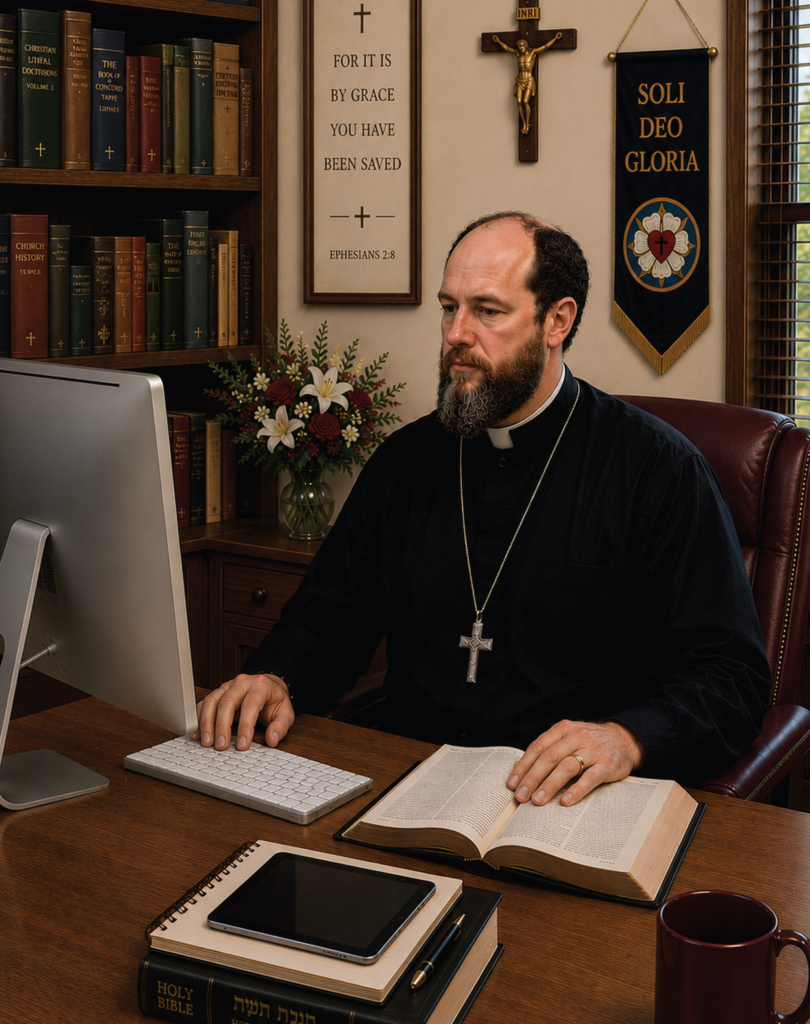
It was bizarre. Here we had a picture-perfect image of a pastor in his study, generated in seconds by an AI bot, and it was somehow all wrong. Looking back at the image now, the only thing I notice is the eyes: Vacant and soulless, they look straight ahead but seem to see nothing.
This image was a far cry from the photographs of actual Lutheran pastors I’ve seen from artists like LCMS photojournalist Erik Lunsford. The subjects in Erik’s photos are never perfect — he usually doesn’t wait until folks have on their “social-media-selfie faces” to start shooting — but they always look alive and human. This is what visual artists do, whether they “make pictures” like Erik or paint with oils on canvas — or even sketch with mechanical pencils on printer paper like my young daughters: they open a window on living humanity and help us see the soul and beauty in it.
As Lutherans, we believe “that God has made me and all creatures; that He has given me my body and soul, eyes, ears, and all my members, my reason and all my senses, and still takes care of them” (SC II 1). We confess, moreover, that mankind was created “in the image of God” (Gen. 1:27). Gazing at the empty eyes of the AI “creation,” it was hard to see how this “art” (if such it was) could possibly communicate these glorious and eternal truths.
Right … but also wrong
We moved on to Carolyn’s second cover: an image of a pastor sitting in the back of a sanctuary typing on a laptop with research keywords emanating from it. And again, it was impressively right while also being eerily wrong. The Reformation solas were there, as were the words “Christ Centered.” The altar held a chalice and paten, two candles and an open Bible. A cross and two stained-glass windows were positioned behind the altar and green paraments hung down in front of it. And yet … the chancel was noticeably asymmetrical, off center.
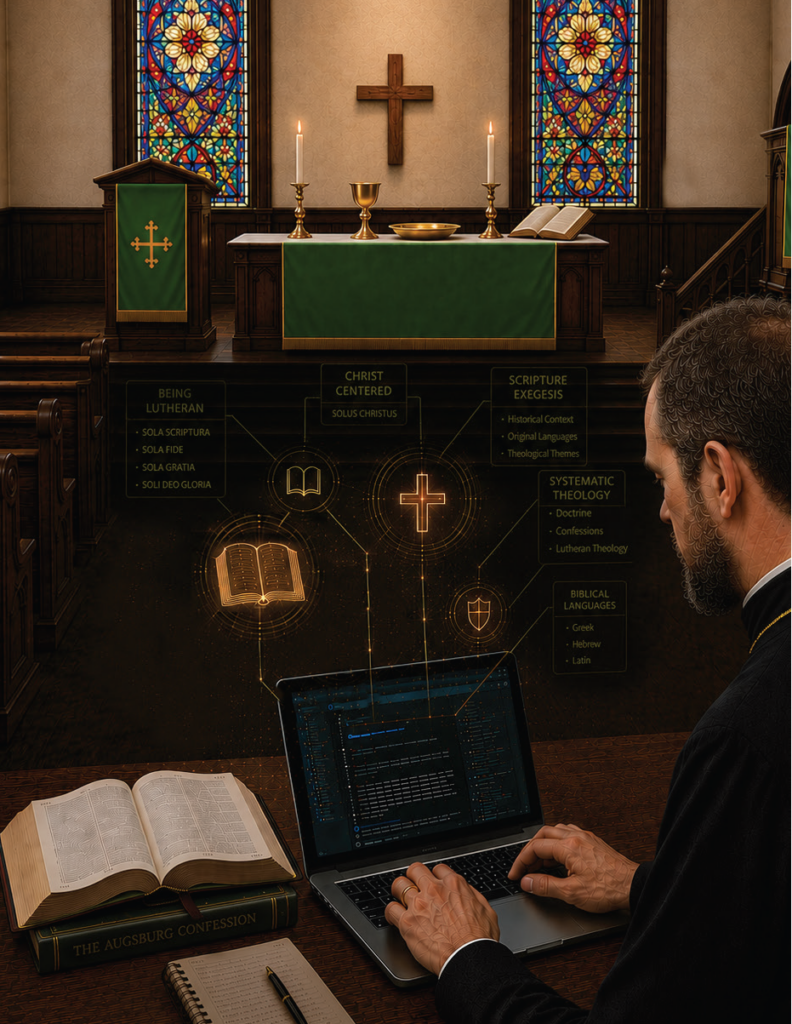
When I now zoom in to 400%, the uncanny nature of the image becomes even more obvious. The pastor’s hands are crisscrossed with bulging spider-web veins, and the fingers on the left hand appear to have been cut off at the knuckles. The words on the computer screen — not to mention the words on his open Bible — are lines of nothingness, melting off the page. There is no Word of God here.
The whole effect reminds me of a passage from C. S. Lewis’s 1945 novel That Hideous Strength. At this moment in the story, a group of demoniac intellectuals is attempting to initiate the book’s protagonist, Mark Studdock, into what they call a sense of “objectivity” by exposing him to uncanny and profoundly unsettling works of art:
“There was a portrait of a young woman who held her mouth wide open to reveal the fact that the inside of it was thickly overgrown with hair. It was very skilfully [sic] painted in the photographic manner so that you could almost feel that hair. … But most of the pictures were not of this kind. At first, most of them seemed rather ordinary, though Mark was a little surprised at the predominance of scriptural themes. It was only at the second or third glance that one discovered certain unaccountable details — something odd about the position of the figures’ feet or the arrangement of their fingers or the grouping. … What was the curious trick of lighting that made each picture look like something seen in delirium? When once these questions had been raised the apparent ordinariness of the pictures became their supreme menace — like the ominous surface innocence at the beginning of certain dreams. Every fold of drapery, every piece of architecture, had a meaning one could not grasp but which withered the mind.”[1]
I’m not saying that AI is demonic. Please don’t let that be the message you take away from this article. As several of the articles in our August issue point out, AI is a tool — one that can be usefully applied in many different contexts, from medicine to farming. I’m simply pointing out the alarming resemblance between Lewis’s description and the cover designs Carolyn created for us using ChatGPT. It’s all mildly disconcerting, to say the least.
Needless to say, we did not choose either of Carolyn’s AI “experiments” to grace the cover of our August issue. Instead, we opted for a more old-fashioned cover design — one featuring an incarnational image (snapped by flesh-and-blood photographer Erik Lunsford) of a human hand (something AI has famously struggled to render accurately) interacting with digital technology in the real world.
Yet our AI adventure was nonetheless eye-opening for the whole team, and none of us will soon forget the lessons we learned from it.
[1] C. S. Lewis, That Hideous Strength: A Modern Fairy-Tale for Grown-ups (Scribner, 2003), 295–296.
Cover image: AI-generated cover design prompted using ChatGPT; LCMS Communications/Carolyn Niehoff
Looking upon these images, I could immediately tell this was not an LCMS Pastor. Not a single book published by CPH.
Great article, Rachel! I admit the picture caught my eye b/c of its ‘perfect-ness’ while I was quickly scrolling through FB. At the time I noticed this picture, my casually dressed pastor-husband and I were enjoying a cup of coffee together while he took a break from sermon writing in his ‘comfortable’ home office (it’s not uncommon to see piles of paper and several theological books open alongside his Bible–hardly a picture perfect scene!). I drew my husband’s attention to the LW picture saying, “Look at this ‘picture perfect’ pastor working in his ‘neat as a pin office.’ It doesn’t even look real!” And then I read your article… I appreciate the thoughtful theological insight you shared after trying to find the ‘perfect’ AI cover design (that wasn’t!) for LW. May God continue to bless your work!
Rachel,
Very interesting article. The A1 just doesn’t have the human touch. Your Lutheran thoughtful approach and touch. Thanks for sharing this idea but I don’t think A1 is for me.
Yours in CHRIST,
Jim Pellerito