
A Feast, a Bonfire and ‘Martin Luther’
One Oct. 31, I went to a Christian gathering hosted by a local pastor, the Rev. Mitchell Dick, for youth and families at his home. I wasn’t expecting anything out of the ordinary, but it turned out to be a remarkable Reformation celebration.
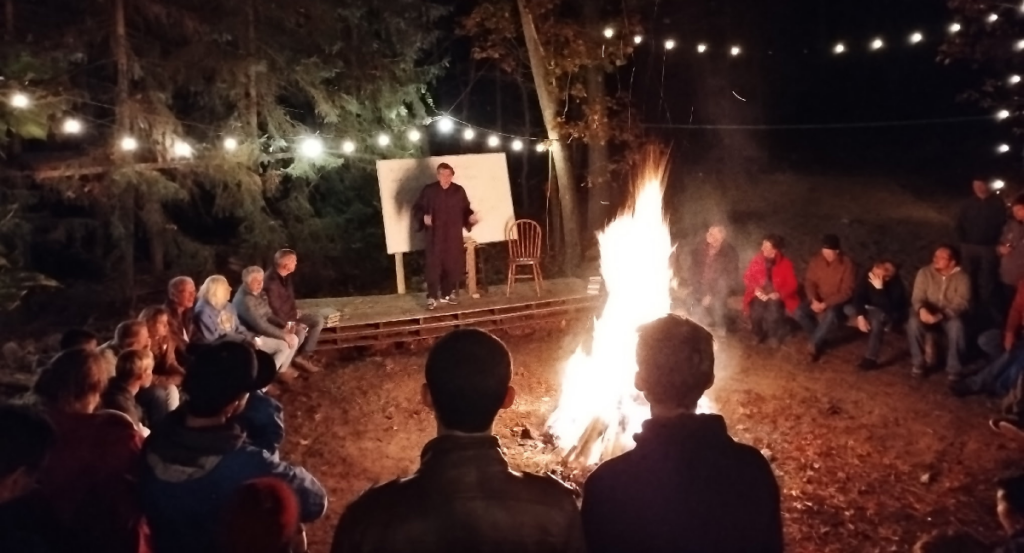
The evening began with a bountiful meal. As dusk fell, everyone moved outside to a backyard bonfire. Then came the surprise. Standing near the fire was “Martin Luther” himself, dressed in a monk’s robe, ready to tell his story.
We sat on logs around the blazing bonfire. Across the fire, we saw his silhouette. The pastor, in character, walked the group through the events surrounding the Reformation, beginning with the problems in the church that Luther objected to: abuses surrounding indulgences and distorted understandings of repentance, forgiveness and salvation. He also recounted how, on Oct. 31, 1517, Martin Luther nailed the 95 Theses to the door of the Castle Church in Wittenberg, Germany, hoping to spark a theological debate and help reform the church. The pastor brought to life Luther’s rediscovery of salvation by grace through faith, his escalating conflict with Rome and the dramatic moment when Luther publicly burned the papal bull that threatened him with excommunication. He even threw a replica of the bull into the bonfire! The crackle of the fire and the sparks flying into the sky turned church history into something young people could see and remember.
Immediately after that, hymnals were passed around, and “Martin Luther” shared the context in which “A Mighty Fortress Is Our God” (LSB 656/657), often called the “Battle Hymn of the Reformation,” was written. Luther composed the hymn during an incredibly turbulent period: His friend had been executed and the plague was raging. But the hymn, which he based on Psalm 46, sounds so defiant and assured: God is a fortress in which one finds refuge when everything feels like it is falling apart.
One voice started singing “A Mighty Fortress Is Our God,” and several dozen more voices immediately joined in. Several more logs were thrown into the fire, making hundreds of embers fly straight up into the dark, starry sky. We kept singing Martin Luther’s hymns until very late. Still, nobody wanted to leave. None of us wanted that beautiful evening to end. What could be better than celebrating Reformation Day in such a joyful, educational and unmistakably Lutheran way?
Remembering Wittenberg
The events of that evening sparked powerful memories in me. Several years earlier, I had visited Wittenberg myself. I saw the Castle Church door associated with Luther’s posting of the 95 Theses, and later, I stood at the exact spot where he burned the papal bull Exsurge Domine. The bull condemned 41 propositions from Luther’s writings, ordered his books to be burned and gave him 60 days to recant. When those 60 days expired, Luther gathered a crowd and threw the papal bull into the fire. He later described doing so while “trembling and praying.” Standing in those places had already made the Reformation feel much closer to me. Years later, sitting around the fire, watching a replica of the bull disappear into the flames, brought those memories back vividly.
Even so, I don’t think it was my trip to Wittenberg that made my experience of Rev. Mitchell’s bonfire so intense. The people sitting next to me and singing Reformation hymns were equally moved, and none of them, to my knowledge, had ever seen Wittenberg. It was Rev. Mitchell who gave us a concrete, memorable and deeply Lutheran experience in which the history of the Reformation suddenly felt alive, personal and worth remembering.
What struck me even more was this: The pastor who organized this evening isn’t even Lutheran. He is a United Reformed pastor. He simply appreciated the historical significance of the Reformation and chose to commemorate it in a vivid and memorable way.
That experience left me wondering: If a non-Lutheran pastor can recognize the importance of Oct. 31 and celebrate it so meaningfully, why do we Lutherans sometimes let Reformation Day pass without making more of it? We possess a remarkably rich inheritance within our own tradition, and Reformation Day gives us a wonderful opportunity to celebrate and pass that heritage on to the next generation.
Costumes, Candy — and Missed Opportunities
After Oct. 31 is behind us, the first Sunday in November arrives. We go to our local LCMS church. The service is beautiful, as usual. But I have begun to notice how easily conversations about costumes and candy become intertwined with conversations about the Reformation.
The children’s message may start with the pastor asking the children, “So, how was your trick-or-treating?” I find myself wondering: What if the Reformation itself became a natural starting point for talking with our children about Oct. 31?
When I sit in the pews on the first Sunday in November, my memory often returns to the bonfire and the Christians gathered around it singing “A Mighty Fortress Is Our God.” After seeing how vividly Oct. 31 can be celebrated as Reformation Day, I simply cannot imagine letting the day pass while our own Lutheran tradition goes unnoticed.
Since then, I have talked to many Lutheran pastors about recovering our Lutheran heritage. For example, I spoke with Rev. Marin Cerchez, who was inspired by the story of that bonfire. His congregation, Calvary Lutheran Church in Charleston, South Carolina, decided to focus more intentionally on celebrating Reformation Day on Oct. 31.
Rev. Cerchez recalls:
For years, Calvary held an oyster roast every November as a fellowship gathering, a chance for our members to enjoy good food and one another’s company. This year, we’ve become more intentional. As a congregation, we are returning to our historic Lutheran roots, so instead of our November fellowship roast, we’re holding our first Reformation Day Oyster Roast on Saturday, October 31. It is both a celebration and an outreach event: a celebration of who we are as Lutherans, and an open invitation to our neighbors to come see for themselves. From 2:00 to 5:00 p.m., families can enjoy a Family & Kids’ Afternoon with hands-on stations that bring the Reformation to life. Children can nail their own “theses” to a wooden door and print a page on our printing press. They can make a Luther Rose craft, visit a table of “relics,” and play games like the Diet of Worms and the Indulgence Toss, and they’ll still be home in time for trick-or-treating. From 5:30 to 7:30 p.m. We’ll gather around the fire for oysters, sing the great hymns of our tradition, including “A Mighty Fortress,” and hear a short talk on why the Reformation still matters. I’ll be at a table all evening for anyone who wants to ask questions or simply get acquainted. We want our neighbors to know who we are and why it matters, and we’d love for them to join us.
Our Lutheran Heritage: A Compelling Alternative
American Lutheran congregations respond to Halloween in a variety of ways. Some fully engage, some participate with caution, and some even discourage participation. But relatively few congregations provide families and youth with a compelling Lutheran alternative. In a time when cultural pressures easily pull families in many directions, giving Reformation Day a more prominent place on Oct. 31 could become a powerful way for Lutheran congregations to celebrate and publicly share their faith and heritage.
A Reformation bonfire and hymn-sing can strengthen congregational life in several ways at once. It can revitalize Lutheran congregations by bringing families together around a shared tradition rooted in faith. It can support theological education by teaching the core insights of the Reformation in a concrete and memorable form. It can strengthen youth ministry by giving children and young people a vivid encounter with church history and the Gospel. And it strengthens Lutheran families by offering them a joyful and meaningful way to celebrate their faith together. For these reasons, I would love to see Lutheran congregations rediscover Oct. 31 as a night of church history, Christian teaching and joyful fellowship.
Cover image: Vladimir Snurenco