

A literary reflection by Kate Deddens on John Bunyan's The Pilgrim's Progress.
This is one installment of a monthly series providing reflections on works of literature from a Lutheran perspective.
My walk is heav’nward all the way;
Await my soul, the morrow,
When God’s good healing shall allay
All suff’ring, sin, and sorrow.
Then, worldly pomp, begone!
To heav’n I now press on.
For all the world I would not stay;
My walk is heav’nward all the way.— “I Walk in Danger All the Way,” LSB 716:6[1]
In the waning years of the 18th century, Samuel Taylor Coleridge published his famous poem, The Rime of the Ancient Mariner, a tale of a sea voyage that may be read as symbolic narrative of a Christian life. From its initial stanzas, it thrusts the reader into a world of biblical imagery. The poem’s wealth of such references makes it no surprise that Coleridge praised John Bunyan’s even more famous allegory: “I know of no book, the Bible excepted … which I … recommend as teaching and enforcing the whole saving truth according to the mind that was in Christ Jesus, as The Pilgrim’s Progress.”[2]
Bunyan himself heaped similar high praise on another book, one which may come as a surprise: Martin Luther’s Commentary on Galatians. Obtaining an English translation of it, Bunyan wrote:
It was so old that it was ready to fall piece from piece if I did but turn it over. Now I was pleased much that such an old book had fallen into my hands; the which, when I had but a little way perused, I found my condition, in his experience, so largely and profoundly handled, as if his book had been written out of my heart. … I do prefer this book of Martin Luther upon the Galatians, excepting the Holy Bible, before all the books that ever I have seen, as most fit for a wounded conscience.[3]
Just as Martin Luther transformed the world, Bunyan’s allegory took its place as a literary work of tremendous impact. The Pilgrim’s Progress[4] has never been out of print since it was published nearly 350 years ago. It has been translated into 200 languages and is estimated to have sold over 250 million copies. That is a legacy few other texts can dream of matching.
About the Author
Considering its origins, the success of The Pilgrim’s Progress comes as another surprise. John Bunyan had no worldly status, wealth or extensive education. He was born to a humble family of traveling tinkers. He could read and write, but he left school early. As a young man, he was swept up in the religious, social and political tensions of the English Civil War, after which he married. In his autobiography, Grace Abounding to the Chief of Sinners, he described that he and his wife “came together as poor as poor might be (not having so much household stuff as a dish or a spoon betwixt us both).”[5] Born into the Anglican Church, Bunyan was later influenced by Puritan theology, becoming an independent itinerant preacher. He was later arrested for preaching without the sanction of the Anglican Church. While imprisoned, he wrote The Pilgrim’s Progress.
The allegory was penned during an era of profound religious and political strife. Within those turbulent times, Bunyan experienced tremendous adversity, coming to intimately understand the ordeals of poverty, physical confinement and personal spiritual warfare. In Grace Abounding, Bunyan speaks of grappling with a troubled mind and a disturbed conscience, his soul immersed in the turmoil of doubt and despair. He also describes his liberation from that condition. This personal experience is the backstory for The Pilgrim’s Progress.
‘Road Map’ for the Christian
The Pilgrim’s Progress, painstakingly providing extensive scriptural references throughout the book as its ongoing compass,[6] is intended to be a road map for the Christian. Bunyan writes:
This book will make a traveler of thee,
If by its counsel thou wilt ruled be;
It will direct thee to the Holy Land,
If thou wilt its directions understand…[7]
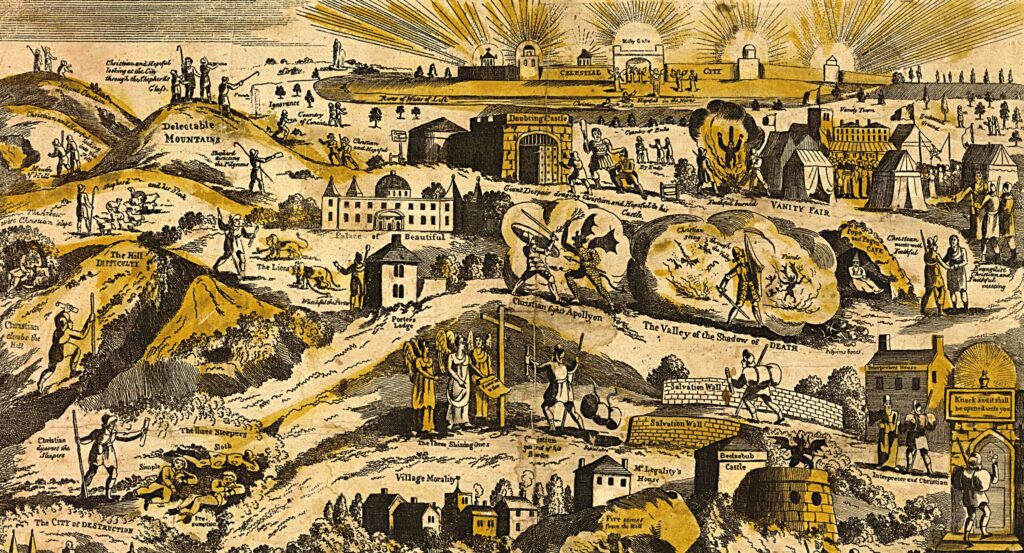
The story unfolds through descriptive prose, heavy allegory and dialogue. It depicts a treacherous trek across uncertain terrain as the protagonist journeys towards eternal life in the heavenly Celestial City. The tale is the retelling of a dream, following the pilgrim named Christian who carries a heavy burden upon his back.
Christian follows a straight and narrow path through a landscape of mythological proportions: infused with dangerous quagmires, steep mountains, dark valleys and places like the City of Destruction and Vanity Fair; marked by castles and keeps, homely houses and restful arbors; infested by all manner of monsters and terrors; and populated by individuals, such as Mr. Worldly Wiseman, who endeavor to turn Christian astray, as well as by godly, sometimes supernatural guides such as Evangelist and Goodwill who help Christian complete what he could never do on his own. Christian has been given his salvation by grace; the story is focused on the journey he makes in this earthly life as he encounters both obstacles as well as divine intervention to combat them.
Luther’s Influence
Beginning with the words “As I walked through the wilderness of this world,” The Pilgrim’s Progress follows a tradition of spiritual questing established in the earliest literary masterpieces, such as Homer’s Odyssey, Virgil’s Aeneid and Dante’s Divine Comedy. Yet it is probably not in any of those that Bunyan found inspiration. Rather, he took his cue from the great reformer Martin Luther’s Commentary on Galatians. While not an autobiography, Commentary on Galatians reflected Luther’s struggles and experiences, containing anecdotes and the language of personal enlightenment through encountering Scripture.
The spirit of Luther’s commentary permeates Bunyan’s allegory, from Christian’s convictions through reading the Word, to his miraculous liberation from his burden at the feet of Christ crucified, to his encounter with the dragon Apollyon during which Christian wounds him with the Sword of God while proclaiming Scripture (Micah 7:8; Rom. 8:37).
There are, admittedly, many aspects of Bunyan’s allegory that conflict starkly with Lutheran theology. For example, the focus on personal striving and required action on the part of Christian is emphasized from the beginning of the text, where Christian, after reading the Bible, “wept and trembled; and not being able longer to contain, he brake out with a lamentable cry, saying, ‘What shall I do?’”
Nevertheless, The Pilgrim’s Progress makes it clear that Bunyan took Luther’s teaching in Commentary on Galatians to heart. In it, Luther writes: “[T]he afflicted conscience has no remedy against despair and eternal death except to take hold of the promise of grace offered in Christ, that is, this righteousness of faith.”[8]
Indeed, there are pivotal moments in the text when Christian, ever stepping forward in faith, unquestionably requires explicit divine intervention to protect and heal him, such as when Goodwill forcibly pulls Christian to safety to shield him from Beelzebub’s arrows, when three angelic beings minister to him at the cross after his burden falls away, and when a supernatural hand heals him following his battle with Apollyon. Christian receives this divine provision with a spirit of gratitude and praise.
Bunyan’s tale describes the walk of the Christian through this earthly life, afflicted by both external and internal destructive forces. The Christian, however, perseveres to “run the race” (1 Cor. 9:24–25; Heb. 12:1–3; 1 Tim. 4:7). Although no Sacraments are referenced, the world in which the Christian must walk is saturated with a sacramental ethos, teeming with invisible evil forces that attack and delay him, but also with heavenly agents who guide, help and miraculously bring him to the finish line. He does not come to the end of the straight and narrow path by his own strength or merit.
The hymn “I Walk in Danger All the Way” is a musical echoing of The Pilgrim’s Progress. It was written by Lutheran Bishop Hans Adolf Brorson, who lived not long after Bunyan. Given the reach of The Pilgrim’s Progress, which reportedly had tens of thousands of copies in circulation even during Bunyan’s lifetime, Brorson was likely familiar with the allegory. More significantly, he would have been well acquainted with the teachings of Martin Luther: the man who provided significant comfort to Bunyan in his own pilgrimage — a journey he described in a story which is possibly the second bestselling book in history after the Bible and whose popularity has endured for generations. Despite significant theological differences with Lutheran beliefs and practices, The Pilgrim’s Progress is ultimately edifying, eloquently reminding us to journey always in the grace of Christ Jesus, walking “heavn’ward all the way.”
[1] Lutheran Service Book 716. I walk in danger all the way | Hymnary.org
[2] The Literary Remains of Samuel Taylor Coleridge, Notes on The Pilgrim’s Progress
[3] John Bunyan, Grace Abounding to the Chief of Sinners
[4] This reflection focuses on the initial book, now referred to as Part I. Bunyan later published a second part, The Pilgrim’s Progress from This World to That Which Is to Come: The Second Part, Delivered Under the Similitude of a Dream.
[5] John Bunyan, Grace Abounding to the Chief of Sinners
[6] The original 1678 version cites Scripture repeatedly to support Bunyan’s narrative; later editions do not necessarily include these citations.
[7] John Bunyan, “Apology” Logos Virtual Library: Bunyan: The Pilgrim’s Progress, I, Apology
[8] Martin Luther, Luther’s Works, Vol. 26: Lectures on Galatians, 1535, Chapters 1-4, ed. Jaroslav Jan Pelikan, Hilton C. Oswald, and Helmut T. Lehmann (Concordia Publishing House, 1999), 5–6.
Cover image: Detail from “The Pilgrim’s Progress, or, Christian’s Journey from the City of Destruction in This Evil World to the Celestial City in the World That Is to Come”(London: J. Pitts, 1813).