


By David Van Rooy
One Sunday not long ago at my congregation (Immanuel Lutheran Church in Alexandria, Va.), we said goodbye to yet another military family as they prepared to move overseas. The moment was a familiar one. There were prayers at the altar, a bustle of activity and conversation during coffee hour after the service, but also the unspoken awareness that this farewell might be permanent. And for my military family, watching them depart carried particular weight, because we know that sooner or later the same moment will come for us. It is a pattern we recognize well, one we both anticipate and dread. With each set of military orders come new opportunities, new relationships and new ways to serve God. Yet every arrival in a new place also marks the beginning of the next cycle of saying goodbye.
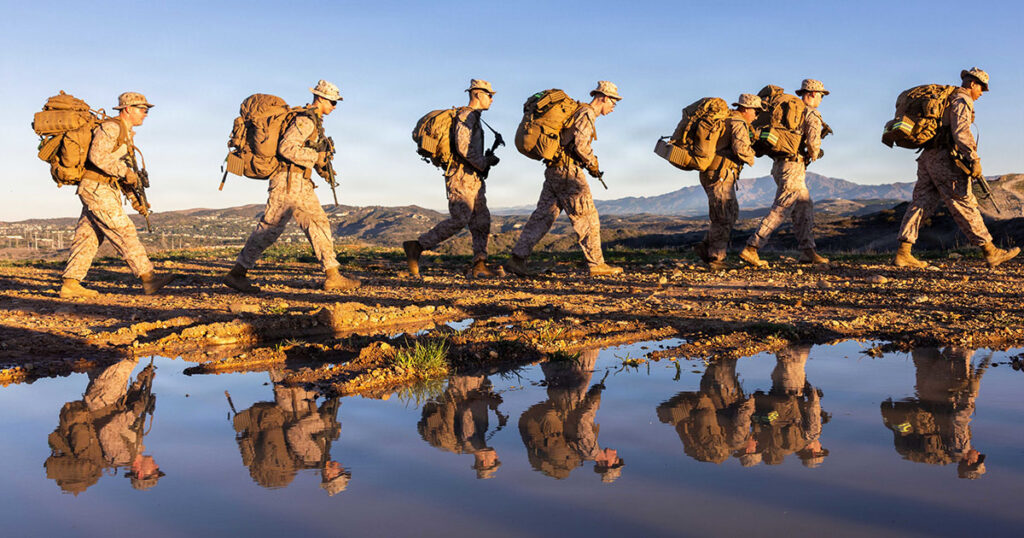
Over the last 14 years, my wife and our three daughters have learned to live within this rhythm, though it never becomes comfortable. Yet this pattern exists for a reason. Men and women who serve are asked to answer a call that reaches beyond any single community or place. That call binds them to a broader duty, to service that preserves a way of life that allows Americans to live without fear and enables the church to carry out her mission freely. In this way, military service is a necessary and honorable calling, one that Christians can rightly understand as God-ordained and worthy of respect as a genuine vocation.
The Purpose of the Military
At its most basic level, military service exists to protect God’s people as they go about the ordinary work of life. It deters aggression so that war does not occur. It stands ready when violence threatens communities, peoples and nations. It responds when disaster overwhelms civil authorities. It gives elected leaders lawful options in response to crisis. For those who serve, the daily work is preparation, readiness, discipline and vigilance, undertaken for the preservation of peace in the world through the use of force.
This purpose is often misunderstood when the military is reduced to caricature, either as institutionalized violence or as a tool wielded for political gain. Such portrayals miss the disciplined and morally constrained manner in which the profession of arms is meant to operate. Our military does not unleash lawless force, but employs force in a restrained manner, ultimately directed toward the protection of human life. That distinction matters, especially for Christians who take seriously the call to love their neighbors in a fallen world.
God’s Work Through Earthly Service
Our Christian faith has long recognized that God works in more than one way. He saves us through Christ’s sacrifice on the cross, delivering forgiveness, life and salvation through the Gospel. At the same time, He preserves life in this world through earthly callings. Parents raise children. Courts punish wrongdoing. Civil authorities restrain violence. Lutheran theology has often described this as God’s work in His kingdom of the left hand, distinct from His saving work through Word and Sacrament in His kingdom of the right hand.
Military service belongs to this preserving work within the left-hand kingdom. Soldiers do not advance the Gospel by force, nor do they fight holy wars. Instead, they serve their neighbors by helping to restrain violent evil so that ordinary life may continue in peace and order. This work does not replace God’s grace, nor does it promise an ultimate worldly peace. Yet in a broken world, it remains one of the means through which God shelters His people from harm and preserves the conditions under which faith, family and community can endure.
The Cost of Service
This calling carries real moral weight. Authority must be lawful. Force must be restrained. Only the force necessary to accomplish the mission should be employed. These limits do not remove the tragedy that accompanies the loss of human life, but they guard against cruelty and excess. They remind those who serve that they act under judgment, accountable not only to laws and superiors, but to God Himself.
Military service also shapes those who undertake it. It places responsibility on young shoulders. It demands discipline, endurance and obedience to authority. It tests character under pressure and exposes weakness that cannot be hidden behind words or intentions. These traits are not cultivated for their own sake, but because the task requires them. When lives depend on preparation and reliability, character matters.
At the same time, this formation of character and military readiness comes at a cost. Separation from family, frequent moves and deployments, exposure to danger and moral strain are part of the vocation itself. To honor military service is not to romanticize it, but to acknowledge both the good it seeks and the weight it places on those who bear it.
A Worthy Path
Soon, my family and I will stand where others have stood before us, receiving prayers and saying our own goodbyes. We will do so with clear eyes and grateful hearts, knowing that this calling, though costly, is good. For young men and women discerning their place in the world, military service remains a worthy path, one through which God works to protect His people and preserve the peace of the country we are honored to serve.
Photo: LCMS Communications/Erik M. Lunsford.


I spent 28 years in the military and more times then not, my family took a backseat to the demands of the military. Many times friends and family stepped in to help bridge the gap while I was gone. With that said I ask and encourage my fellow parishioners to help step in and offer to help those families with what ever you can offer.
1. The mother is often saddled with holding the family fort down while the spouse is gone. One of the best things to do is to offer to watch the kids while mom needs to take a Saturday break to recharge.
2. Offer to help them with family activities or shuttling kids around.
3. Help with outside chores around the house – cutting and trimming the landscaping, mowing the lawn, moving snow.
4. Bringing the littles to Sunday School/Church.
It doesn’t take a big time commitment to help out.
Thanks and God Bless to those that helped my family during my many deployments.
Mike Weisz