


Editor’s Note: This series from LCMS Church Worker Wellness is hosted on The Lutheran Witness site. Visit the “Ministry Features” page for regular Worker Wellness content.
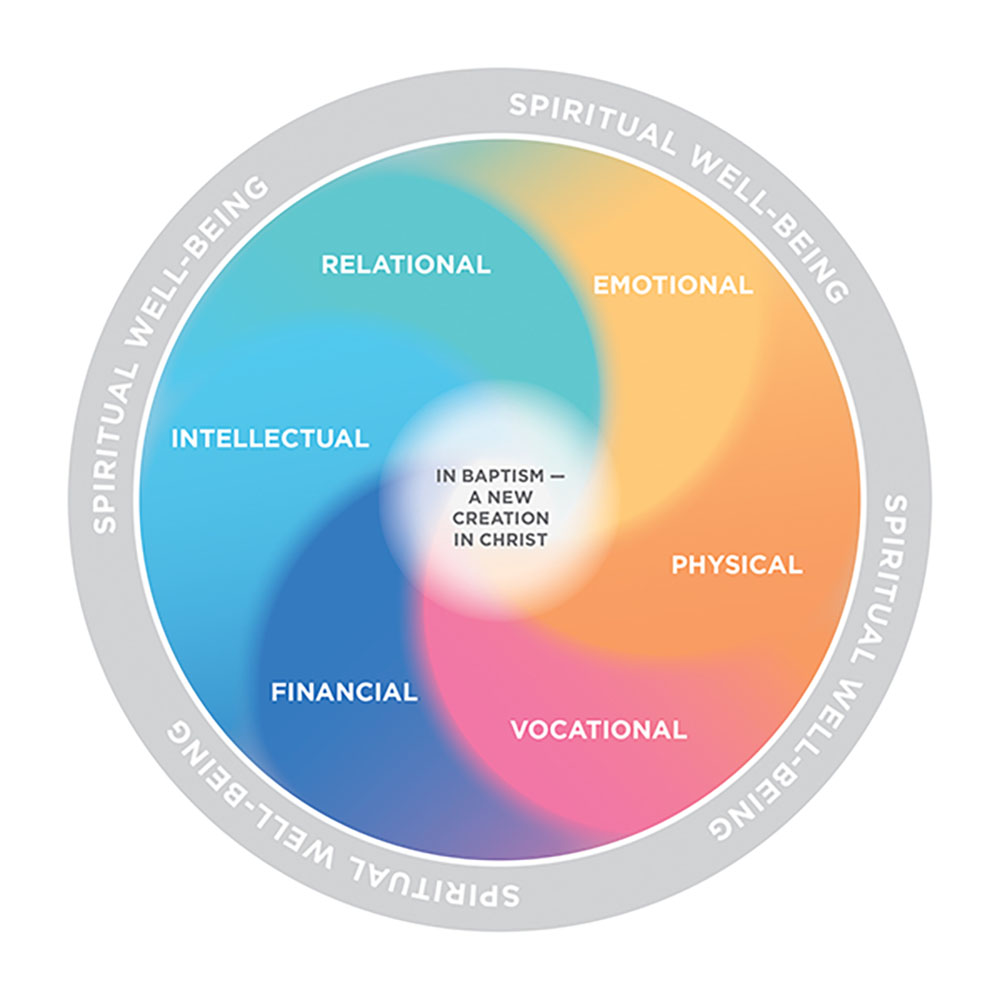
As Lutherans, we understand that the various aspects of our wellness — intellectual, emotional, relational, physical, financial and vocational — relate to and depend upon one another, and are all rooted in our Baptism, our true identity as new creations in Christ. We understand spiritual well-being not as a facet of our wellness, but as fundamental to any and all facets of wellness for a Christian.
The following reflection, written by the Rev. Dr. Heath Trampe, explores the theology of vocational well-being in team ministry.
Team ministry functions like a good pair of bifocals — both amplifying what is present and bringing it into greater focus. When a team is working effectively, its combined efforts far outstrip the efforts of the pastor alone. When members of a team are experiencing conflict, it generally comes to light more quickly than when a pastor experiences inner turmoil. And it can have a significant impact on the congregation. Having served in team ministry my entire career, I have extensive experience with both realities. Whether functional or dysfunctional, team ministry is inherently biblical.
In 1 Corinthians 12, Paul uses a familiar Greco-Roman political analogy by comparing the church to a body.[1] And while Paul returns to this analogy many times throughout his epistles,[2] this instance is likely the most well known. He writes: “For just as the body is one and has many members, and all the members of the body, though many, are one body, so it is with Christ. … If all were a single member, where would the body be? As it is, there are many parts, yet one body” (1 Cor. 12:12, 19–20). And then in Romans 12:6, he adds, “Having gifts that differ according to the grace given to us, let us use them.”
Serving from the ‘First Chair’
Every pastor in the LCMS shares with his members the vocation of “baptized Christian.” Most pastors also share some variation of the calling to be a son, brother, husband and/or father. Foundationally, the vocational responsibilities of parish pastors are strikingly similar — whether senior pastor, associate pastor or sole pastor. However, the senior pastor working with a team often has amplified vocational responsibilities that are worthy of discussion.
To be certain, even senior pastors with administrative oversight for dozens of paid staff have the primary responsibility to be grounded in the Word, to be in daily prayer and to receive God’s gifts as redeemed sinners. They are called to faithfully preach the Word of God and administer His Sacraments. They are called to care for and counsel the sick, the injured, the heartbroken and the homebound. In addition to this, they are called to care for the staff they serve alongside.
In Building Up the Body of Christ, the Rev. Dr. Bruce Hartung writes: “God gives church leaders an office of leadership and the spiritual gifts they possess not because of their own inherent capacities and skills, but in grace and for the good of others. … Leaders who understand themselves and see the gifts and offices of others in the light of these biblical truths will strive in the Spirit to strengthen those around them and be strengthened themselves as the Body of Christ is built up.”[3]
Many senior pastors, particularly those with administrative responsibility for paid staff, have displayed gifts of leadership that are highly praised by the secular world. Conventional cultural wisdom dictates that such individuals should be elevated. Yet it is vital for pastors, staff and laity alike to remember that these leadership gifts have been distributed for the good of the church — not the glory of the pastor: “True servant leadership will always seek to better those you are leading in order to help subordinates be successful and effective in their current role.”[4] Truly, a rising tide lifts all boats. Focusing on the success of those around us provides vocational satisfaction and contributes to the well-being of the ministry and community being served.
Leading from the ‘Second Chair’
Team ministry leaves room for various second chair leaders. A “second chair leader” could be an associate pastor, but it could also be a director of Christian education, a kantor, an executive director or a whole host of volunteer leaders. In their book Leading from the Second Chair, Mike Bonem and Roger Patterson list ideal traits that should be front and center on any “second chair” position description: “Support the [first chair] through your loyalty, your encouragement, and by taking on specific duties as they are assigned. Gain a clear understanding of the authority that [he] is giving you, and always keep [him] informed of any significant undertakings or issues. Always think of the needs of the [congregation] ahead of any specific tasks.”[5]
Truly, the authority to carry out our work is bestowed by Christ (Matt. 28:18–20) and through the congregation that has called and/or hired us. In team ministry settings, authority has also been given to the senior pastor to oversee the various responsibilities of the team. When the senior pastor and his team operate according to the Word of God and in service to one another and the congregation, this functions as a great amplifier, serving the congregation and community more deeply and widely than when the pastor serves alone. But when teams move in different directions or communication falls to the wayside, it can easily lead to siloed ministries and resentment.[6]
What can we do to promote vocational well-being within the team? Return often to the Word of God: “Dwelling in God’s Word and praying must characterize the work of church leaders, not only during corporate worship and individual devotions, but also during church board meetings. These disciplines reflect dependence on Christ, keeping the command to have no other gods. They also shape God’s people as spiritually focused leaders.”[7] And upon this foundation of God’s Word and prayer sits a house composed of organization and trust.
Meeting regularly and keeping each other informed will pay dividends when seasons get busy. Good organization and communication are the responsibility of everyone on the team, for the good of the congregation. Speaking from personal experience, the highs and lows I experienced while serving as an associate pastor have stuck with me through many years of serving as a senior pastor.[8] I remember with gratitude (and a healthy amount of humility!) the lessons learned from my senior pastor and fellow team members. When done for the glory of God and for the good of the congregation, team ministry is an incredible blessing.
The ‘Vital Few’ and the ‘Helpful Many’
Volunteers in the church serve millions of full-time equivalent hours each year. Regardless of the staff size at your church, much of the work of the parish is done by volunteers. The Rev. Dr. Jamison Hardy, president of the Concordia University System and former president of the LCMS English District, writes: “The greatest contributions made to the ministries and congregations I have served were done by title-less laymen and women, people of God who had a passion of serving others and loving their neighbor.”[9] Whether discussing those with involved leadership roles (the vital few) or those who continually show up to ensure that many hands make light work (the helpful many), it’s important to express genuine gratitude as a rule: “You can never thank people enough for the dedication and sacrifice they make as title-less leaders in congregations and ministries throughout the church.”[10]
This wisdom applies also to the titled members of the ministry team. We can model the apostle Paul in his letter to the Philippians (a passage I included at the bottom of nearly every card I wrote to members of my congregation or my teams): “I thank my God in all my remembrance of you, always in every prayer of mine for you all making my prayer with joy, because of your partnership in the gospel from the first day until now. And I am sure of this, that He who began a good work in you will bring it to completion at the day of Jesus Christ” (Phil. 1:3–6).
More could be said about volunteers in the church. Genuine gratitude goes a long way. And when gratitude is added to a foundation of Scripture, prayer and solid communication, the church serves with joy.
The Joy of Team Ministry
The Rev. Dr. Darrell Zimmerman, who served as the longtime director of Grace Place Wellness Ministries, writes that joy is “fuel for ministry” and provides seven compelling reasons to back his claim.
Joy is fuel for ministry …
- because it flows from the Good News of the Gospel of Christ;
- because it’s a foundational emotion of life in Christ;
- because even though the flesh is weak, a heart filled with joy continues in the challenging daily task of ministry;
- because all ministry is the work of the Holy Spirit;
- because just when we feel like giving up, He opens the eyes of our hearts to see the work of Jesus;
- because we are friends of the Bridegroom; and
- because the Word of God fuels ministry, and there’s always joy in the Word of God.[11]
I grew up attending a smaller LCMS church in a rural community of under 300 people. The LCMS model of my childhood was of a faithful sole pastor serving the congregation with help from a modest number of volunteers. And, since those volunteers were often my parents, grandparents, cousins and friends, I felt intimately involved in the gentle ebb and flow of congregational life. When I was called out of seminary to serve a congregation of thousands as the associate pastor, I entered the Office with no small amount of trepidation. Preconceived notions quickly gave way to daily awe as God combined my humble efforts with those of dozens of staff members and hundreds of volunteers. True to the bifocal metaphor, God amplified my efforts and the efforts of my teammates as we worked together for His glory. And while conflict came and went through the years, I mostly remember the blessings.
Whether you serve a smaller congregation with mostly volunteers or a larger congregation with many paid staff, God has bestowed similar vocational responsibilities. Remember your Baptism. Love your family. Serve your congregation faithfully as one redeemed by Christ the crucified. And count it all joy. Lift up your eyes — the fields are white for harvest (John 4:35).
[1] Gregory J. Lockwood, 1 Corinthians (Concordia Publishing House, 2000), 444.
[2] See Rom. 12; Eph. 1; 4:12, 16; Col. 1–3.
[3] Bruce M. Hartung, Building Up the Body of Christ: Supporting Community Life in the Church (Concordia Publishing House, 2016), 18–19.
[4] Jamison J. Hardy, Pastoral Leadership: Shepherding and Caring for God’s People (Concordia Publishing House, 2023), 124.
[5] Mike Bonem and Roger Patterson, Leading from the Second Chair: Serving Your Church, Fulfilling Your Role, and Realizing Your Dreams (Fortress Press, 2020), 82.
[6] Bonem and Patterson, Leading from the Second Chair, 73–75.
[7] Ted Kober, Built on the Rock: The Healthy Congregation (Concordia Publishing House, 2017), 181.
[8] And currently, as I serve at the LCMS Office of National Mission.
[9] Hardy, Pastoral Leadership, 128.
[10] Hardy, Pastoral Leadership, 132.
[11] Darrell Zimmerman, Reclaiming the Joy of Ministry: The Grace Place Way to Church Worker Wellness (St. Louis: Grace Place Wellness Ministries, 2020), 101–103.
To learn more about church worker wellness, browse LW ‘s Worker Wellness series, download the 2021 booklet “A Lutheran Perspective on Well-Being” (LCMS), or visit the LCMS Church Worker Wellness site.