
The following article originally appeared in our April 2026 print edition. It is being published online now as part of LCMS Life Ministry’s Resource Library.
If you were to ask a medical doctor what it means for a human to have “life,” he would probably cite several physical characteristics, beginning with a heart that is beating and a brain that has gamma-wave activity. He might go on to state that there are Leading Health Indicators put forth by the U.S. Department of Health and Human Services, such as life satisfaction, sense of meaning and purpose, future outlook, as well as physical and mental health. There is also an international Human Development Index, which assesses the quality of life globally based upon life expectancy, amount of education and income level. It is supposed that the higher these indicators are, the better the lives of the people.
The Scriptures define “life” much differently than a family physician or a set of indicators. They reveal that the one true God, the Holy Trinity, is the Creator and Source of life. A small detail in the creation narrative of Genesis is very significant for the biblical understanding of human life: “Then the Lord God formed the man of dust from the ground and breathed into his nostrils the breath of life, and the man became a living creature” (Gen. 2:7). A human is more than just flesh and blood; vital to human life, as the Scriptures reveal, is having the breath or Spirit of life. In short, life is being in communion or union with God, the source of life, through the Spirit. As the Gospel of John records, Jesus taught that “life” means communion with the true God, through the Spirit who creates and nurtures faith.
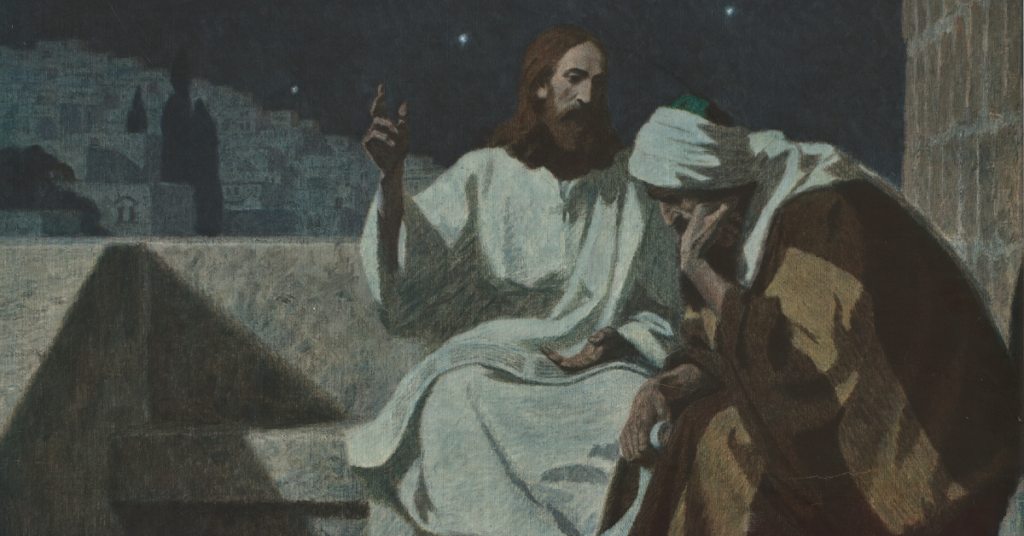
In the opening verses about the Son as the eternal Word, John writes, “In Him was life, and the life was the light of men” (John 1:4). Because the Son is true God and the one through whom the Father created all things (John 1:3), He is the source of life. As Jesus taught, “For as the Father has life in Himself, so He has granted the Son also to have life in Himself” (John 5:26). To be in communion or faith union with the Father and the Son through the Spirit is to have life. The opposite is also true: Those who are not in communion with the true God are truly dead, even if they have a beating heart and brain activity. In John 3, Nicodemus was puzzled when Jesus implied that he was spiritually dead because he needed to be “born from above” (John 3:3; author’s translation) or “born of water and the Spirit” (John 3:5). In response, Jesus explained, “That which is born of the flesh is flesh, and that which is born of the Spirit is spirit” (John 3:6). Without the Spirit who brings us into communion with God, we are dead.
Your Eternal Life Has Already Begun
Jesus then told Nicodemus a very important characteristic of this “life” He was offering: “As Moses lifted up the serpent in the wilderness, so must the Son of Man be lifted up, that whoever believes in Him may have eternal life” (John 3:14–15). This is an amazing promise! Because of the Son being lifted up on the cross as the atoning sacrifice for all sin, a life without end — an eternal life — is given as a gift to undeserving sinners in whom the Spirit works faith. While faith always produces good works, it is this faith union with Christ that alone saves. This is the first of several times the adjective “eternal” is found with “life” in this Gospel.
Much of the world thinks of life as lasting 70 or 80 years (Psalm 90:10), maybe less and sometimes a bit more, but it seems unnatural to speak of life as eternal. Humans have become so used to death all around us that it is often talked about as a natural part of life. That is a lie. What is natural is that we were created to be in eternal communion with God, a communion that was destroyed by mankind’s sin (Gen. 3:1–7; Rom. 5:12). God is eternal, so the life He gives is eternal. It does not end in a tragic accident or on a hospital bed; it continues beyond physical death as we remain alive in communion with God even while our body rests in a burial vault 6 feet underground.
There is a tendency among Christians to think of eternal life as a future reality beginning upon physical death. But Jesus taught that eternal life begins the moment the Spirit brings us to faith: “Whoever hears My word and believes Him who sent Me has … passed from death to life” (John 5:24).
For many Christians, this happened through “water and the Spirit” at our Baptism (John 3:5). Because our eternal life has already begun, we live confidently without the constant fear of physical death. Because we are already in communion with God, we live not focused on ourselves and guided by selfish desires, but knowing that our key purpose is to love God and our neighbor, guided by His Word (John 13:33–35). Christians on earth can experience, in part, the abundant life as it was first created to be. This is what Jesus referred to when He taught, “I came that they may have life and have it abundantly” (John 10:10).
You Will Rise Again
Besides being eternal and abundant, Jesus teaches of another wonderful characteristic of the life He offers: the resurrection of the body. This is especially clear when He tells Martha after the physical death of her brother, Lazarus, “I am the resurrection and the life. Whoever believes in Me, though he die, yet shall he live, and everyone who lives and believes in Me shall never die” (John 11:25–26). Jesus not only spoke this truth, but He demonstrated it a short time later by raising Lazarus from the dead. And most importantly, He demonstrated that He is the resurrection and the life when He Himself rose on the third day! In Christ’s resurrected, flesh-and-blood body, we see that our future life will include our resurrected body, which will never die or decay for the rest of eternity. When speaking of Himself as “the Bread of Life,” Jesus repeatedly emphasized — almost like a refrain — that the eternal life He gives will climax in His raising up the bodies of those who believe in Him (John 6:39, 40, 44). God created us body and spirit, so His redemption involves not only our spirit, but also our body, which He will restore to reflect the glory and image of God in which it was created. When resurrected life is our future, we can always live now with confident hope.
We have all witnessed this life in Christ in fellow Christians. My mother was diagnosed with early onset Parkinson’s disease at age 36. She could no longer walk at 46. She lived in a nursing home for 33 years. She physically died at 80. The world might say that was not much of a life. But they would be very wrong! She was in communion with the Son and the Father through the Spirit all of her earthly life, including those challenging decades. She showed forth her abundant life in Christ each day in expressions of faith, hope and love. She knew she was eternally alive in Christ, so her rigid body and wheelchair were temporary; she trusted daily that her future would be a resurrected body with a perfectly functioning nervous system when Jesus returns in glory. She continues to live in communion with Christ and all who are in Him. Because Jesus rose and lives victorious over sin and death, this is the life that we have been graciously given.