

A literary reflection by Cheryl Magness on Isak Dinesen's Babette's Feast.
This is one installment of a monthly series providing reflections on works of literature from a Lutheran perspective.
“For mercy and truth have met together, and righteousness and bliss have kissed one another!”
General Loewenhielm’s Psalm 85-inspired speech to his fellow dinner guests in Isak Dinesen’s novella, Babette’s Feast, is the story’s apex, the moment in which the narrative’s threads of plot and character converge during a dinner party that turns out to be much more than a dinner party.
What exactly it is, though, depends on the character. For Loewenhielm, the visiting general, the meal provides the framework for a sudden burst of gratitude in a life marked by restless discontent. For locals Martine, Philippa and their fellow church members, it is a “kind of celestial second childhood” in which they find themselves transported back to their youth. For Babette, the cook, it is an utter draining of self, leaving her, at evening’s end, “white and deadly exhausted.”
Of course, each of these reactions can be explained in simple terms. What party guests aren’t invigorated by freely flowing wine, and what cook — especially one who almost singlehandedly prepares, serves and cleans up from the meal — isn’t spent once it’s over?
Yet it is clear that this feast derives its significance not merely from the guests, the occasion or the extent and quality of the repast — though those are certainly contributing factors — but from something more, something bordering on the divine: “Of what happened later in the evening nothing definite can here be stated. None of the guests later on had any clear remembrance of it. They only knew that the rooms had been filled with a heavenly light, as if a number of small halos had blended into one glorious radiance.”
What kind of feast was this, anyway? What circumstances have led to this eclectic gathering of simple church folk, a decorated general and his aunt, and a mysterious female chef from Paris, and what does it all mean? The answer is both simple and profound. Spoilers ahead.
A Story for Lutherans
Many Lutherans are familiar with the award-winning motion picture version of “Babette’s Feast” (1987, Danish), but not as many have read the story on which the movie is based.
As the narrative opens in 1893, sisters Martine and Philippa (named, respectively, after Martin Luther and Philip Melanchthon) are living with their French maid, Babette, in their childhood home in the remote Norwegian village of Berlevaag. Their father (“the Dean”), founder of their tiny, pietistic Lutheran sect, is deceased, and Martine and Philippa have never married. They spend their days doing good works, studying Scripture, singing hymns and attempting to navigate the “sad little schisms” that persist in their dwindling, aging congregation.
Then comes a request by Babette — who arrived at the sisters’ front door 12 years earlier as a refugee from political unrest in Paris — to serve up an authentic French meal on the occasion of the sainted Dean’s 100th birthday. Although the sisters are uncomfortable with the idea, fearing that the meal’s extravagance may be at odds with their piety, Babette pleads for it so passionately that they are persuaded. At her insistence, they even agree to let her pay for the meal, as she has recently come into a large sum of money via a long-held lottery ticket.
The preparations commence, but when Martine happens to see a giant turtle Babette has procured for the menu, she panics, wondering what she and Philippa have agreed to. (Will they be eating this grotesque thing? Is this some sort of witch’s concoction?) She tearfully shares her concerns with her fellow church members, who determine that “for their little sisters’ sake they would, on the great day, be silent upon all matters of food and drink.”
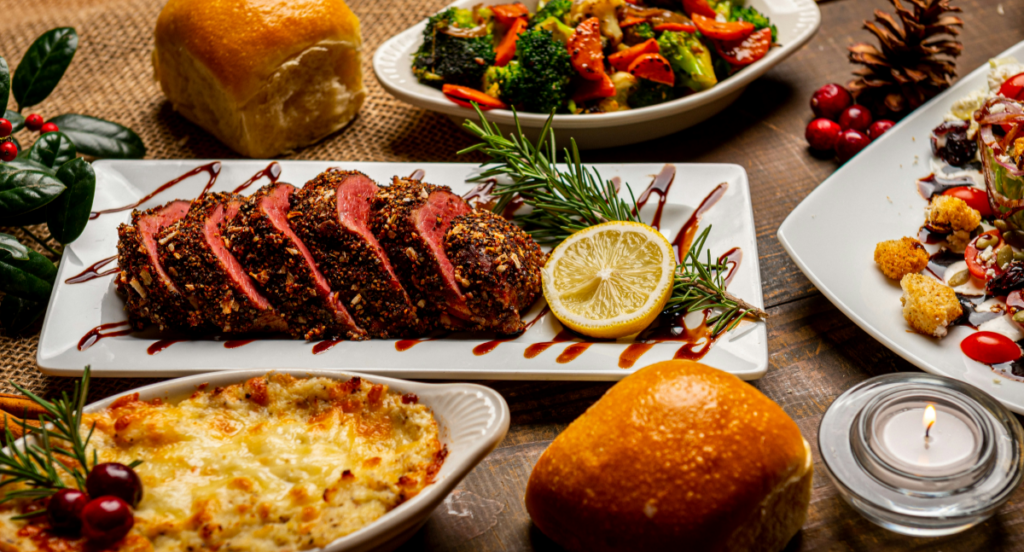
The day comes, and as Babette lavishes course upon course of luxurious fare upon the diners, the Brothers and Sisters enjoy the food in spite of themselves. In fact, as the evening progresses, its effects go beyond physical eating: Tongues are “loosened,” cherished memories relived, past hurts forgotten, old grudges forgiven and youthful love revisited.
Loewenhielm’s experience of the meal is simultaneously a revelation, reminding him of those prepared at the Café Anglais in Paris by a female chef who was recognized by high society as “the greatest culinary genius of the age.” But he, too, is affected by more than the food.
Years ago, visiting his aunt near Berlevaag, he had met and fallen in love with Martine, though he later left, without voicing his feelings, to pursue a military career. Returning now, “a moral person, loyal to his king, his wife and his friends, an example to everybody,” he is nevertheless “not perfectly happy” and has lately been “worrying about his immortal soul.” He hopes, during his first visit back to Berlevaag in 30 years, to be confirmed in his past choices. Instead, he is overcome — by Martine’s abiding serenity, the Berlevaagers’ faithfulness, the food’s excellence and the evening’s encompassing beauty — and rises to speak:
Man, my friends … is frail and foolish. … In our human foolishness and short-sightedness we imagine divine grace to be finite. For this reason we tremble. … We tremble before making our choice in life, and … tremble in fear of having chosen wrong. But the moment comes when our eyes are opened, and we see and realize that grace is infinite. Grace, my friends, demands nothing from us but that we shall await it with confidence and acknowledge it in gratitude. Grace, brothers, makes no conditions. … See! That which we have chosen is given us, and that which we have refused is, also and at the same time, granted us.
After dinner, the guests depart, frolicking outside in the snow like children who — in language reminiscent of Baptism — have “had their sins washed white as wool.” Martine and Philippa, returning to the house, find the exhausted and forgotten Babette, expecting to hear that she will soon be leaving them to return to Paris with her lottery winnings. Instead, she informs them that the funds have all been spent on the meal they just enjoyed. Martine, horrified, tells Babette, “You ought not to have given away all you had for our sake,” to which Babette replies, “For your sake? … No, for my own.”
Babette as Christ Figure
Not a few readers have noted the similarities between Babette, who gives her all for an earthly feast, and Christ, who gives His all for an eternal one. Artist and Touchstone contributing editor Mary Elizabeth Podles writes that Babette,
as the giver of grace through her art, is a parallel to Christ who gives himself through the Eucharist, with all that it entails of the gifts of unity and forgiveness. Parallel to Christ’s self-giving in the Lord’s Supper is the self-giving of the partakers in communion, the fellowship and mutual aid of the Christian community. Their union with God and the saints, a result of the forgiveness of sins, is brought about in the Eucharist and results in mutual forgiveness of mutual grievances.[1]
The parallels don’t stop there. When Babette comes to Berlevaag, she is penniless and homeless, a “friendless fugitive” with no resources and seemingly nothing to offer beyond a letter from Philippa’s former suitor, the opera singer Achille Papin, asking the sisters to take her in. But in due time, she becomes indispensable to them, cooking meals for the sick that have unusually restorative results, “miraculously” reducing the cost of running the house, even extending her influence to the Brothers and Sisters, who, after first looking “askance at the foreign woman in their midst … found that troubles and cares had been conjured away from their existence, and that now they had money to give away, time for the confidences and complaints of their old friends and peace for meditating on heavenly matters.”
But what are we to make of Babette’s insistence that she spent all her earthly wealth and prepared such a magnificent meal not for those she served but for herself and her art? Does the comparison to Christ collapse here?
Perhaps the answer can be found in Babette’s explanation to the sisters of why she did not return to Paris with the money that certainly enabled her to do so. That life, she explains, is no more — a casualty of the revolutionary Parisian uprising of 1871, when she herself “stood upon a barricade” and “loaded the gun for my menfolk.”
Babette has come to Berlevaag to put her own violent past behind her. In this, she honors her Lord’s call to “lay aside every weight, and the sin which clings so closely” (Heb.12:1). And like Christ himself, she endures great hardship for “the joy set before [her]” (Heb. 12:2) — in this case, the opportunity to share the fullness of her culinary gifts with those who have welcomed her into their community.
Paradoxical Truth
“For mercy and truth have met together, and righteousness and bliss have kissed one another!”
In his essay, “Jesus Christ Is the Truth,” delivered at the 69th Regular Convention of The Lutheran Church—Missouri Synod, the Rev. Dr. Jon Bruss, president of Concordia Theological Seminary, Fort Wayne, asks, “If Jesus Christ is the truth, how are we to know the truth about Jesus Christ?” Later he draws on Martin Luther’s 1524 “Preface to the Psalms,” in which Luther explores the meanings of the words “mercy” and “truth”:
Likewise, “truth” means “faithfulness,” [such that] one may rely on another and have recourse to him and he keeps what he has said and what one expects from him. Thus, God praises Himself toward us everywhere in Scripture for being merciful and faithful, that is, that He demonstrates love and faithfulness and extends to us every friendliness and favor, and we may confidently rely upon Him to act and remain faithful to what can be expected from Him.
Christ, who is the truth, extends that truth to the church by being faithful to Himself. In Him, as the psalmist writes, mercy and truth meet, and righteousness and bliss kiss each other. Here we see another set of parallels between Babette and Christ: Like Christ, Babette willingly humbles herself, masking the true extent of her genius as she takes the form of a servant (Phil. 2:7). Yet also like Christ, when Babette does reveal her culinary gifts in their full glory — when she pours herself into her art for the sake of her neighbors — she enables those who receive those gifts to experience a wondrous meeting of truth and beauty.
In truth, Babette would have been well within her rights to take her lottery money and return to her beloved France. Yes, Martina and Philippe rescued and cared for her, and she is grateful to them, but having now served them for so many years, she has certainly repaid their kindness. She is hardly obligated to stay with them or to spend her last dime on a banquet for them. She does so not out of any sense of guilt or debt or external obligation but because her love for them and her nature as an artist compel her to. That is the deeper meaning of Babette’s claim that she did it for herself — not merely for her own gratification, but because it is her very self and soul and identity that move her to act.
Ultimately Babette, the great artist, paradoxically serves others — even those who turn their backs on her, even her enemies — by fully exercising and delighting in the artistic genius God has given her. The act of creation that brings “perfect happiness” to those around her also brings her joy, peace and fulfillment. In creating, she unites her own joy with the joy of those she serves, just as Christ, the Divine Artist, paradoxically glorifies Himself at His own expense by perfectly serving His Father. In the same way that Babette was not obligated to stay in Berlevaag, a righteous God is not obligated to send His beloved Son to save a sinful creation, but He does so out of His own merciful nature, glorifying Himself through His act of self-sacrifice.
A Foretaste of the Feast to Come
Not only is Christ represented in this remarkable story; we are, too. Babette represents Christ, but she also represents each of us — as do the party guests served by her.
Achille Papin’s letter to Martine and Philippa — the letter commending Babette into their care when she first arrived — recalled his unrequited love for Philippa, whom he had met and heard sing 15 years prior when he was in Norway on vacation. Enchanted by Philippa’s voice, he had given her lessons and, in so doing, had fallen in love with her. Papin ultimately leaves Berlevaag, but he never forgets Philippa. In the letter, he writes of his hope, in the afterlife, to hear her voice again: “There you will sing, without fears or scruples, as God meant you to sing. There you will be the great artist that God meant you to be. Ah! How you will enchant the angels.”
Years later, when Babette informs the sisters that she will be remaining in Berlevaag, she tells them that Papin once told her that “it is terrible and unbearable to an artist … to be applauded for doing, his second best. … Through all the world there goes one long cry from the heart of the artist: Give me leave to do my utmost!”
Babette’s earthly opportunity to do her utmost comes and goes, leaving her and those she has served through her art a fleeting moment of bliss. Yet even though the meal is over, in her years of service in Berlevaag she has also found a community of mutual love and care that will continue long after the last dish has been dried and put away. Thanks be to God that Christ’s utmost for those He came to serve is not a passing bliss or momentary understanding but one that provides a foretaste of the eternal feast to come, a feast in which He imparts to us His own righteousness and truth, enabling each of us to be the artists He created us to be and, in so doing, to share His love and mercy with all we meet.
In his book Grace Upon Grace, the Rev. Dr. John Kleinig describes the life of a Christian as being a “life of reception”: “We have been justified by the grace of God the Father, so we now live by faith in His grace. Because we believe in Him we now receive every spiritual gift from Him. We receive grace upon grace from the fullness of the incarnate Christ.”[2]
In Babette’s Feast, a single meal becomes a metaphor for the entire Christian life, one in which those who are invited to the table — even amid great sadness, loss and regret — receive one bountiful course after another, served by a master chef to diners who cannot fully appreciate the richness of what they are receiving or the sacrifice behind it.
May each of us poor and undeserving guests, like our humble counterparts in Berlevaag, ever trust in our Lord’s infinite grace for us, looking to Him with childlike confidence as we await, with joy and gratitude, all that He promises to deliver.
[1] Mary Elizabeth Podles, “Babette’s Feast: Feasting with Lutherans,” The Antioch Review 50, no. 3 (1992): 551–65, doi.org/10.2307/4612569.
[2] John W. Kleinig, Grace Upon Grace: Spirituality for Today (Concordia Publishing House, 2008), 10.
Cover image: Jed Owen/Unsplash