



It is a special gift to live between two worlds — one foot still in the red soil of Africa, the land I once called home, and the other on the paved streets of an American suburb. As an immigrant, my whole life shows what the Apostle Paul meant when he wrote, “There is neither Jew nor Greek, slave nor free, male nor female, for you are all one in Christ Jesus” (Gal. 3:28). But I have learned that this “oneness” does not mean we all become the same. The deep and beautiful unity we share takes hard work to build. I have seen this especially in my ministry both to first-generation immigrants and to their children born in America.
For the past 15 years, I have wrestled with the challenges of second-generation ministry. I have talked with other Lutheran immigrant groups who are struggling with the same issues. I worship and serve among first-generation Ethiopian immigrants. In my own experience, serving a congregation of mostly first-generation Africans, faith is a link to our home country. We sing the liturgy in our own language. The hymns have the rhythms and beats of Africa. The sermons are teaching-focused, often giving us moral guidance to help us deal with the secular culture of the West.
However, the children of this immigrant congregation — the second generation — do not share this nostalgia. They were born here. Their cultural touchstones are not the village elders but the complex social dynamics of American high schools, the pervasive influence of digital media and the burden of a hyphenated identity that they did not choose. For them, the cultural trappings of the “old country” are not comforts; they are often barriers. They do not speak the language fluently, and they struggle to connect with a theology that is wrapped so tightly in a cultural package that feels foreign to their lived experience. This is the crisis and the opportunity. It forces us to ask the critical question: What is the kernel of our faith, and what is the husk?
Herein lies the genius of our unified message: The Gospel of Jesus Christ is not a Western export, nor an African possession, nor an American commodity. It is a divine proclamation that transcends cultural barriers because it addresses the universal human condition and its cure — sin and grace, death and resurrection. The Gospel speaks to the African grandmother praying for rain and the American teenager wrestling with anxiety. It speaks to the immigrant longing for home and to the native-born citizen searching for purpose. Our message is unified because the problem it solves is unified: We are all sinners in need of a Savior.
But how do we proclaim this unified message without committing the sin of cultural imperialism or, conversely, without diluting the Gospel into a vapid moralism? This is where faithful Lutheran theology, with its clear distinction between Law and Gospel, becomes our greatest tool. Lutheran theology, at its heart, is portable. It does not depend on Gothic cathedrals, German chorales or any specific cultural aesthetic. It depends on the Word and the Sacraments.
Teaching the faith in a new key
To teach Lutheran theology in a variety of cultural contexts is to understand that the substance is immutable, while certain aspects of the expression may be fluid. We see this principle clearly set forth in the Augsburg Confession: “For the true unity of the Church it is enough to agree about the doctrine of the Gospel and the administration of the Sacraments. It is not necessary that human traditions, that is, rites or ceremonies instituted by men, be the same everywhere” (AC VII 2–3).
But what is the substance, and what is the expression? The substance is justification by grace through faith for Christ’s sake. The expression is how that justification is communicated, sung, felt and lived.
My preaching, for example, may sound different depending on whether I’m speaking primarily to first- or second-generation hearers. For the first generation, steeped in the African contexts, sin is often understood in corporate terms — the breaking of communal harmony. The Gospel is the restoration of that harmony through Christ as He reconciles us to God and to one another. For the second generation, born into the hyper-individualistic and agonizingly isolated context of American culture, the Law must speak to the sin of narcissism, the idolatry of the self and the despair of loneliness. The Gospel, then, is proclaimed not merely as a personal insurance policy for heaven but as the declaration that in Christ, we are adopted into a new family — a family that transcends the biological and the ethnic, uniting believers from every tribe and tongue in the Eucharistic feast.
The worship service I lead may also look different depending on who is present. In a first-generation service, the music is loud, percussive and participatory. The service lasts for hours, and the sermon is lengthy and prophetic. In a second-generation context, the music might incorporate contemporary instruments or be more contemplative. The liturgy might be in English, and the sermon might be a dialogue rather than a monologue, addressing the intellectual doubts and existential angst unique to the American experience. We might even move away from an exclusively didactic style to a more catechetical one, engaging the culture’s stories, movies and music as points of contact for the Law and Gospel.
Yet despite these differing expressions, the substance will be the same. The Means of Grace will remain central. The Word will still be read and proclaimed. Holy Baptism will still be the once-in-a-lifetime event of dying and rising with Christ. The Eucharist will still be the center of our life together, where we receive the very body and blood of Christ for the forgiveness of sins. The hymns, whether sung in Swahili or English, will still confess the ancient creeds and the theology of the cross. The structure of the Divine Service — the gathering, the Word, the Meal, the sending — will remain the unchanging rhythm of our spiritual life. This is not a concession to tradition; it is a recognition that these are the very Means by which God has promised to meet us.
The ultimate importance
What, then, does this transitional struggle teach us about what is ultimately important in the church? It teaches us three profound things.
- Our identity is in Christ alone. The first generation of immigrants I serve is gradually learning to let go of the idolatry of culture. It is a painful process. We often cling to our language and customs because they are all we have left of a world we lost. But if we make those customs prerequisites for salvation or even for full fellowship, we have erected a barrier that Christ tore down. The church is not a cultural preservation society; it is the Body of Christ. Conversely, the second generation is learning humility and patience as they seek to honor the faith of their parents who carried the Gospel across oceans and come to appreciate that “foreign” expressions of the faith, far from irrelevant, are testimonies to the Gospel’s power to save all kinds of people.
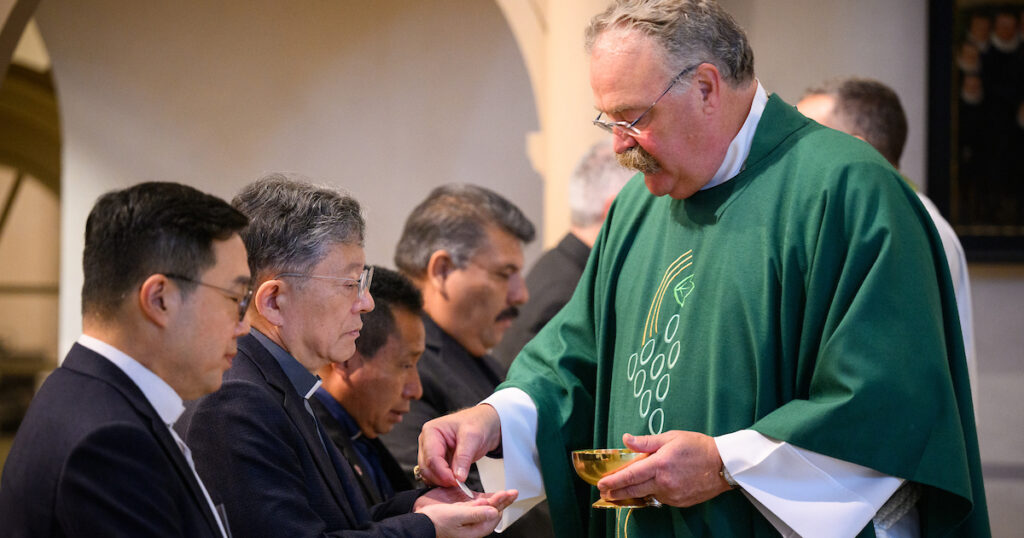
- Unity is a gift to be received, not a project to be achieved. We cannot manufacture unity through multicultural festivals or politically correct language. Unity is given in the Eucharist. When we come to the altar, we do not come as Africans or Americans; we come as sinners. And in the same mouths that confess our sins, we all receive the same body and blood of Christ. In that moment, our differences are not erased, but they are relativized. They are subordinated to the greater reality of our union with Christ and with each other. This is what it means to be a “catholic” church — we hold the universal faith.
- The church is a hospital for sinners, not a fortress of saints. The transition between generations is often messy. There can be conflict over music, over liturgy, over leadership styles. There may be hurt feelings and even a sense of betrayal. But in that mess, we are given the opportunity to practice the Gospel, forgiving each other just as we have been forgiven. This is the ultimate apologetic. It is not our doctrinal precision that will win the world, though that is necessary. It is our love — our ability to bear with one another amidst profound cultural dislocation.
In conclusion, the transition from generation to generation, and from immigrant to native-born citizen, is not a problem to be solved but a mystery to be lived. It is a microcosm of the eschatological reality: that the kingdom of God is for all peoples. The Gospel does not belong to any single culture. It is a river that flows through every human landscape. Our task is not to control the river or to confine it to the vessels of the past but to ensure that the vessels we build today, whatever their shape or color, carry the water of life to a thirsty world. The vessel may be African, American or something else entirely, but the water is always the same: Christ crucified, risen and reigning. May we have the wisdom to preserve the water and the courage to shape the vessel anew.
Cover image: “River in Winter – Oregon, USA,” Robin Canfield/Unsplash
To Rev. Dr. Peressa – Well said! Thank you and God bless your ministry in the LCMS! ✝️
It is great to read such wonderfull message. Be blessed my professor .
RE: “We cannot manufacture unity…. Unity is given in the Eucharist.”
I’m thinking: Well, unity in a marriage is certainly a gift. Yet a husband and wife can each influence the degree of unity in their marriage. Is it not the same way with unity in the community of believers?
“Every good gift and every perfect gift comes from above” (James 1:17 ESV). Nevertheless God invites and encourages His richly gifted people to “make every effort” to bring about good things (2 Peter 1:3-8), bearing fruit to His own glory (John 15:8) and their own joy (John 13:17, 15:11). That’s not about “manufacturing” anything by way of our own energy and devices; that’s about being His instruments according to what He has called us to do.
God’s Word encourages us to consider thoughtfully our attitudes and the quality of our fellowship and to act in such a way that we continue “standing firm in one spirit, with one mind striving side by side for the faith of the gospel” (Phil. 1:27), “eager to maintain the unity of the Spirit in the bond of peace” (Eph. 4:3-4).
Gathering for a few moments at the Lord’s Table does indicate a common faith, certainly. But isn’t the kind of unity that God is concerned about more clearly revealed in how we engage one another away from the Lord’s Table?
“And let us consider how to stir up one another to love and good works” (Heb. 10:24). In every culture, youth have idealism and energy. A pivotal period in my youth was when my church offered opportunities for meaningful service by which I discovered my gifts and the joy of utilizing them for good, for Jesus’ sake. So perhaps likewise, among youth today, cultivating a sense of unity with the rest of the church might be helped by enlisting them zealously in fulfilling God’s own purposes for his people (Titus 2:14!).
“Having gifts that differ according to the grace given to [them], let [the youth] use them[!]” (Romans 12:6).