


The following article originally appeared in our April 2026 print edition. It is being published online now as part of LCMS Life Ministry’s Resource Library.
“I’m so lonely,” sobbed Edwin as he sat on the edge of his bed. After serving as a pastor for 45 years and dedicating much of his life to missionary work in India, he now felt isolated. Claire, a former teacher now in her 90s, looked at me yearningly. “I want to go home. Pastor, please ask God to take me home.” Walter, a creative woodworker for over 50 years but now handicapped, expressed his despair: “I have nothing to live for.”
These are the voices of Christian men and women who have lived long and fruitful lives but now pine away in solitary and often infirm existence. Their once “up and at ’em” outlook with the rising sun has turned into dread upon waking to another gloomy morning. They echo the prophet Job who lamented the day of his birth, “Why is light given to him who is in misery, and life to the bitter in soul, who long for death, but it comes not” (Job 3:20–21).
When a man is young, he may feel like he can take on the world. Each day seems to open up to countless blessings. For many elderly Christians, however, life feels like a burden rather than a blessing. The years take a toll on their bodies; friends and family are gone or live far away; the meaning and purpose of their lives seems elusive. For them to ask, “Why am I so alone?” or “Why can’t I go home to heaven?” or “Why is there nothing to live for?” stems not from ingratitude but from genuine sorrow over the losses they have experienced and the physical frailty they have come to know.
There are no easy answers to their questions — and yet, the Lord offers us guidance in His Word. As with so many other questions about life, the Bible confronts old age head on. Ecclesiastes 12:1–3 says, “Remember also your Creator in the days of your when the keepers of the house tremble, and the strong men are bent.” These verses speak of a time coming for every man when his hands begin to tremble, his legs are bowed, his eyesight dims, and his desires fade. Moses spoke similarly in Psalm 90:10, “The years of our life are seventy, or even by reason of strength eighty; yet their span is but toil and trouble; they are soon gone, and we fly away.” The patriarch Jacob, at 130 years old, described his life to Pharaoh: “Few and evil have been the days of the years of my life” (Gen. 47:9). God’s Word confirms the sad reality: Aging brings trouble, sorrow and a longing for relief.
Thankfully, our Lord does not leave us without hope in our weakness. His Word declares His unwavering assurance. Isaiah 46:4 says, “Even to your old age I am He, and to gray hairs I will carry you. I have made, and I will bear; I will carry and will save.” God does not abandon His redeemed people. The same loving Creator who formed us in our mother’s womb now bears us up like a mother carries a weary child. King David also holds out hope when he pleads in Psalm 71, “So even to old age and gray hairs, O God, do not forsake me, until I proclaim Your might to another generation, Your power to all those to come” (71:18). Almost in spite of our weakness and frailty, there remains a godly vocation for God’s aged children: to proclaim God’s faithfulness to every generation.
Martin Luther understood this well. He suffered many ailments in his later years — kidney stones, arthritis and more. He wrote in his Fourteen Consolations that Christ has “consecrated and hallowed all sufferings, even death itself.” By His touch, He makes them “holy, harmless, wholesome, blessed, and full of joy.”[1] Luther urged Christians to look at suffering as sanctified by God, a hidden blessing through which the Lord works His grace despite our maladies. He wrote, “This life, therefore, is not godliness but the process of becoming godly, not health but getting well, not being but becoming” (AE 32:24). In old age, the “becoming” continues — not by our own strength, but through trust and dependence on Christ.
Christ turns our sorrows into joy, perhaps especially when we are elderly. Psalm 92:14 says about the righteous, “They still bear fruit in old age; they are ever full of sap and green.” Our fruitfulness may no longer mean missionary journeys or woodworking, but it still may flourish in our prayers, our Christian witness, or even in our simply receiving care with humility. Even the elderly may “serve” by allowing others to fulfill their callings — such as children caring for their parents or parishioners visiting the homebound. In Jeremiah 31:13, God promises to turn mourning into gladness for both young and old alike. “I will turn their mourning into joy; I will comfort them, and give them gladness for sorrow.” This is the Gospel-rooted gladness Luther wrote about: “Christ is a God of joy. … A Christian should and must be a cheerful person” (“Table Talk,” AE 1 54:96). Christian joy flows not from our circumstances but from faith in Christ and from the work of the Holy Spirit.
In the end, all of these questions find their fullest answer in the hope of the resurrection. Revelation 21:4 offers this comfort, “He will wipe away every tear from their eyes, and death shall be no more, neither shall there be mourning, nor crying, nor pain anymore.” In my 40 years of ministering to the elderly and homebound, this has always been my message to them. To Edwin, Claire, Walter and all who ask, “Why am I still alive?,” our Lord says, “Fear not, for I have redeemed you; I have called you by name, you are Mine” (Isaiah 43:1).
The same loving Lord who made you and redeemed you now promises to carry you. You are precious in His sight. Your prayers arise as incense before Him, your patience testifies to His faithfulness, and your waiting, as painful as it may be, is only preparing you for glory. Jesus bore all of your sins and your sorrows on the cross; He now carries you even through old age and gray hairs until the day when He shall wipe away every tear from your eyes.
[1] Martin Luther, “The Fourteen of Consolation for Such as Labor and Are Heavy Laden,” in Works of Martin Luther, Vol. 1 (Philadelphia: J. Holman Company, 1915), 105–171.
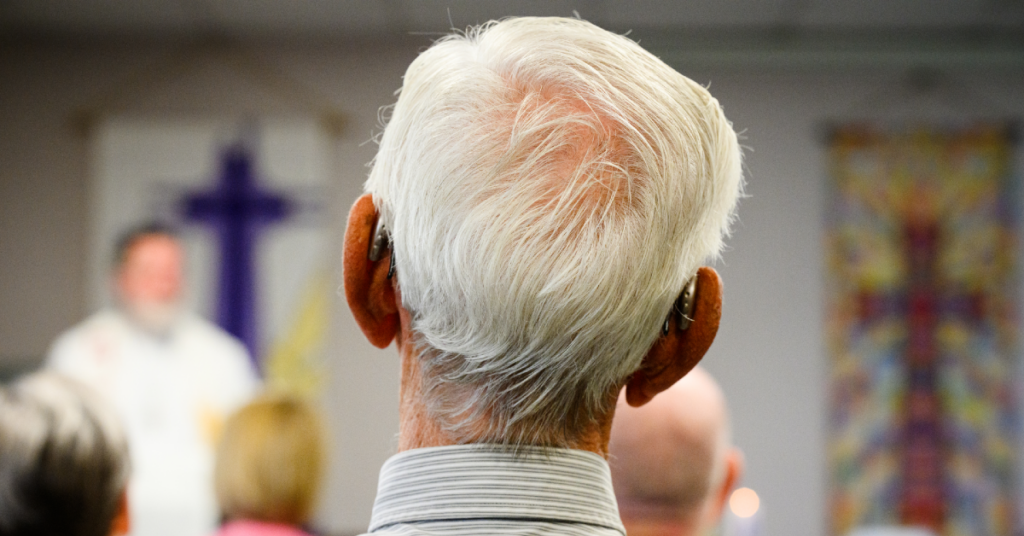
Cover image: Don Heller listens during preaching at Divine Service on Sunday, April 14, 2024, at Epiphany Lutheran Church in Bastrop, Texas. LCMS Communications/Erik M. Lunsford



AAT 81 THIS WAS A GREAT MESSAGE! THANK YOU!
RE: “Luther urged Christians to look at suffering as sanctified by God, a hidden blessing through which the Lord works His grace….”
Human suffering is caused by sin in the world, and people may experience real damage to body, mind or spirit. Jesus healed people, and one way we ourselves show love to others is by making a sincere and compassionate effort to relieve their suffering.